



When bookings slow down, the instinct is almost always the same: lower the price. But what if the price isn’t the problem?
In a recent live webinar, PriceLabs Senior Product Specialist Liene Mozalevska and Product Marketing Manager Piusha Debnath shared results from a data study covering over 10,000 Airbnb listings — and the findings challenge one of the most common assumptions in short-term rental hosting. The message is clear: before you touch your prices, check your listing content.

Airbnb Doesn’t Just Reward Great Properties — It Rewards Great Listings
Most hosts think about quality in operational terms: Is the property clean? Are the amenities working? Is check-in smooth? These things matter deeply. But Airbnb’s ranking algorithm looks at quality through an entirely different lens.

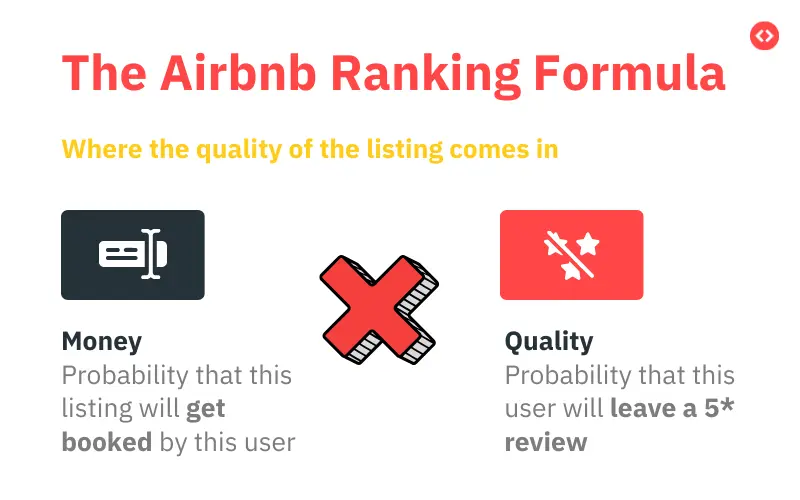
According to insights shared at Airbnb’s own host-focused events in the US, the platform’s ranking formula is built around two core signals:
- Signal 1: The probability that a guest will
- Signal 1: The probability that a guest will book your listing — heavily influenced by how attractive, relevant, and trustworthy your listing looks at first glance.
- Signal 2: The probability that a guest will leave a 5-star review — which reflects the real-world experience your property delivers.
Both signals matter, and they work together. A listing that looks great but under-delivers will accumulate negative reviews and slip in rankings over time. But a listing that delivers an exceptional experience won’t get the chance to prove it if its content isn’t strong enough to win the click in the first place.
Worth knowing: Airbnb also has a commercial incentive to surface quality listings. Poor guest experiences generate support tickets, which cost Airbnb money. The algorithm actively predicts which listings are most likely to deliver positive stays and rewards them with better visibility.
Your Star Rating Has a Direct and Measurable Impact on Revenue
One of the most striking findings in the webinar came from a PriceLabs data study of listings in Greece — with results that hold true in markets around the world. The data reveals a steep, direct relationship between average star rating and average daily rate (ADR).
| €106 ADR at 5.0 stars | €92 ADR at 4.90–4.99 | €80 ADR at 4.70–4.89 | €68 ADR below 4.50 |
That’s a 36% gap in earning power between a perfect-rated listing and one rated below 4.50 — and it compounds. Lower-rated listings attract more price-sensitive guests, struggle to justify competitive nightly rates, and because Airbnb weights the likelihood of a 5-star review in its algorithm, they also appear less frequently in search results.
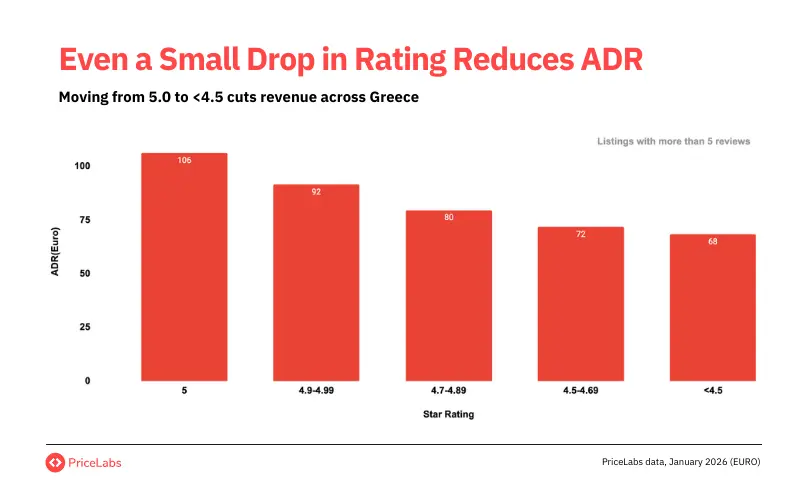
Protecting your star rating isn’t just about guest satisfaction — it’s one of the most powerful revenue levers available to you.
What 10,000 Listings Revealed About the Real Revenue Blockers
PriceLabs’ data science team analysed over 10,000 Airbnb listings globally, examining every major revenue driver: location, amenities, listing content, ranking, property size, and cancellation policy. Even after controlling for all those variables, one factor consistently made the difference — listing content.
In other words: two listings in the same location, with similar amenities and comparable size, could perform very differently based purely on the quality of their titles, photos, descriptions, and how consistently that information was presente
| 88% have issues hurting visibility | 70% have weak or unclear photos | 54% have incomplete descriptions | 54% have listing inconsistencies |
And perhaps the most striking finding: only 9% of listings have genuinely strong content — and those listings are 38% more likely to beat the market. Strong content is rare. That’s exactly what makes it such a powerful competitive advantage.
What “Revenue-Making” Content Actually Looks Like
Liene used the image of an iceberg to explain listing content quality: there’s what guests see immediately on the surface, and then there’s the deeper structure underneath that determines whether they click, explore, and ultimately book.
1. Title
Title is your listing’s first impression. It should be specific, evocative, and tailored to what guests in your market care about. Near the beach? Pet-friendly? Say so. Generic titles that could describe any property are an immediate disadvantage.
2. Photos
Great photos aren’t just aesthetically pleasing — they’re informative and trust-building. Your cover image is especially critical. Every photo in your gallery should serve a purpose: showcasing key amenities, conveying space and layout, and reflecting the real character of the property. Low-resolution or misleading photos are flagged as quality issues by Airbnb.
3. Amenities
List what you have, and photograph what you list. Inaccurate amenities undermine guest trust and contribute to negative reviews. Missing amenities mean guests who would have loved your property simply never find it. Pay attention to market-specific needs — business travellers want reliable Wi-Fi and a workspace; hiking guests might value bike storage.
4. Description
A listing description has two jobs: convince the guest your property is the right choice, and signal relevance to Airbnb’s search algorithm through naturally included keywords. Narrative, specific, guest-focused descriptions consistently outperform flat bullet-point lists.
5. Consistency
When your title, photos, amenities, and description all tell the same story, guests feel confident booking. When they don’t align — when a photo shows a hot tub that isn’t listed as an amenity, or a description mentions parking that appears nowhere else — it creates doubt. Doubt kills conversions.
6. Review Signals
Positive reviews aren’t just social proof — they feed directly into Airbnb’s quality scoring. Volume, recency, and overall rating all affect your visibility in search. Five-star experiences build a cumulative advantage over time.
Why Generic AI Tools Won’t Fix Your Listing
Many hosts have turned to tools like ChatGPT to rewrite descriptions or generate new titles. While these tools can produce readable content, they have fundamental limitations when it comes to actually diagnosing listing quality issues.
Generic AI tools can generate content — but they can’t diagnose performance. They have no access to Airbnb’s quality signals, no visibility into your market benchmarks, and no way to tell you what the top-earning listings in your area are doing differently.
Diagnosing why a listing is underperforming requires Airbnb-specific data, local market benchmarking, and an understanding of Airbnb’s own guidelines — combined. That’s a combination generic tools simply cannot replicate.
Introducing Listing Optimizer: Find the Leaks, Fix Them Fast
PriceLabs’ Listing Optimizer is purpose-built to solve this problem. It analyses and scores every element of your Airbnb listing against Airbnb’s quality standards and the benchmarks set by top-performing listings in your local marke

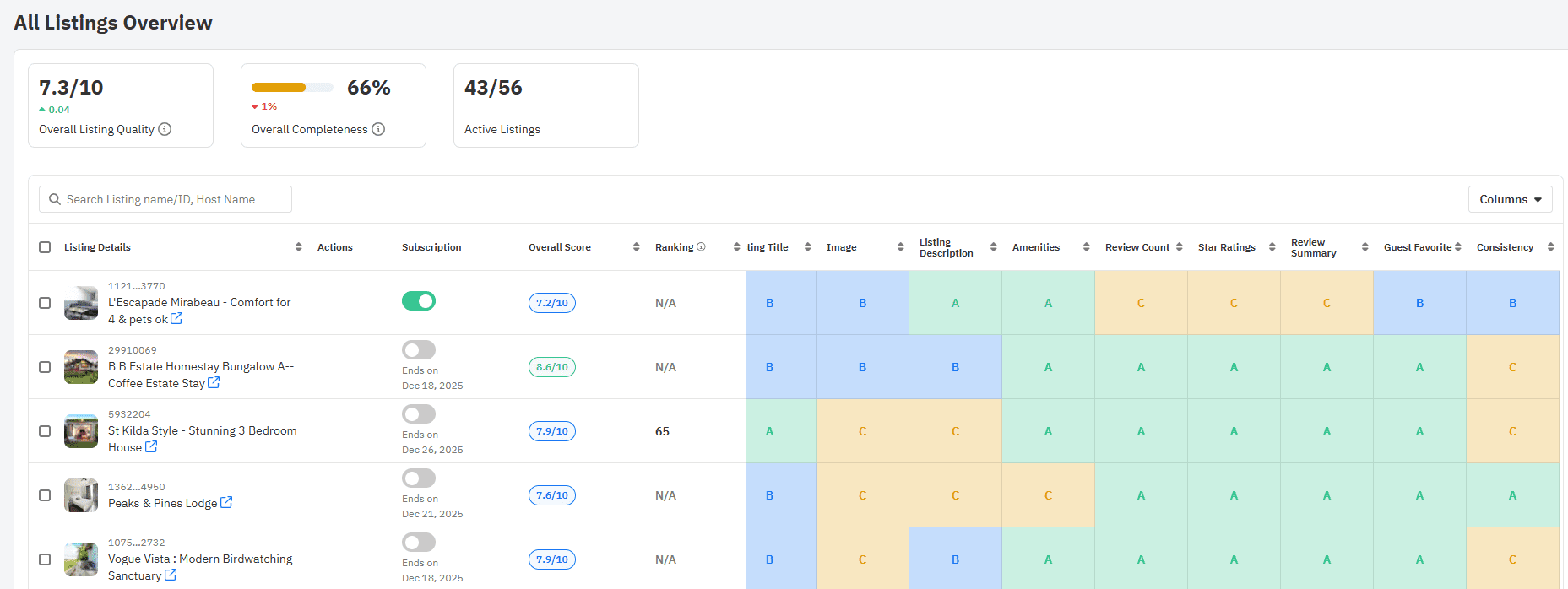
Here’s what the tool does for each listing:
- Analyse: Scores every aspect of your listing — title, photos, description, amenities, consistency, and review signals.
- Audit: Identifies and prioritises the specific weak areas so you know exactly where to focus first.
- Benchmark: Compares your listing to the top-earning properties in your area and delivers AI-powered recommendations to close the gap.
- Fix & Track: Tracks your Airbnb search ranking week over week so you can see exactly how content changes affect your visibility.
What a Real Analysis Looks Like
During the webinar, Piusha walked through a live analysis of a real listing. One example stood out: a listing’s photo section received a ‘C’ score — not because all the photos were poor, but because a single low-resolution image was dragging the entire score down. The tool identified exactly which photo it was, explained why it mattered (Airbnb flags low-resolution images as a quality signal), and recommended specific replacements.
For the title, the tool compared the current version against what top-performing listings in the same market were using, then generated a specific alternative that incorporated the amenities and location features most likely to attract guests. The recommendation is copyable with one click — ready to paste directly into Airbnb.
“At this point, I’d call it the most advanced tool in its category — and a game changer for anyone serious about visibility and conversion optimisation.”
— Natasha Osborn, Founder & Principal Consultant, Listing Lift
Pricing & How to Get Started
Listing Optimizer is a standalone product — it works independently of PriceLabs’ dynamic pricing tools. You don’t need to be an existing PriceLabs customer to use it.
Getting started takes only a couple of minutes. Add your Airbnb listing URL or host ID to the dashboard. The tool analyses your listing — typically within 10–15 minutes — and sends an email notification when results are ready. After making changes, you can re-run the analysis to track improvement.
The tool currently supports Airbnb listings, with Vrbo and Booking.com support coming soon. The ability to manually select your own comparison competitors is also in development.
The Bottom Line
Lowering your price when a listing underperforms feels like the obvious move — and sometimes it is the right one. But when 88% of listings have content issues actively suppressing their visibility, cutting your rate often treats the symptom, not the cause. Guests who never see your listing can’t book it, regardless of how competitive your nightly rate is.
Strong listing content is one of the rarest and highest-impact advantages a host can build. Only 9% of listings have genuinely good content — and those listings are 38% more likely to beat the market. That edge is available to any host willing to look honestly at what guests are seeing when they find your property