



In 2026, the Airbnb Era of generic beige palettes and “live, laugh, love” signage is officially over. For professional property managers managing portfolios of 50, 100, or 500+ units, the market has polarized demand. Guests are no longer just looking for a place to sleep; they are looking for identity alignment.
The stakes are higher than ever. With the global vacation rental market surpassing $200 billion this year, your brand is either a premium asset or a commodified liability.
Here is the definitive guide to vacation rental branding at scale for the modern professional:

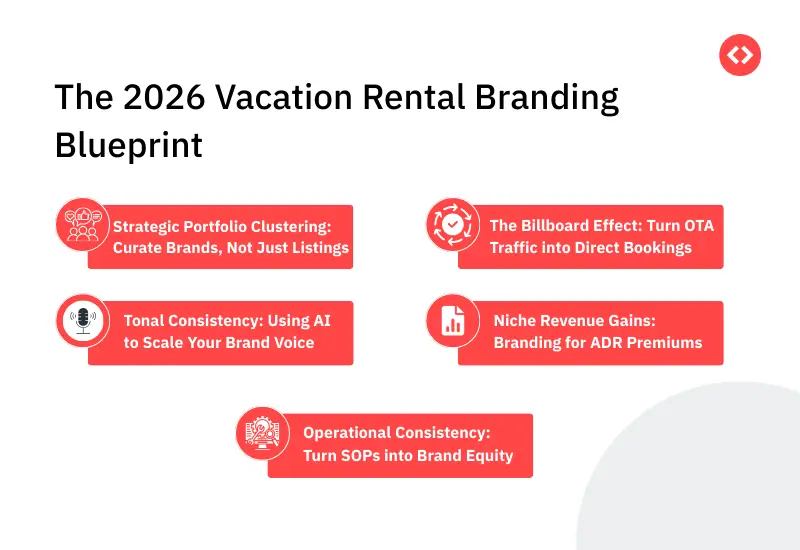
1. The Identity Realignment: From Manager to Curator
In 2026, the most successful large-scale STR Portfolio managers have stopped branding themselves as “Management Companies” and started branding themselves as Curated Collections.
- The Data: Recent 2026 trends show that “generic” rentals are fading. Travelers now choose properties that reflect their specific values or tastes. properties with a clear “identity” see a 15-20% higher conversion rate than those with generic listings.
- The Strategy: Categorize your portfolio into “Brand Pillars.” Instead of one monolithic brand, create sub-identities like The Executive Suite (for workcations), The Eco-Luxe Collection (for sustainable travel), or The Family Escape.
- Actionable Step: Use Reputation-Based Pricing. In 2026, guests are willing to pay a premium for a brand they trust, even when the local market is flat.
2. Leveraging the Billboard Effect for Direct Bookings
Large portfolios often suffer from high OTA fees. In 2026, branding is your escape hatch. The “Billboard Effect”—where guests find you on Airbnb but book directly—is more powerful than ever, but only if your brand is “findable.”
- The Lead-Time Gap: Direct bookers in 2026 plan their stays an average of 102 days in advance, whereas OTA guests book just 41 days out.
- The Strategy: Your website shouldn’t just be a booking engine; it must be a “Digital Front Door.”
- Mobile-First: 68% of travel bookings are now completed on smartphones. If your branded site isn’t optimized for Apple Pay/Google Pay, you are losing 1 in 3 potential guests.
- Brand Recall: Over 80% of guests forget their host’s name within 2 months. Combat this with a branded Guest App that keeps your logo and “local expert” guides front and center throughout their stay.
3. The Rise of Automated Personalization
Scaling a brand usually means losing the personal touch. In 2026, AI has solved this paradox.
- Tonal Consistency: Use AI not just for speed, but to enforce your Brand Voice. Whether your brand is Coastal Casual or Metropolitan Sophisticate, every automated message—from the booking confirmation to the checkout instructions—must sound like it was written by the same person.
- The Niche Advantage: Pet-friendly portfolios are seeing an ADR (Average Daily Rate) increase of $17.41. Brands like Hostaway are leveraging this by using AI to collect a pet’s name at booking and include it on a digital welcome board or a branded “Pup-Package” upon arrival.
Optimize Your Brand’s Revenue Potential
Optimize pricing across your entire portfolio with the industry's most powerful data-driven tools.
Start Free Trial Now4. Professionalizing the Workcation and Wellness Segments
The 2026 traveler is either working or “unplugging.” Your branding must signal which one you support.
- Work-Ready Branding: For your urban or mid-term stay portfolios, “High-Speed Wi-Fi” is no longer enough. Brand these properties with Work-Ready Certifications: verified 100+ Mbps fiber, ergonomic seating, and noise-dampening “Quiet Zones.”
- Wellness Branding: Following 2026 trends from Booking.com, “Quiet Travel” is a major driver. If your brand focuses on rest, your photography should emphasize sleep hygiene (blackout curtains, premium linens) rather than just the living room furniture.
5. Standardizing the Brand Promise Across Hundreds of Units
Consistency is the hardest part of branding at scale. In 2026, your “Brand” is actually your SOP (Standard Operating Procedure).
- Operational Excellence: 73% of property managers cite staffing and revenue pressures as their biggest 2026 hurdles.
- The Solution: Use Branded Amenities to create a sensory anchor. The “scent” of your lobby or the specific brand of local coffee in every kitchen creates a subconscious “safety signal” for the guest. When they see your logo, they should instantly know the quality of your linens and the reliability of your check-in process.
The 2026 Branding Checklist for Large Portfolios
| Strategy | 2026 Goal | Competitive Edge |
| Direct Booking Engine | >30% Direct Bookings | Saves 15-20% in OTA commissions per stay. |
| Niche Portfolios | “Work-Ready” or “Eco-Luxe” | Captures high-intent, high-budget segments. |
| AI Tonal Guardrails | Consistent Guest Comms | Builds “Automated Trust” without manual labor. |
| Community PR | Local “Hero” Status | Boosts owner acquisition and local SEO. |
Conclusion: From Property Manager to Hospitality Powerhouse
The shift in vacation rental branding for 2026 is clear: you are no longer just managing “units” or “doors.” You are managing a reputation for reliability in an increasingly fragmented market. For the large-scale portfolio manager, your brand is the only shield against the “commodity trap” of the OTAs and the rising noise of amateur hosts.
In a world where travelers prioritize identity alignment and automated trust, a cohesive brand strategy isn’t just a marketing expense—it is your most resilient financial asset. By standardizing your Brand Promise, leveraging the Billboard Effect for direct bookings, and segmenting your portfolio into curated pillars, you transform your business from a service provider into a recognizable hospitality destination.
As we move deeper into 2026, remember that the most successful portfolios aren’t necessarily the ones with the most listings, but the ones with the most loyal guests. When a traveler closes their eyes and thinks of their next stay, they shouldn’t be thinking of “an Airbnb”—they should be thinking of your brand.
Frequently Asked Questions
1. Why is branding more important in 2026 than in previous years?
The market has reached a “professionalization peak.” With the short-term rental industry now a $200B+ powerhouse, generic listings are losing visibility. Travelers in 2026 suffer from “decision fatigue” and are actively seeking curated, low-friction choices. A strong brand acts as a trust shortcut, signaling quality and consistency that an unbranded property cannot match.
2. How does branding help reduce my reliance on Airbnb and Vrbo?
It triggers the “Billboard Effect.” Guests often discover properties on OTAs but will search for your brand name specifically to find a direct booking site. By having a recognizable brand name and a professional, mobile-optimized website (supporting Apple Pay/Google Pay), you can capture these guests directly, saving 15–20% in commission fees.
3. Can I brand a large portfolio if the properties have different styles?
Absolutely. In 2026, the trend for large portfolios is “Brand Pillar” segmentation. Instead of trying to fit a mountain cabin and a city condo under a single aesthetic, create sub-brands (e.g., The Urban Executive vs. The Wilderness Retreat) under your master brand. This allows you to target different “guest avatars” with tailored messaging while maintaining a single operational standard.
4. What is “Automated Trust,” and how does it relate to branding?
Automated Trust is the use of AI to maintain a consistent brand voice at scale. For large portfolios, you can’t manually message every guest. Branding in 2026 involves setting “tonal guardrails” in your AI tools so that every automated text, email, and digital guidebook reflects your brand’s unique personality—whether that’s “formal and concierge-driven” or “local and adventurous.”
5. Does a “brand” require expensive physical upgrades to every unit?
Not necessarily. While property quality must meet a baseline, branding is often about the sensory and digital experience. Consistency in branded digital guidebooks, a signature scent, or a specific local coffee partner across your entire portfolio creates a “brand promise” that guests recognize and return to, regardless of the property’s decor.
6. How do I measure the ROI of my vacation rental branding?
Focus on three key 2026 metrics:
- Direct Booking Ratio: The percentage of total revenue coming from your own site.
- Repeat Guest Rate: Branded portfolios typically achieve a 20-30% higher repeat guest rate.
- Brand Search Volume: How many people are typing your company name into Google rather than generic terms like “rentals in [City].”