


For independent hoteliers, the challenge of staying competitive against large chains often comes down to one thing: pricing. You may have wondered, “What role does predictive analytics play in hotel dynamic pricing software?” or “How can small hotels use competitor benchmarking to inform dynamic pricing decisions?”
At PriceLabs, we are committed to democratizing sophisticated revenue management tools. We believe every property, regardless of size, deserves access to actionable market intelligence. In this guide, we’ll explore how predictive analytics hotel dynamic pricing can transform your operations from manual guesswork into a data-driven revenue engine.
Understanding Predictive Analytics in Hotel Dynamic Pricing
To master your revenue, you first need to understand the technology. Predictive analytics is the process of using historical and real-time data, combined with statistical algorithms and machine learning, to forecast future demand and inform optimal pricing decisions.
Dynamic pricing is the automated adjustment of hotel room rates based on real-time factors like booking pace, demand, competitor prices, weather, and local events.
Predictive Analytics vs. Traditional Manual Pricing
| Feature | Traditional Manual Pricing | Predictive Analytics & AI |
| Data Source | Intuition or basic spreadsheets | Real-time market data & historical trends |
| Speed | Weekly or monthly updates | Updates rates daily or multiple times a day |
| Accuracy | High risk of human error | Data-backed precision |
| Strategy | Reactive to past results | Proactive based on hotel revenue forecasts |
Key Benefits of Predictive Analytics for Small Hotels
For smaller operations, every room night counts. Pricing mistakes cause greater revenue loss for small hotels because they have limited inventory to “make up” for lost margins.
Transform your hospitality approach today
Discover actionable strategies tailored for small hotel owners and managers creating unforgettable stays for your guests & expanding revenues for your hotel!
Start your 30-day FREE trial now!- Increased RevPAR: Dynamic pricing can lead to higher RevPAR in the first few years.
- Optimized Occupancy: AI analysis ensures your prices are never so high that they drive guests away or so low that they dilute your ADR.
- Agility: Real-time updates are essential to keep prices aligned and avoid revenue loss during market shifts.
How Predictive Analytics Drives Dynamic Pricing Decisions
The workflow of data-driven pricing is a continuous loop designed to enhance your bottom line:
- Data Collection: The system pulls data from your current bookings, competitor rates, local events, weather, and even traveler sentiment.
- Analysis: Machine learning algorithms process these signals to identify patterns.
- Rate Suggestion: The system calculates the “right” price for every room type and every date.
- Adjustment: Through integration with your PMS or channel manager, these rates are updated automatically across all platforms.
- Outcome Monitoring: The system tracks how guests respond to the new prices and refines future forecasts.
This proactive approach allows you to anticipate demand spikes—such as a local festival or concert—before they occur, ensuring you capture the highest possible rate.
Competitor Benchmarking: Informing Smart Pricing Strategies

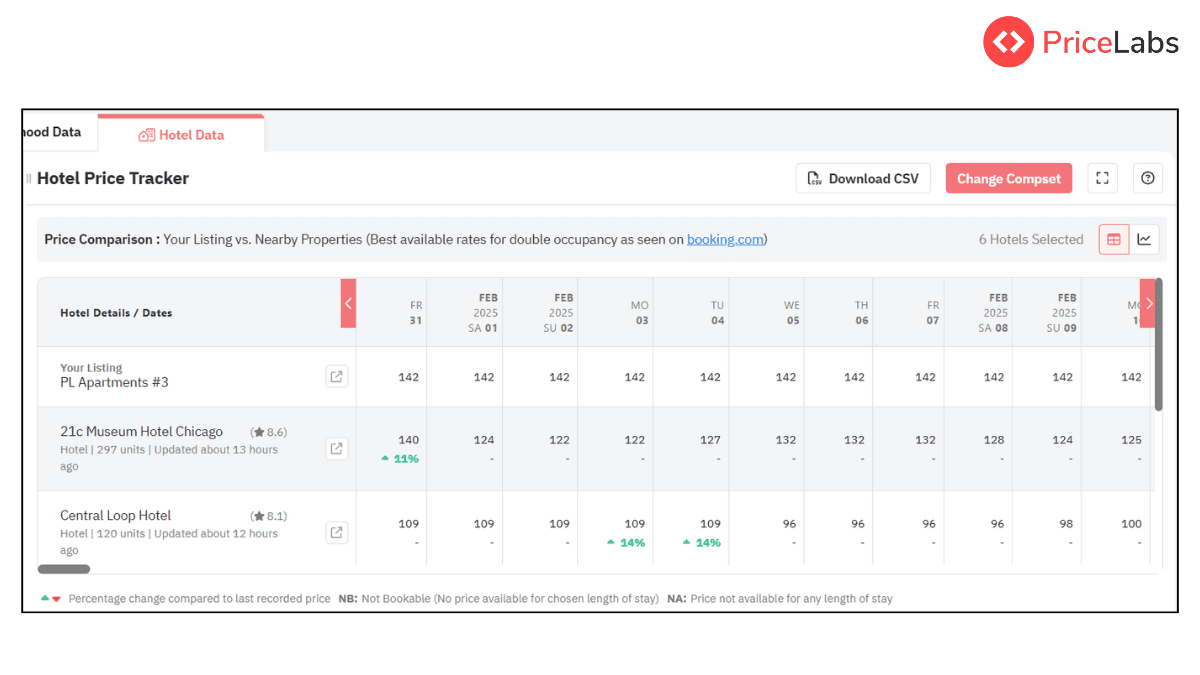
A common question is: “How can small hotels use competitor benchmarking to inform dynamic pricing decisions?” Competitor benchmarking is the ongoing process of monitoring and analyzing your rivals’ rates and occupancy to inform your own strategy.
- Tracking Sold-Out Dates: If your primary competitors sell out for a specific weekend, your room becomes more valuable. Automated tools allow you to raise your prices instantly to capture that overflow demand.
- Hybrid Benchmarking: It is essential to compare your property not just with direct neighbors, but also with high-end competitors and even short-term rentals to understand the full competitive landscape.
- PriceLabs Integration: By using a “Comp Set” view, you can select and monitor specific competitor hotels for precise benchmarking, which then feeds directly into your automated pricing updates.
Integrating Predictive Analytics with Hotel Technology
To be truly effective, predictive analytics hotel dynamic pricing must be seamless. Integration with your Property Management System (PMS) and channel manager is the “nerve center” of modern operations.
- Automation: Direct integration eliminates the need for manual rate changes, saving hours of work and reducing the risk of costly manual errors.
- Leveling the Playing Field: These tools allow boutique hotels to compete with international chains without needing a full-time, in-house revenue team.
- Centralized Control: A single dashboard provides real-time updates on occupancy, revenue, and pricing performance across all booking channels.
Future Trends in Dynamic Pricing for Small Hotels
The hospitality industry is evolving, and small hotels must stay proactive to remain relevant:
- Hyper-Local Prediction: AI will soon offer even more granular data on neighborhood-specific demand trends.
- Social Sentiment Integration: Pricing models will begin to account for real-time traveler sentiment and social media buzz about a destination.
- Democratization of Tech: Advanced revenue management capabilities will continue to become more accessible and affordable for even the smallest B&Bs and inns.
Wrapping Up
Mastering predictive analytics hotel dynamic pricing turns data into your most powerful ally. By using competitor benchmarking, hotel pricing, and automated forecasting, you can ensure your property is always priced to win.
Frequently Asked Questions
What data do small hotels need to effectively use predictive analytics for pricing?
You need historical booking trends, current booking pace, competitor rates, local event calendars, and seasonality data.
How often should small hotels update their room rates using dynamic pricing?
Ideally, rates should be updated daily. Using automated tools like PriceLabs allows for real-time adjustments as market conditions change.
Can dynamic pricing work for very small properties like B&Bs or inns?
Yes. In fact, small properties benefit most because they lack the “safety net” of a large inventory, making every correctly priced room vital for survival.