



Success in the competitive short-term rental (STR) landscape requires more than just property ownership; it requires an architectural shift in perspective. To achieve true operational leverage and high-yield performance, one must pivot from viewing a property as “rentable square footage” to seeing it as a “vessel for human experience.” This mindset is the bedrock of five-star ratings and business longevity. When you prioritize the guest’s emotional well-being over simple occupancy, you create a strategic moat that corporate, generic hotels cannot cross.
The Philosophy of Abundance vs. Scarcity
The traditional “Landlord” operates from a scarcity mindset, viewing every coffee pod or extra linen as a cost centre to be minimised. In contrast, the Strategic Architect adopts the “Philosophy of Abundance” championed by hosts like Chuck Mobraten and Dean Baker. In this model, generosity is an investment in guest satisfaction. Providing coffee pods, multiple brewing methods (French press, drip, and Keurig), and high-end, crisp, ironed linens ensures the guest never feels “nickel-and-dimed.”
As Mobraten notes, finding only two pods—one being decaf—creates immediate friction; abundance creates an immediate psychological “win” for the guest.
The Golden Rule of Service: Strategic Empathy
Hospitality is the oldest tradition in the world, and its most effective SOP (Standard Operating Procedure) remains the Golden Rule: treat guests as you wish to be treated.
Charlene Miller and Emealia Hollis demonstrate that building trust starts with “Thoughtful Touches” that prove you are paying attention.
- Contextual Awareness: Emealia Hollis illustrates this by researching a guest’s destination; discovering they are visiting a funeral home allows for the provision of a condolence card and snacks—a $20 investment that secures a lifelong brand advocate.
- Arrival Kits: Snack bags for families (Miller) bridge the gap between a long journey and the first grocery run.
- Handwritten Notes: Personal greetings that thank the guest for supporting a small business rather than a faceless corporation.
The “So What?” of Human Warmth
As Abhimanyu observes, the “so what” of prioritizing human warmth is its role as a low-cost, high-ROI marketing engine. By adopting a “low, warm voice” and listening to guests like family, you trigger a referral mechanism. Guests who feel truly “seen” don’t just leave reviews; they recommend the property to their families and social circles, thereby climbing platform rankings without spending a cent on advertising.
Connective Tissue: While the philosophy of abundance sets the stage, the physical environment must deliver on that promise through meticulous, functional design and a commitment to “eating your own dog food.”
The Experiential Foundation: Designing for the Guest Lens
A property’s “soul” is found at the intersection of aesthetics and utility. A home that looks beautiful in photos but fails to provide a bottle opener or a place for a wet towel is a failed product. Strategic design requires a cold, analytical audit of the space through the guest’s lens.
The “Eat Your Own Dog Food” Mandate
Addie Wales, Frankie Painter, and Marc Corlett all advocate for the critical process of staying in your own rental. You cannot manage what you have not experienced. Staying overnight reveals the friction points—the drafty window, the lack of hooks, or the uncomfortable pillow—that are invisible during a standard walkthrough.
Functional Detail Audit & “Guest-Proofing”
Your design must anticipate needs before they become complaints. Marc Corlett suggests functional additions like mudrooms with secondary fridges to handle family-sized coolers. Simultaneously, Shaun Budd emphasizes the need for “guest-proofing”: mounting shelves and fixtures directly into studs so they can “take a good beating” and remain safe for families.
The Functional Checklist (Expanded):
- Kitchen Granularity (Painter): Beyond pots and pans, ensure the presence of Pam spray, olive oil, seasonings, muffin cup liners, tinfoil, and chip clips.
- The “Five-Star Fire” (Addleman): Stephanie Lynn Addleman created a “wow” moment by offering to pre-set or help guests start fires in the property’s fire pits, transforming a simple amenity into a memorable service.
- “Soulful” Touches (Biggar): Sharon Biggar suggests moving away from the generic by adding a stack of board games or a projector instead of a standard TV to make the stay feel unique and memorable.
Authenticity Over Perfectionism
While functionality is non-negotiable, Alaa Soufiani and Amadi Leaks warn against “analysis paralysis.” Do not delay a listing for minor cosmetic perfections. A home with “soul” and warmth will always outperform a sterile, corporate apartment. The goal is a “cozy,” well-thought-out product that generates income while you refine the details.
Connective Tissue: A soulful environment is the product, but without the digital scaffolding of a Pricing Engine and PMS, the host becomes a slave to the administration rather than the master of the experience.
The Scalability Engine: Leveraging Tech to Enhance Humanity
Automation is not a replacement for hospitality; it is the fuel that frees up the host’s mental bandwidth for higher-value personal connections.
Dynamic Pricing: Mitigating Emotional Bias
Manual pricing is a liability. It leads to “panic lowering” during quiet weeks or missing massive revenue spikes during local events. As Amanda Larson and Joe Rafalowicz noted, failing to use dynamic pricing results in “awkward bookings”—single nights at low rates during peak demand, such as Christmas.
| Manual Pricing Pitfalls | Algorithmic (Dynamic) Advantages |
| Missed Revenue: Booking peak dates (e.g., festivals) too early at flat, low rates. | Yield Optimization: Adjusts rates in real-time based on local demand and supply. |
| Panic Lowering: Dropping prices out of fear during a quiet gap (Chris). | Value Protection: Gradually adjusts rates for gaps while maintaining a floor price. |
| Fixed Rates: Charging the same for a random Tuesday as a holiday weekend. | Seasonality Logic: Captures 20-25% year-over-year ADR increases (Patrik Strebel). |
| Manual Nightmare: The rework of updating Airbnb, Vrbo, and Booking.com individually. | Unified Sync: Pushes pricing across all channels via API instantly. |
The Automation/Connection Balance
Michael Baker warns that “Dear Guest” messages are ignored. To scale while remaining personal, use “Tokenization” in your automated messaging.
Service Standards for Messaging:
- Mandatory Personalization: Automate the structure, but pull in specific tokens: the guest’s name and the trip’s purpose (e.g., “Hi Christy, I hope the kids have a blast on their first Disney trip!”).
- The “Day Two” Check-in: Automate the 24-hour check-in instructions, but manually (or via smart automation) ask “How was your first night?” the next morning to ensure the guest feels “seen.”
- Audit the Amenities: If an amenity causes constant technical friction—like the “backpack strap in the washer” incident mentioned by Shideh Javan—remove the amenity or the friction point to protect your time and ratings.
Unified Management Systems
A robust Property Management Software (PMS) like Hostaway or Hospitalitable prevents the “manual nightmare” of double bookings (Spencer Rex). By creating a central “command center,” you can manage calendars across multiple platforms, allowing you to focus on strategy rather than calendar syncing.
Connective Tissue: Even the most sophisticated digital systems are useless without a physical support team to execute the standards on the ground.
The Operational Backbone: Local Relationships and Maintenance
For the remote host, your cleaning and maintenance teams are your “Aces in Places” (Nicholas Casely-Parker). They are the “Achilles heel” of the model (Tonga Nfor); if they fail, the entire guest experience collapses.
The “Formula 1” Operations Model
Christian Munoz likens STR operations to a Formula 1 pit crew: a team that doesn’t waste a second or a night, focused on maximum quality at the lowest viable cost. This requires redundancy. Tonga Nfor emphasizes never relying on a single cleaner; always have a primary and a backup who both know the property inside out.
Cleaning as Rigorous Quality Assurance
The “Polly and Patrick Combs” model treats cleaning as a multi-point inspection, not a chore. Polly Combs inspects the home with a “fine-tooth comb” before every check-in.
- The Fine-Tooth Standard: Search for “individual scraps,” “cigarette butts on the fake lawn,” or “grains in the coffee filter.”
- The Visual Stage: Nicholas Casely-Parker insists the home must be staged exactly as it appears in the professional photos. If the throw blanket is folded differently, the “product” is inconsistent.
The “Brownie Strategy” for Neighbors
Your neighbors can be your local security or your biggest obstacle. Lucy Krakow suggests the “Brownie Strategy”: proactively meet neighbors, bring gifts, and find mutual benefits. Krakow even traded redwood panels for a “lifetime supply of fresh eggs” for her guests. Similarly, Toshimitsu Ueta suggests hosting an “Open House” for neighbors after a renovation to build rapport and even find local cleaning help.
Connective Tissue: Managing teams and neighbors requires the same emotional intelligence and resilience needed to handle the host’s most unpredictable variable: the guest.
The Host’s Journey: Resilience, Ethics, and Long-Term Growth
Hosting is a marathon of human psychology. It requires professional detachment and the understanding that “Clarity is the best form of hospitality.”
Managing the “Unreasonable”
Alandria Saifer recommends building a “toolkit of options” by joining host communities and Facebook groups. When a difficult guest arrives, reach out to your peers first to ensure your response doesn’t come from a place of “anger or fear.” As Tuti advises, sometimes “you don’t win” an argument; let it go to protect your mental energy for the next guest.
Financial Stewardship and Contingency
A professional host is a steward of capital. Use a “Financial Dashboard” (Daniel Zammata) to track every expense from day one. More importantly, have a “Contingency Plan.” Mark Richmond warns that if STR regulations change—as they did for him twice—you must know if the property can survive as a long-term rental or if it must be sold.
Clarity as Hospitality
Puneet Dhillon’s principle—”Clarity is the best form of hospitality”—is the ultimate filter for guest issues. Most problems occur when expectations are mismatched.
- The Ferry Example: Paula Garrett manages a listing on a barrier island accessible only by boat. By personally reaching out to every guest to ensure they understand they must take a ferry, she eliminates 90% of potential cancellations and “unmet expectation” complaints.
The Final Directive: Modern hospitality is the synthesis of the “Formula 1” operational mind and the heart of a “kind family member.” By utilizing professional systems to handle the “dumb hard work,” you reclaim the mental space to deliver a deeply personal, human experience. Treat your property like a product, your team like partners, and your guests like the reason you do this work. The five-star reviews will not be an accident; they will be the inevitable result of your design.
How PriceLabs Can Help
PriceLabs serves as a powerful dynamic pricing and revenue management tool that can transform a host’s business.

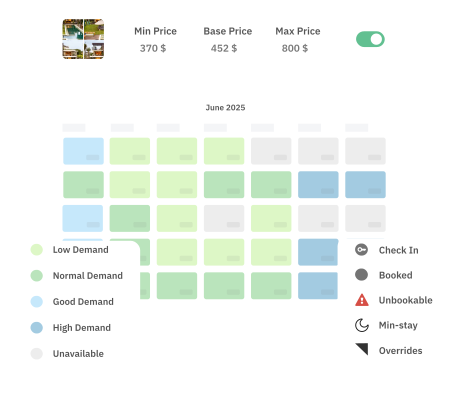
Here is how it helps:
- Maximize Revenue and Occupancy: PriceLabs automatically adjusts your nightly rates based on real-time market data, seasonality, weekends, and local events. By trusting the algorithm to capture high-demand periods and adjust for slow seasons, hosts report significantly increasing their daily rates and overall gross booking value.
- Save Time Through Automation: Instead of manually analyzing the market and updating calendars every day, PriceLabs automates the process. It easily syncs your optimized prices and minimum-stay rules across multiple platforms like Airbnb, Vrbo, and Booking.com, acting as a “set it and forget it” solution.
- Attract Better Guests: Pricing is also a screening tool. By using PriceLabs to ensure your property is priced competitively at or above market value, you can naturally deter partiers and attract high-quality guests who will treat your home with respect.
- Reduce Stress and Emotional Decisions: PriceLabs removes the mental burden of constantly second-guessing your rates. It prevents hosts from “panic lowering” their prices after a slow week, ensuring they stick to a data-driven strategy that protects their baseline revenue.
- Gain Market Intelligence: The software provides deep insights into your specific market, allowing you to see competitor pricing, average cleaning fees, and length-of-stay trends so you can make informed decisions.