



In the short-term rental industry, the difference between a “good” year and a “record-breaking” year isn’t just about the nightly rate—it’s about timing. Most revenue managers spend their days reacting to the market, but the top 1% use a systematic short-term rental pricing SOP to stay ahead of demand. This guide, based on the recent collaboration between VRNation and PriceLabs, breaks down the transition from reactive to proactive management.
The Proactive Edge: Why Systems Beat Instinct
Reactive managers only check their rates when occupancy feels “off” or run reports after a disappointing month. They often rely on “gut feel” and find themselves responding to market shifts 2-3 weeks too late. In contrast, a professional short-term rental pricing SOP is built on a repeatable system. By reviewing a 30/60/90-day calendar every Monday and tracking booking pace against the previous year, you can identify demand signals 14–21 days before they hit.
The Four Pillars of the Revenue Flywheel
To maintain peak performance, your strategy must rotate through four interlocking categories:
- Market Pulse: Detecting real-time demand signals and event-driven spikes.
- Pricing Review: Auditing your rate calendar for gaps and managing pricing guardrails.
- Comp Set Intelligence: Monitoring competitor ADR positioning and availability.
- Booking & Forecasting: Analyzing pickup pace and channel mix to predict future performance.
SOP: Weekly Revenue Management (The 2026 Refinement Edition)
Objective: Maximize RevPAR by transitioning from a “growth” to an “efficiency” mindset through hyper-local demand analysis and professionalized distribution. Frequency: Every Monday (Early Week).
Step 1: Market Pulse & Global Demand Scan
- Identify Macro Tides: Review regional growth trends. For instance, if operating in the UK, account for the +76.44% surge in bookings; if in Mexico, prepare for the +85.74% explosive demand.
- Segment-Specific Analysis: Differentiate strategies by property tier. Luxury apartments saw a 119% booking increase in 2025—ensure these listings feature premium amenities like wellness features to meet rising traveler expectations.
- Supply Maturation Check: In mature markets like the US, where supply has hit 1.6 million listings, recognize that occupancy may slightly dilute (e.g., from 53% to 51%), requiring more aggressive yield management.
Step 2: Competitive Set (Comp Set) & Professionalization Audit
- Identify Professional Encroachment: Note that professional managers now control up to 72% of inventory in markets like Portugal and 70% in the US. Audit if your “Comp Set” has adopted professional tools like dynamic pricing.
- The “Dynamic Pricing Delta”: Recognize the occupancy gap. In markets like Italy, properties using high-frequency dynamic pricing achieve 68% occupancy compared to just 38% for static listings—a 30% “Delta”.
- Availability Tracking: Monitor when competitors “go dark.” In short-window markets like Mexico (11.6-day booking window), these signals are critical for last-minute rate spikes.

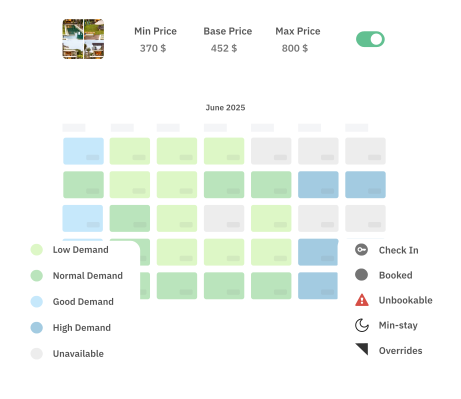
Step 3: Calendar Pricing & Behavioral Restrictions
- Length of Stay (LOS) Optimization: In the US, where LOS increased to 4.42 days, implement 4-night and 7-night discounts to capture higher-value guests and reduce turnover costs. In Spain or Portugal (LOS 5.2–5.4 days), enforce strict minimum stay requirements early to secure profitable weeks before opening for weekends.
- Booking Window (BW) Calibration: * Shrinking Windows: If BW is dropping (down to 22.3 days in the US), do not panic-discount 30 days out; hold firm until the 14–21 day mark.
- Hyper-Spontaneous Markets: For LATAM (12-day BW), hold base rates until day 14, then deploy aggressive drops to capture the late surge.
Step 4: Distribution & Diagnostic Review
- Channel Diversification Audit: “Diversify or Die”. Ensure properties are not “Big Two” dependent. Check performance on Booking.com (+48.7% growth) and Expedia (+53.4% growth).
- Shoulder Season Redefinition: In Southern Europe (Italy/Greece), adjust algorithms to treat May and September as premium periods rather than “low” seasons due to shifting climate preferences.
- Forecasting Visibility: Determine if unbooked dates are a Price issue (lack of dynamic pricing) or a Visibility issue (limited channel distribution).
Scaling with Technology: The PriceLabs & Rentals United Flywheel
Manual execution for a portfolio is an operational bottleneck.
PriceLabs: Automates the “Dynamic Pricing Imperative,” reacting to localized spikes and shrinking booking windows in real-time.
Rentals United: Acts as the “Resilient Distribution Net,” pushing inventory to high-growth niche channels to maximize visibility in high-supply markets.