


Setting your hotel room rates without a dynamic strategy is like trying to sail a ship by looking only at the wake you leave behind; you might know where you’ve been, but you have no idea what waves are coming next. For independent hoteliers, understanding the intricacies of your pricing strategy is the difference between an empty property and a thriving, profitable business. Today, we are moving past the outdated idea of a single “base rate.” We are going to dive deep into exactly what is nightly price in hotel terms, how you can use it to your advantage, and how smart tools can do the heavy lifting for you.
Decoding the Core Question: What is Nightly Price in Hotel Operations?
If someone asks you, “what is nightly price in hotel operations,” the simplest answer is that it is the actual, final monetary amount a guest pays to sleep in a specific room on a specific date.
However, in the modern hospitality industry, that definition barely scratches the surface. What is nightly price in hotel terms today? It is a living, breathing number. It is a reflection of current market demand, local events, the lead time before check-in, and the intrinsic value of your specific property compared to the competitor down the street.
The days of setting a static base rate in January and leaving it untouched until December are long gone. The nightly price is your most powerful tool for enhancing revenue. If your price is too high during a low-demand period, your rooms sit empty. If your price is too low during a festival weekend, you leave thousands of dollars on the table. Understanding what is nightly price in hotel strategy means understanding fluid demand.
Practical Tip: Always view your nightly price as a moving target, not a fixed anchor. Review your upcoming 30, 60, and 90-day windows weekly.
How PriceLabs Helps Here

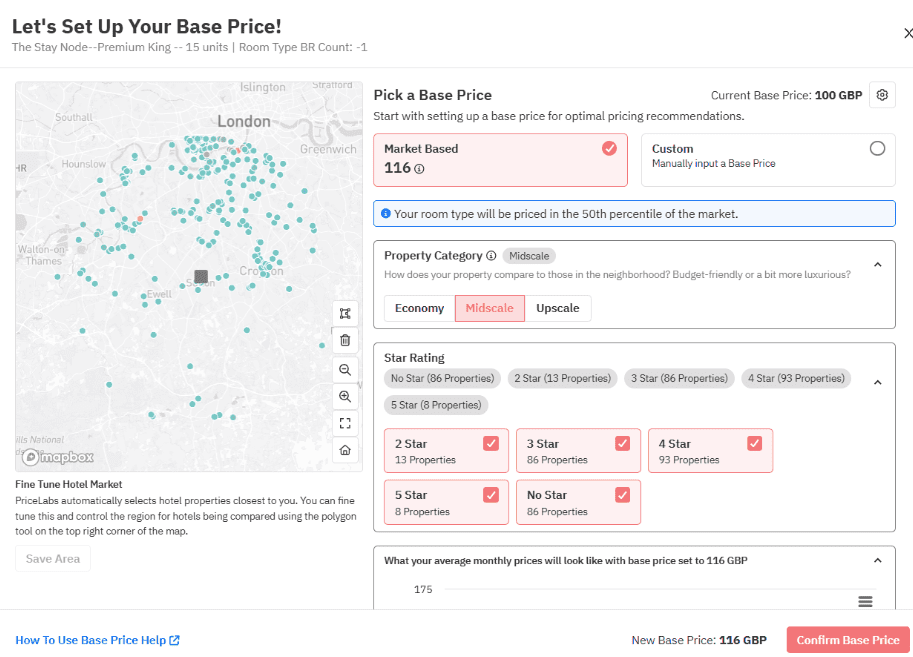
If you are wondering how to establish a strong starting point for your nightly price, PriceLabs offers Base Price Guidance. This tool provides data-informed recommendations for setting your annual average rate. It grounds your baseline in your hotel’s historical performance and current market conditions, ensuring that your starting point is always rooted in real data, not guesswork.
Hotel Rack Rate vs. Nightly Rate
To truly understand what is nightly price in hotel revenue management, we have to address the elephant in the room: the rack rate.
Hotel rack rate vs. nightly rate is a classic comparison between the “sticker price” and the actual price. The rack rate is the maximum, published, undiscounted rate for a room. Historically, this was the price printed on a brochure or posted on the back of the hotel room door. It is the absolute highest amount you would ever charge for that room.
The nightly rate, on the other hand, is the actual price a guest pays after market adjustments, discounts, seasonal drops, or last-minute deals.
An Example to Make It Clear: Imagine a guest walks into your independent boutique hotel at 11:00 PM on a slow Tuesday without a reservation. If you quote them the rack rate, you might ask for $350. However, if that same guest booked online a week prior during a low-demand season, the actual nightly rate they paid might be $180.
Relying on a rack rate is an outdated concept. Modern guests are savvy; they compare prices across multiple Online Travel Agencies (OTAs) and your direct website. If your actual nightly rate doesn’t reflect the market reality, your rack rate means nothing because no one will book it.
How PriceLabs Helps Here

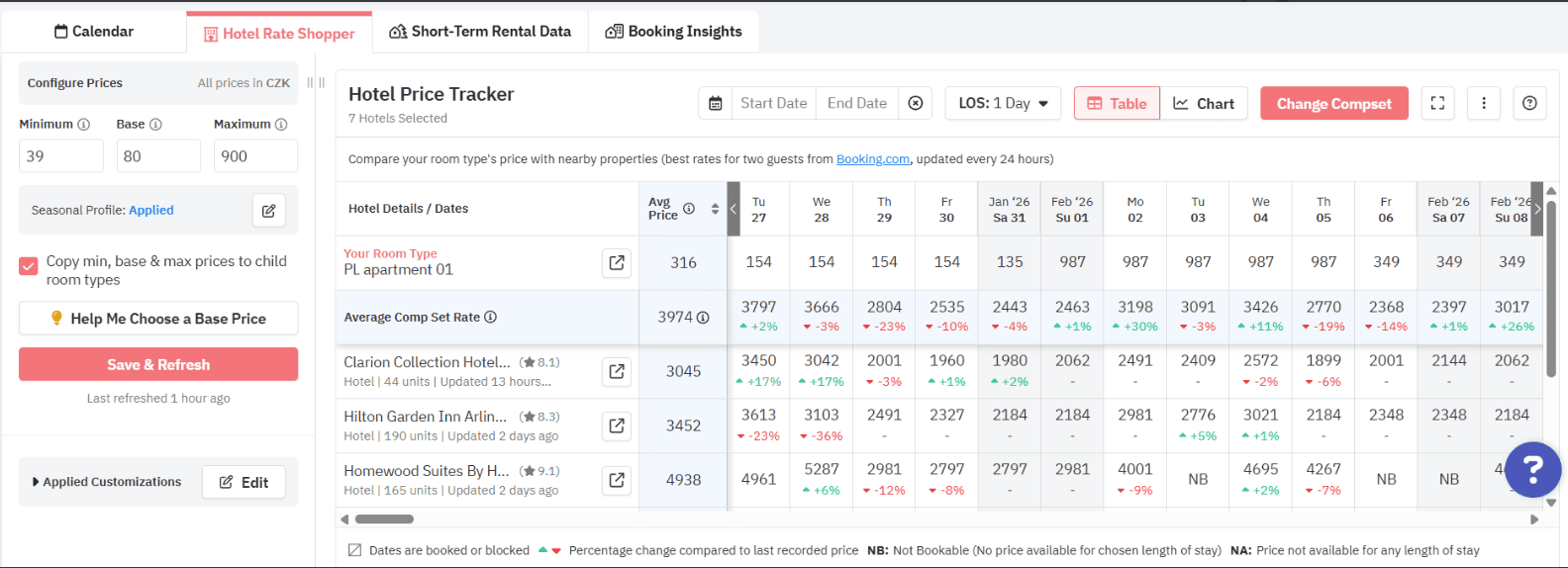
Navigating the hotel rack rate vs. nightly rate difference requires knowing what your competitors are actually charging, not just their published maximums. With the PriceLabs Hotel Data Tab and Rate Shopper, you can monitor real pricing trends across up to 350 nearby hotel-like properties. You can track recent rate changes and identify high-demand periods using publicly available data. Furthermore, with Custom Comp Sets, you manually select specific rival hotels to benchmark against, ensuring your nightly rates are competitive with the properties guests are actually considering alongside yours.
The Math Behind the Magic: Average Nightly Rate (ADR) Explained
Once you grasp what the nightly price in hotel operations on a day-to-day basis, you must look at the bigger picture. This brings us to a crucial piece of industry terminology: Average nightly rate (ADR) explained.
ADR stands for Average Daily Rate (often called average nightly rate). It is one of the most vital Key Performance Indicators (KPIs) for any independent hotelier. While your nightly price fluctuates daily, your ADR tells you the average income earned per occupied room over a specific time period.
How to Calculate ADR: Total Room Revenue / Number of Rooms Sold = Average Nightly Rate (ADR).
Practical Example: Let’s say your hotel has 20 rooms. Last night, you sold 15 of them.
- 5 rooms sold for $100 a night (Total: $500)
- 5 rooms sold for $150 a night (Total: $750)
- 5 rooms sold for $200 a night (Total: $1000) Your total room revenue for the night is $2,250. Divide $2,250 by the 15 rooms sold, and your ADR for that night is $150.
Having the average nightly rate (ADR) explained is vital because it helps you understand your profitability. A high occupancy rate is great, but if your ADR is terribly low, you are working harder (cleaning more rooms, using more utilities) for less profit. The goal of understanding what is nightly price in hotel strategy is to find the perfect balance between high occupancy and a high ADR.
How PriceLabs Helps Here: You don’t need to calculate your ADR manually on a spreadsheet. PriceLabs features a robust Report Builder that creates custom reports using key hotel KPIs such as ADR, Occupancy, RevPAR, and pacing. Additionally, the Portfolio Analytics tool allows you to track these metrics at the property, room-type, and individual room level, giving you crystal-clear insights to make better financial decisions.
Factors Influencing the Nightly Price in Hotel Operations Today
If the nightly price isn’t static, what makes it move? To truly master what is nightly price in hotel management, you must understand the forces that drive it up and down.
1. Seasonality and Weather Every location has peak seasons, shoulder seasons, and off-seasons. A beachfront hotel will command a much higher nightly price in July than in November.
2. Lead Time (Booking Window) How far in advance is the guest booking? Generally, independent hoteliers want to secure a base level of occupancy early on. As the date approaches and inventory shrinks, the price should theoretically increase (if demand is high). Conversely, if the date is tomorrow and the hotel is empty, the price might need to drop to attract last-minute travelers.
3. Local Events and Holidays A massive concert, a city-wide marathon, or a major convention can cause demand in your neighborhood to skyrocket. If you don’t know these events are happening, you will sell out too early at a low price, missing out on massive revenue.
4. Day of the Week Corporate-focused hotels might see high demand (and higher nightly prices) from Tuesday to Thursday. Leisure-focused boutique hotels usually see price spikes on Friday and Saturday nights.
How PriceLabs Helps Here

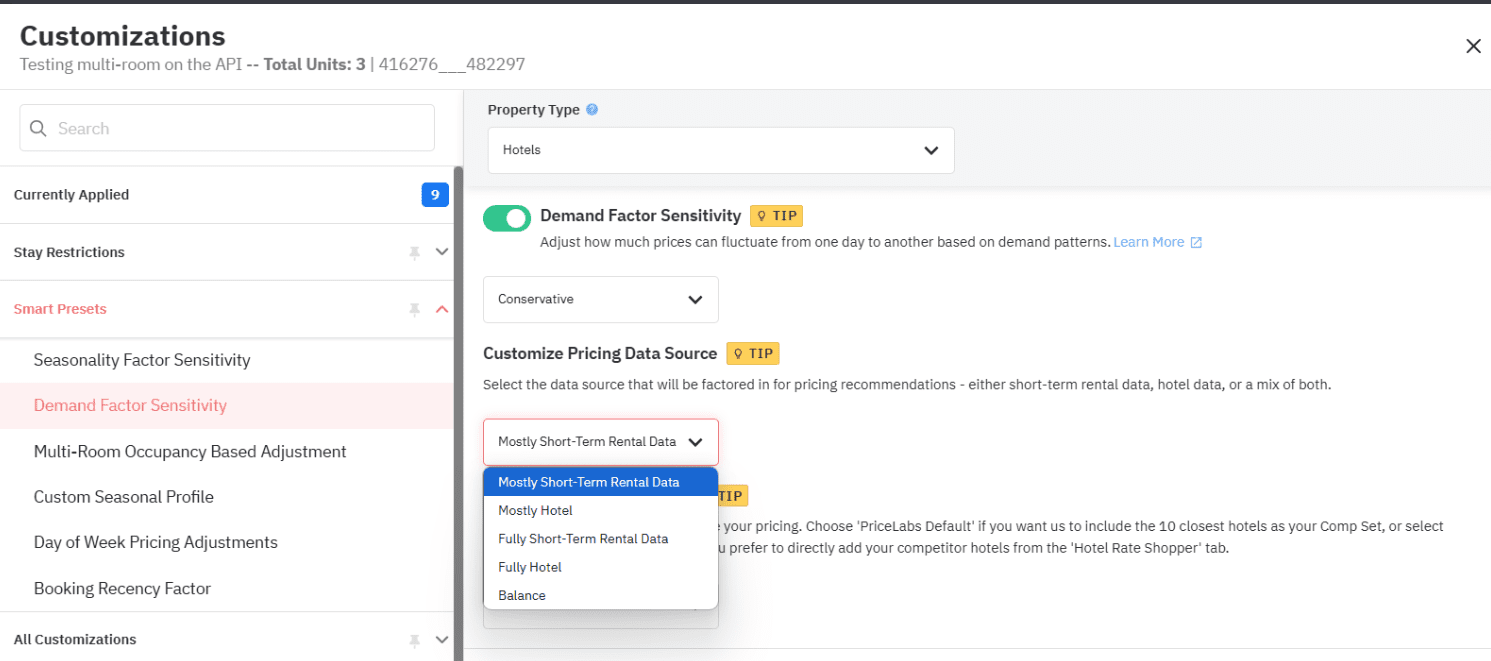
PriceLabs completely automates the response to these factors.
- Seasonal Profiles: Allow you to define distinct pricing and stay-rule strategies for peak, shoulder, and off-peak seasons.
- Last-Minute Pricing Adjustments: Automatically tweak recommendations for close-in dates to help fill empty rooms.
- Far-Out Pricing Adjustments: Protect your value by shaping pricing recommendations for dates far in advance to reflect long lead times.
- Neighborhood Data Tab: Helps you analyze short-term rental pricing trends and your competitive positioning regarding local events.
The Game Changer: Dynamic Nightly Pricing for Hotels
We have arrived at the most critical strategy for modern independent hoteliers: Dynamic nightly pricing for hotels.
If you ask a revenue manager in 2026, “what is nightly price in hotel management,” they will tell you it is the result of dynamic pricing algorithms. Dynamic pricing is the practice of automatically adjusting your room rates in real-time based on supply and demand. Airlines and ride-sharing apps have done this for years; now, independent hotels can do it too.
Dynamic nightly pricing for hotels takes the human error out of rate setting. It is virtually impossible for a human to manually monitor competitor prices, track historical pacing, analyze upcoming local events, and adjust rates across multiple OTAs 24 hours a day.
When you implement dynamic pricing, your hotel acts like a sponge, absorbing data and squeezing out the absolute optimal price for every single room, every single night. This is how independent hotels compete with massive, corporate chains that have entire floors of revenue managers.
How PriceLabs Helps Here: PriceLabs is the industry leader in Dynamic Pricing (Hyper Local Pulse). The system generates daily pricing recommendations using your internal occupancy, lead time, seasonality, local events, and publicly available hotel market data. Even better, with Real-Time Sync (for select PMSs), PriceLabs uses webhooks to trigger up to 24 price updates per day instantly following new reservations or cancellations. If a large group cancels suddenly, PriceLabs instantly adjusts your rates across your 160+ connected PMS and OTA integrations to help you re-book those rooms fast.
Step-by-Step: How to Optimize Your Nightly Price
Now that you understand what is nightly price in hotel operations, let’s look at how you can practically optimize it. Here are actionable steps you can take to elevate your revenue strategy.
Step 1: Segment Your Room Types Not all rooms are created equal. A standard queen room should not follow the exact same pricing trajectory as your penthouse suite with a balcony.
- How to do it: Identify the unique selling points of each room category. The demand for family suites might peak during school holidays, while single business rooms peak mid-week.
- PriceLabs Solution: Use Room-Type Specific Pricing to customize strategies based on room categories without affecting your broader property settings.
Step 2: Implement Minimum Stay Restrictions Strategically Sometimes, maximizing revenue isn’t just about the nightly price; it’s about the length of stay. If you have a highly demanded weekend (e.g., a local music festival), you don’t want a guest booking only Saturday night, leaving Friday and Sunday empty and hard to sell.
- How to do it: Apply a 2 or 3-night minimum stay requirement over major event weekends to ensure you capture maximum value.
- PriceLabs Solution: The Minimum Stay Rules feature adapts length-of-stay suggestions automatically based on seasonality, booking patterns, and demand periods, saving you from manually setting these rules date-by-date.
Step 3: Monitor and Adjust for Multi-Room Occupancy If one specific room type is selling out much faster than others, it indicates high demand for that specific product. You should increase the price of that specific room type to slow down the pace and capture higher rates.
- PriceLabs Solution: PriceLabs utilizes Multi-Room Occupancy-Based Adjustments. This adjusts pricing recommendations based on occupancy trends within specific room types, supporting a balanced sell-through across all your inventory.
Step 4: Don’t Be Afraid of Date-Specific Overrides While AI is incredibly smart, you know your specific hotel best. If you just booked a massive wedding block that isn’t showing up in the market data yet, you need to take control.
- PriceLabs Solution: Use Date-Specific Overrides to manually adjust pricing, stay restrictions, and availability for those specific, high-demand dates.
Elevating Your Market Intelligence
To accurately determine what is nightly price in hotel markets going to be next month, you need to look outside your own front doors. Independent hoteliers often operate in a bubble, looking only at their own past performance.
Today’s hospitality landscape is blurred. Your guests aren’t just comparing you to the hotel across the street; they are comparing you to luxury short-term rentals, boutique bed and breakfasts, and serviced apartments in the neighborhood.
Practical Tip: Do a “ghost shopping” exercise once a month. Go onto an OTA and pretend to be a guest looking for a room in your city for an upcoming busy weekend. See where your hotel ranks in price, photos, and reviews compared to the properties listed right next to yours.
How PriceLabs Helps Here

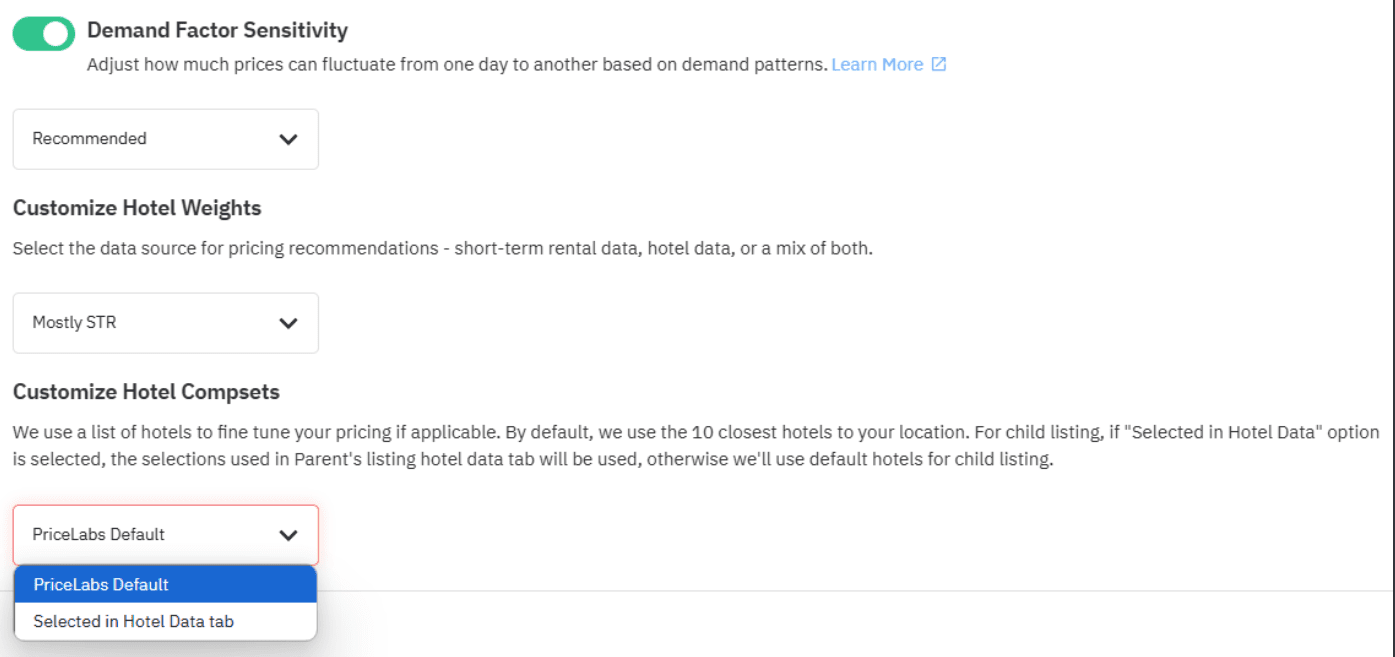
PriceLabs offers a brilliant feature called Hotel Weights. This allows you to control the influence of hotel data versus short-term rental data on your pricing recommendations. If your independent hotel is located in a market heavily dominated by Airbnbs and short-term rentals, you can adjust the algorithm so your nightly prices remain competitive against those specific alternative accommodations.
Furthermore, PriceLabs ensures Seamless Integration & Workflow Efficiency. With role-based permissions, your owners, revenue managers, and front desk staff can all access the multi-user logs to see exactly why a price changed and when, ensuring total transparency.
Way Forward
Understanding exactly what is nightly price in hotel management is the first step toward true revenue independence. We’ve explored the vital differences between rack rates and actual rates, broken down how to calculate your average nightly rate (ADR), and seen how dynamic pricing is revolutionizing the industry. The era of manual spreadsheets, guessing at competitor rates, and leaving money on the table is over. The way forward for independent hoteliers is embracing automation and data intelligence. By leveraging a smart system, you move from reactive guessing to proactive revenue generation, ensuring your property is always perfectly positioned in the market.
Frequently Asked Questions (FAQs)
Q: What is nightly price in hotel booking terms?
A: The nightly price in a hotel is the actual, final amount a guest pays for a single night’s stay. Unlike a static base rate, this price fluctuates based on market demand, seasonality, lead time, and competitor pricing.
Q: Why is my actual nightly rate different from the hotel rack rate?
A: This is the classic hotel rack rate vs. nightly rate scenario. The rack rate is the maximum published price for a room, while the nightly rate is the dynamic, discounted, or market-adjusted price a guest actually pays. Rack rates are rarely charged today unless a guest walks in without a reservation during absolute peak demand.
Q: How do I get my Average nightly rate (ADR) explained simply?
A: Average nightly rate (ADR) explained: It is calculated by taking your total room revenue for a specific period and dividing it by the total number of rooms sold. It tells you the average price guests are paying per room, helping you measure profitability.
Q: How does dynamic nightly pricing for hotels work?
A: Dynamic nightly pricing for hotels uses software (like PriceLabs) to automatically adjust your room rates up or down in real-time. It analyzes factors like local events, your current occupancy, competitor prices, and booking windows to find the optimal price for every single night.
Q: Can I set different pricing rules for different room types?
A: Yes! Using a tool like PriceLabs, you can utilize Room-Type Specific Pricing. This allows you to apply custom pricing rules, minimum stays, and overrides to individual room categories (like suites vs. standard rooms) without changing your entire property’s strategy.