



Imagine waking up on a random Tuesday to find your entire calendar for a weekend six months from now has been wiped clean. Your first reaction might be a fist-pump of victory—until you check the news. A major international tech summit just announced a surprise venue change to your city, or a global pop star just added a “secret” tour stop.
While you were sleeping, “event snipers”—tech-savvy travelers who track rumors and tour leaks—booked your home at your standard, low-season base rate. You didn’t just lose a booking; you lost thousands of dollars in potential revenue because your calendar was “undefended.”
In the high-stakes world of short-term rentals (STR) in 2026, being a “passive” host is a recipe for leaving money on the table. You need a proactive strategy to protect your inventory from being snapped up before you even know you need to raise your prices.
Here is how to play defense against the unknown using the power of PriceLabs and the nuance of Human Intelligence.
1. Implementing a Dynamic Far-Out Pricing Strategy to Protect Long-Term Inventory
The biggest vulnerability in any STR business is the “far-out” calendar. Most hosts set a base price and let it ride into infinity. This is a mistake. The further out a date is, the less you know about it—and in the world of pricing, uncertainty should always equal a premium.
The Strategy: Dynamic Far-Out Pricing
Using PriceLabs, you can implement a “sliding scale” of protection.

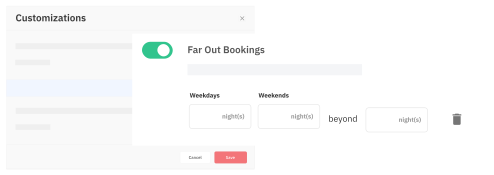
- The 6-Month Rule: For any dates beyond 180 days, your prices should be significantly higher than your current market average. Set a “Far-Out Premium” rule in PriceLabs that increases your rates by 50% to 100% for anything in the distant future.
- Why this works: If a guest is willing to pay double your base rate six months in advance, one of two things is true: either they really love your specific property, or they have “inside baseball” knowledge of an event that hasn’t hit the public consciousness yet. In either scenario, you win.
- The “PriceLabs Recommendation”: Use the Minimum Stay tool in conjunction with high pricing. For dates 6+ months out, set a 4 or 5-night minimum. This prevents someone from “sniping” a high-demand Saturday and leaving you with a Friday/Sunday gap that’s impossible to fill.
Dynamically Price Your Property and Get FREE Custom Reports Tailored To Your Property!
Use PriceLabs Dynamic Pricing to competitively and dynamically price your property according to demand shifts and analyze past performance to set a strong pricing strategy for your property.
Create your Account Now2. How PriceLabs Yield Mapping Automatically Defends Against Sudden Market Demand
You can’t be expected to monitor every local wedding block, corporate retreat, or niche festival in your city. This is where Yield Mapping (also known as Occupancy-Based Adjustments) becomes your best friend.

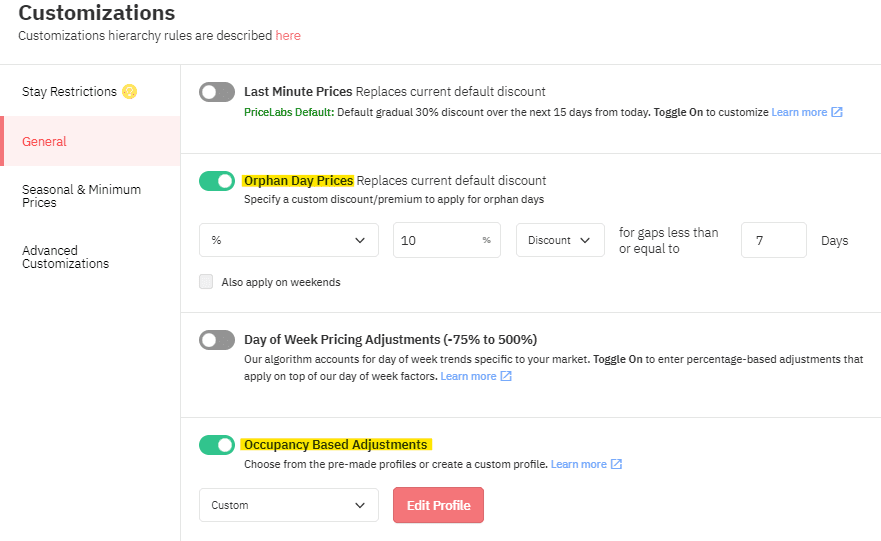
How Yield Mapping Plays Defense
Yield mapping doesn’t care why a date is popular; it only cares that it is. It monitors the supply and demand in your specific micro-market in real time.
- The “Follow the Leader” Effect: If five of your closest competitors suddenly get booked for a specific weekend in November, PriceLabs recognizes the sudden drop in market supply.
- Automatic Shielding: You can program PriceLabs to say: “If market occupancy for these dates hits 40% (even if I am personally 0% booked), raise my rates by 25%.”
- The Benefit: This protects you from the “first wave” of bookings. Usually, the cheapest homes get booked first when an event is announced. Yield mapping ensures that as those cheap homes disappear, your price rises automatically, keeping you at the top of the “premium” tier, where the real profit lies.
3. Building Local Business Networks to Forecast High-Demand Wedding and Corporate Dates
Data is powerful, but it’s often trailing. A computer knows when a booking happens, but a human knows when a booking is about to happen. To truly play defense, you need a network of “boots on the ground.”
The Housekeeping Connection
Your cleaning crew is your most valuable intelligence asset. They often manage multiple properties across the city and see patterns before you do.
- The Play: Ask your cleaning lead, “Are you seeing any weird spikes in ‘hold’ requests or deep-cleans for next spring?” Often, large management companies will “block out” dates for maintenance or owner stays right before a major event is announced to re-evaluate pricing. If your cleaner mentions a specific weekend is getting “blocked” across their portfolio, go to your PriceLabs dashboard and immediately raise your rates for those dates.
The “Guest Inquiry” Intel
Never ignore a “weird” question from a prospective guest.
- The Play: If you receive an inquiry asking, “Is your home near the fairgrounds?” or “Do you have extra parking for a large van in March?”—don’t just answer the question. Investigate.
- The Proactive Response: A simple message like, “We’d love to host you! Just curious, is there a specific event or conference that brings you to town that weekend?” can reveal a goldmine of information. If they mention a specific convention, you now have the lead time to adjust your entire month’s strategy.
Dynamically Price Your Property and Get FREE Custom Reports Tailored To Your Property!
Use PriceLabs Dynamic Pricing to competitively and dynamically price your property according to demand shifts and analyze past performance to set a strong pricing strategy for your property.
Create your Account NowLocal Business Networking
Make friends with the manager of the local high-end hotel or the owner of a popular event venue.
- The Intel: Venues often book weddings or corporate buyouts 12–18 months in advance. A quick coffee with a venue manager can tell you that “The last weekend in June is going to be massive because we have three 300-person weddings back-to-back.”
4. Set Cascading Minimum Stays
Once you’ve successfully “defended” your calendar and kept it open while the rest of the market sold out cheap, you need to maximize the “yield.”

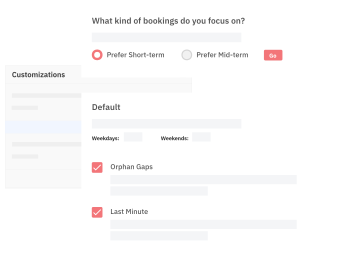
PriceLabs Customization
In the PriceLabs “Stay Restrictions“ settings, implement a Cascading Strategy:
- Phase 1 (The Wall): For dates 90+ days out, require a 4-night minimum.
- Phase 2 (The Filter): At 30 days out, if you are still unbooked, drop to a 3-night minimum, but increase the price by another 10%.
- Phase 3 (The Harvest): At 7 days out, drop to a 2-night minimum.
By the time you get to Phase 3, you are likely one of the few high-quality homes left in the market. A guest who needs to be there for the event will gladly pay a 300% premium for a 2-night stay because they have no other options.
Conclusion: Don’t Be the Last to Know
Playing defense isn’t about being cynical; it’s about being a professional. In the STR industry, information is the most valuable currency. By using PriceLabs to build automated walls around your far-out calendar and using Human Intelligence to spot the cracks in those walls, you ensure that you are never the host who looks back at a “sold-out” month and realizes they could have made double.
Your Action Plan:
- Log in to PriceLabs and check your Far-Out Premiums. Are they at least 50% higher for 6 months out?
- Set up an Occupancy-Based Adjustment rule to trigger a price hike when your neighborhood hits 50% occupancy.
- Text your cleaning crew or a local business owner and ask what “big things” they’re hearing about for the coming year.
Frequently Asked Questions
What is an “unknown event” and why does it pose a risk to short-term rental hosts?
An unknown event is a high-demand driver—like a surprise concert or corporate summit—that hasn’t been officially announced or updated in pricing data. The risk is that “event snipers” who track rumors can book your home at standard low-season rates before you realize the demand has spiked, costing you thousands in potential revenue.
How does the PriceLabs “Far-Out” pricing rule protect my property from early bookings?
This rule creates a “Far-Out Fortress” by automatically applying a steep premium (e.g., 50–100% above base rate) to dates far in the future, such as 6+ months out. It ensures that any early bookings are either highly profitable or discouraged until you have more concrete data about the actual market demand for those dates.
What is Yield Mapping and how does it act as an automated early warning system?
Yield Mapping (Occupancy-Based Adjustments) monitors the real-time supply of your local micro-market rather than relying on event calendars. If your neighbors suddenly get booked and the area’s occupancy hits a certain threshold (like 40%), PriceLabs automatically raises your rates, shielding you from the first wave of bookings that usually hits the cheapest listings.
How can “Human Intelligence” supplement automated pricing tools like PriceLabs?
While AI tracks data, humans track intent; building a network with local cleaning crews, venue managers, and business owners can reveal rumors of large wedding blocks or group turnovers months before they appear in data. Additionally, asking guests why they are visiting can help you uncover niche local demand that hasn’t hit the headlines yet.
What are “Cascading Minimum Stays” and how do they maximize revenue as an event nears?
This is a strategy to filter for the highest-value bookings by gradually relaxing stay restrictions as a date approaches. You start with a strict 4-night minimum for far-out dates; as the event nears (e.g., 7 days out), you drop to a 2-night minimum at a significant price premium, capturing desperate, high-paying guests when inventory in the city is nearly exhausted.