



For many revenue managers, the idea of “testing” prices feels like a gamble. In a high-stakes environment where a few percentage points can determine the year’s success, the fear of leaving money on the table or alienating guests is real. It makes learning how to test pricing strategies without revenue loss all the more important for property managers.
In today’s dynamic hospitality landscape, controlled pricing experimentation is no longer a luxury—it’s an expectation. Modern Revenue Management Systems (RMS) and AI-driven automation have turned pricing from a “guessing game” into a rigorous science. It is entirely possible to iterate on your pricing strategy while protecting your baseline.
What is Controlled Pricing Experimentation?
Controlled pricing experimentation involves running structured tests or simulations designed to measure the impact of price changes while minimizing business risk and volatility.
By leveraging dynamic pricing automation, revenue managers can use machine learning to deliver strategic recommendations and forecast outcomes before they ever go live. This is especially vital for large portfolios or complex inventories, where manual testing cannot be scaled.

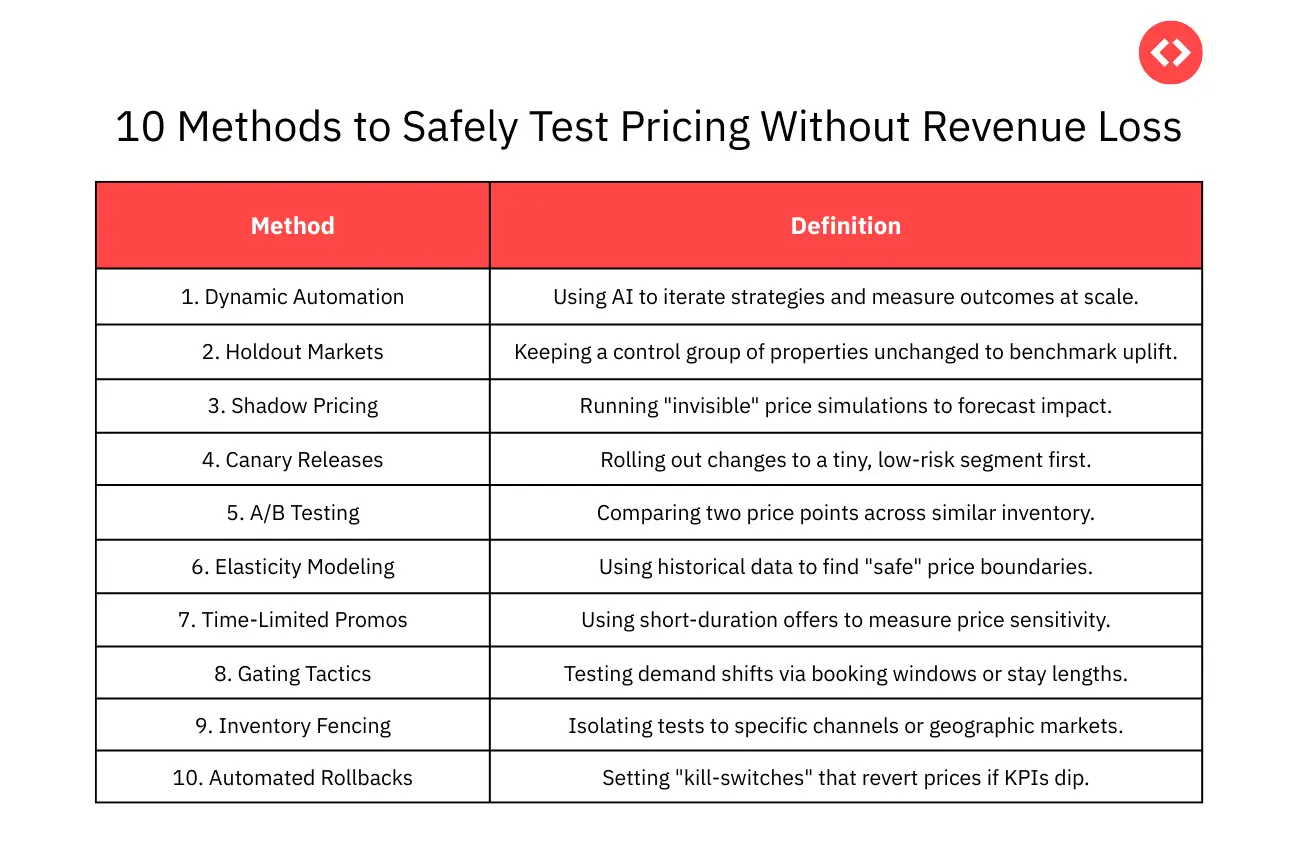
How to Test Pricing Strategies Without Revenue Loss
1. PriceLabs Dynamic Pricing Automation
The foundation of modern experimentation isn’t manual spreadsheets; it’s dynamic pricing automation. PriceLabs acts as a central nervous system for your revenue management strategy, using machine learning to ingest hyper-local market data, seasonal trends, and historical performance.
- Intelligent Guardrails: You can define “safety zones” for your testing. For example, you might allow the AI to experiment with higher rates during a local festival but set a “floor price” that it cannot cross, ensuring you never sell below your break-even point.
- Scalable Iteration: In a manual setup, testing a “Far-Out” pricing rule across 500 listings would take days. With automation, you can apply a rule globally and use Portfolio Analytics to compare your listing’s performance with previous years and to see how the test performs in real time.
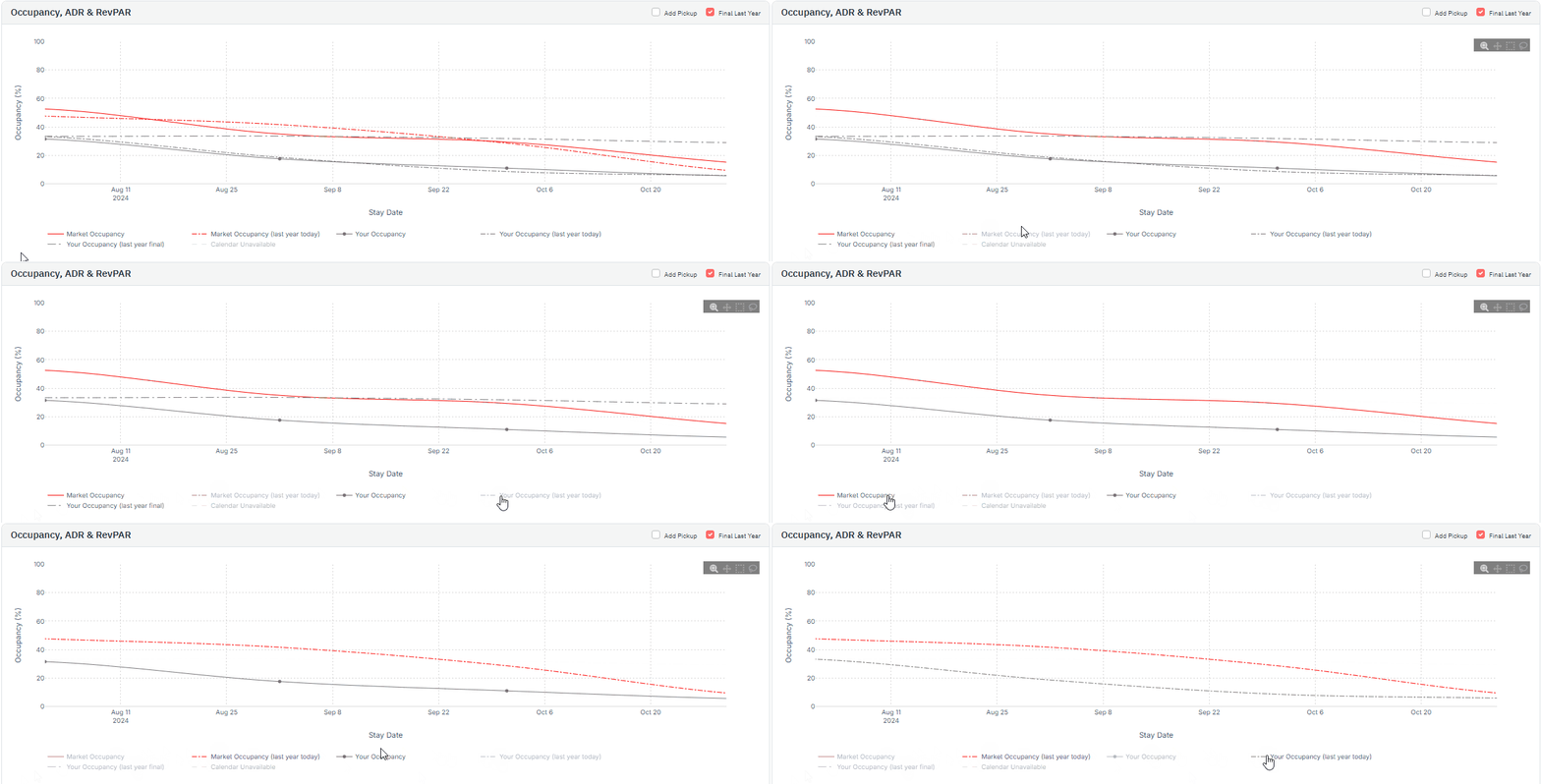
- Data-Driven Confidence: Instead of guessing if a price hike worked, PriceLabs provides clear visualizations of “Market Occupancy vs. Your Occupancy,” letting you see if your test is successfully capturing a larger slice of the pie.

2. Holdout Markets for Controlled Benchmarking
To eliminate “noise” from your data (like a sudden change in weather or a competitor closing down), you must use Holdout Markets. This is the gold standard for scientific testing and should be one of the first things to know when learning how to test pricing strategies without revenue loss.
- The “A/B” of Portfolios: If you manage 50 properties in a coastal city, apply your new “Aggressive Last-Minute” pricing to 40 of them. Keep the remaining 10 on your standard strategy.
- Statistical Integrity: The 10 holdout properties act as the “control group.” If the 40 test properties show a 15% lift in RevPAR while the 10 holdout properties remain flat, you have definitive proof that your strategy—not just market luck—drove the revenue.
- Risk Mitigation: If the new strategy fails, only a small portion of your portfolio (the test group) is affected, leaving your baseline revenue from the holdout group intact.
3. Shadow Pricing and Parallel Simulations
Why risk real money when you can test in a “sandbox”? Shadow pricing allows revenue managers to run a new algorithm “in the dark.”
- How it Works: The RMS calculates the price based on your new rules, but it doesn’t push that price to the OTAs. Instead, it logs that theoretical price alongside the actual price.
- Post-Game Analysis: After 30 days, you can look back and ask: “If we had actually used the Shadow Price, would we have captured more bookings?”
- Scenario Modeling: This is particularly useful for major structural changes, such as moving from a fixed seasonal rate to a fully fluid dynamic model.
4. Canary Releases on Low-Risk Segments
In software, a “canary” is used to detect danger before it affects everyone. In revenue management, this means testing changes on your most resilient or low-impact segments.
- Identifying the “Canary”: Choose a mid-week window three months out, or a specific property type that usually has consistent, predictable demand.
- The Early Warning System: If the Canary Release shows a sudden halt in booking velocity, you can kill the test immediately. Because you only tested a small, far-out window, the total revenue at risk is negligible.
- Scaling Up: Once the “Canary” proves the new rates are being accepted by the market, you can gradually expand the test to peak weekends and higher-value segments.
5. A/B and Multivariate Pricing Tests
A/B testing isn’t just for website buttons—it’s for your nightly rates. This involves presenting different prices to similar segments to find the “sweet spot” of conversion.
- Controlled Variables: You might test a $200 rate with a “Non-Refundable” policy against a $225 rate with a “Flexible” cancellation policy.
- Multivariate Testing: This takes it a step further by testing multiple variables at once (e.g., Price + Minimum Stay + Channel).
- Success Metrics: Don’t just look at who booked more. Look at the Total Yield. If the $225 rate had a slightly lower conversion but a significantly higher profit margin, it might be the winner.
6. Elasticity Modeling and Customer Segmentation
Not every guest reacts to a price increase the same way. Price Elasticity measures that sensitivity.
- Segmented Sensitivity: Business travelers often have “inelastic” demand (they need to stay regardless of a $20 price jump), while family vacationers are “elastic” (a $20 jump might make them book an Airbnb instead).
- Safe-Zone Testing: By using your RMS to identify segments with low elasticity, you can test higher price points with a high statistical probability that you won’t lose the booking.
- Granular Adjustments: This allows you to raise prices for one segment (e.g., OTA bookers) while keeping them stable for another (e.g., direct bookings).
7. Time-Limited Promotions and Coupon Controls
Promotions are essentially “Price Tests with an Expiry Date.” They allow you to gather data on price sensitivity without “poisoning the well” of your long-term ADR.
- Flash Sales: Run a 48-hour “Flash Sale” with a 15% discount. This provides an immediate burst of data: How many people clicked? How many converted?
- Volume Caps: You can set a rule that the promotion only applies to the first 10 bookings. This “caps” your exposure, ensuring that once you’ve gathered enough data, the test automatically ends.
8. Booking-Window and Length-of-Stay Gating
Pricing isn’t the only lever you can pull. Sometimes, changing when or how long someone can book is a safer test than changing the price itself.
- The Window Test: Try closing off your ‘Early Bird’ 10% discount 60 days out instead of 30. Does your occupancy take a hit, or do guests simply pay the standard rate?
- The LOS Test: On a high-demand weekend, test a 3-night minimum instead of a 2-night minimum. You are testing the market’s “willingness to stay,” which protects your revenue by reducing turnover costs and vacancy gaps.
9. Inventory Fencing and Rate Parity Enforcement
Fencing creates a “walled garden” for your pricing tests, preventing test prices from leaking into segments where they might cause brand damage or unnecessary loss.
- Channel Fencing: Run a test price exclusively on a “Hidden” channel or a specific geographic market (e.g., a special rate only for users in the UK).
- Product Fencing: Test a higher price point only on your “Premium Suites” while keeping “Standard Rooms” at the baseline. This prevents “cannibalization,” where a guest might have booked a cheaper room anyway.
10. Automated Rollback Rules and KPI Thresholds
This is your insurance policy. Property management automation ensures you don’t have to stare at a dashboard 24/7 to prevent a disaster.
- The “Kill Switch”: You can program your RMS with a rule: “If RevPAR for the test group drops more than 5% below the control group over a 7-day rolling period, revert to the original strategy.”
- Real-Time Alerts: Instead of finding out at the end of the month that a test failed, you get an automated alert the moment a KPI (like Booking Pace) deviates from the norm.
- Audit Trails: Every rollback is logged, providing a “Post-Mortem” report that helps you understand why the test failed and refine your next experiment.
Frequently Asked Questions
1. How can a revenue manager test pricing strategies without risking long-term revenue loss?
The most effective way is to use dynamic pricing automation with built-in guardrails, combined with holdout markets to benchmark performance. By testing on small segments (canary releases) and setting automated rollback rules, you can identify winning pricing strategies while capping potential losses.
2. What metrics are essential for measuring pricing test success?
While ADR is important, the “North Star” should always be RevPAR and Net Revenue. Additionally, monitor other essential vacation rental KPIs, such as booking pace, conversion rates, and channel mix, to ensure your test isn’t just shifting revenue from one pocket to another.
3. When should a pricing test be rolled back?
A test should be rolled back immediately if it exceeds your pre-defined KPI thresholds—for instance, if occupancy drops significantly below the historical average for that period without a compensating lift in ADR.