



Airbnb’s algorithm has shifted. Visibility now hinges on measurable guest signals, pricing intelligence, and operational precision. Here’s what the data says — and exactly what to do about it.
How Airbnb Search Ranking Actually Works?
Airbnb’s algorithm isn’t a black box — it’s a scoring system that rewards measurable signals. Here’s the framework.
Airbnb’s search ranking evaluates every listing across three core pillars: quality, popularity, and price. Quality is measured through review scores, photo standards, and listing completeness. Popularity captures behavioral signals — bookings, wish-list saves, and click-through rates. And price competitiveness is benchmarked against comparable listings in your market.

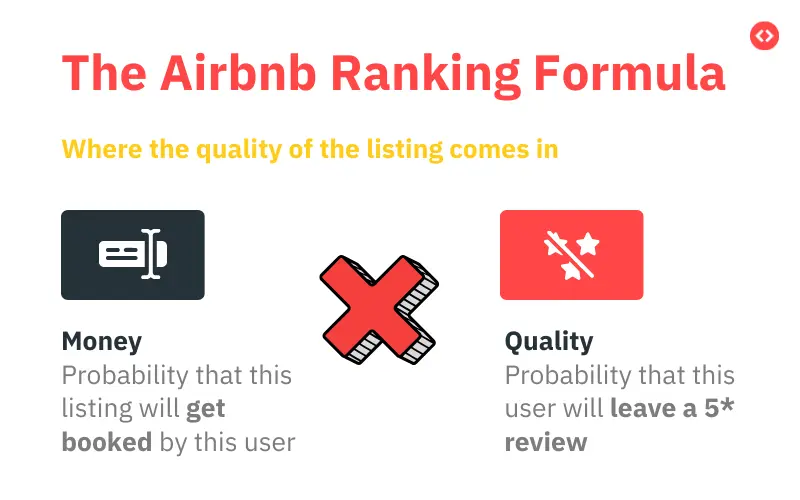
The system is deliberately dynamic. It doesn’t simply rank once and forget — it continuously re-evaluates, using real-time guest behavior (search queries, time-on-listing, booking conversion) to decide which listings surface for which travelers. This means your ranking is earned daily, not fixed.
Here’s what matters most within those pillars: listing completeness and accuracy (every empty field is a missed signal), response rate and speed (falling below 95% or exceeding 1-hour average response time erodes trust and rankings), conversion rate and review sentiment (the algorithm literally parses review text), and content freshness — Airbnb rewards listings that are updated regularly over those left static for months.
What this means for you
Ranking isn’t about gaming a system — it’s about consistently delivering on quality, demand, and price signals. Hosts who treat this like an ongoing operating discipline outperform those chasing one-time hacks.
Audit Your Listing Performance and Guest Feedback
Before changing anything, measure where you actually stand. Most hosts skip this — and optimize blindly.
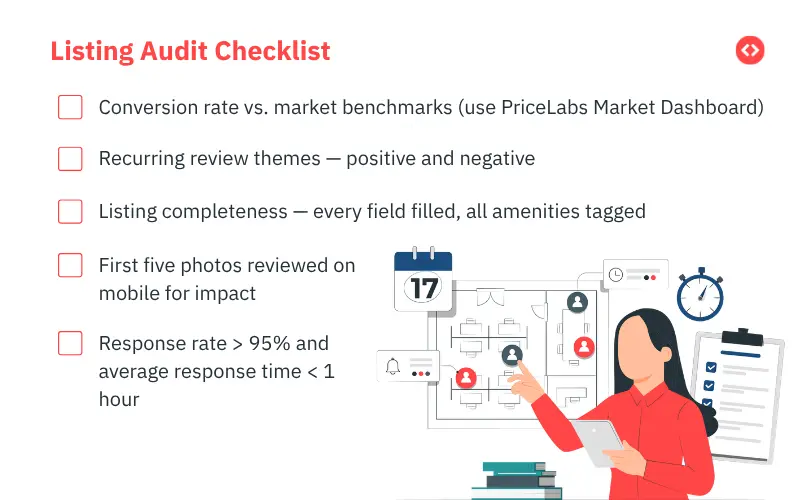
Start with your views-to-bookings conversion rate. This single metric tells you whether guests who find your listing actually want to book it. Below 2%, something material is broken — your photos, pricing, or description is actively turning people away. Above 4%, you’re leaving money on the table and likely underpriced.
| Conversion Rate | Signal | Recommended Action |
|---|---|---|
| < 2% | Problem | Audit photos, pricing, and description immediately |
| 2% – 4% | Healthy | Continue optimizing incrementally |
| > 4% | Strong | Test moderate price increases |
Next, read your last 10 guest reviews with an analyst’s eye. Don’t just count stars — identify recurring themes. The algorithm parses review text for sentiment and topic relevance. If three reviews mention “noisy” or “slow check-in,” those patterns are hurting your ranking, whether you’ve noticed or not.
Then pull up your listing on a mobile device. Your first five photos are the only pitch most guests will ever see. If the lead image isn’t immediately attention-grabbing, you’re losing clicks before your pricing or description even enters the equation.
Incomplete listings structurally underperform. Every unfilled field — amenities, house rules, neighborhood description — is a missed relevance signal. Complete every field, even ones that feel optional.
Use Dynamic Pricing to Capture Demand and Events
Pricing is the single fastest lever you can pull. The question isn’t whether to use dynamic pricing — it’s how sophisticated your approach is.
Dynamic pricing means automatically adjusting nightly rates based on real-time demand, competitor activity, local events, and seasonal patterns. It replaces guesswork with data. And the performance gap between dynamic and static pricing is now wide enough that it directly impacts your search ranking — because conversion rate is a core ranking signal, and mispriced listings don’t convert.

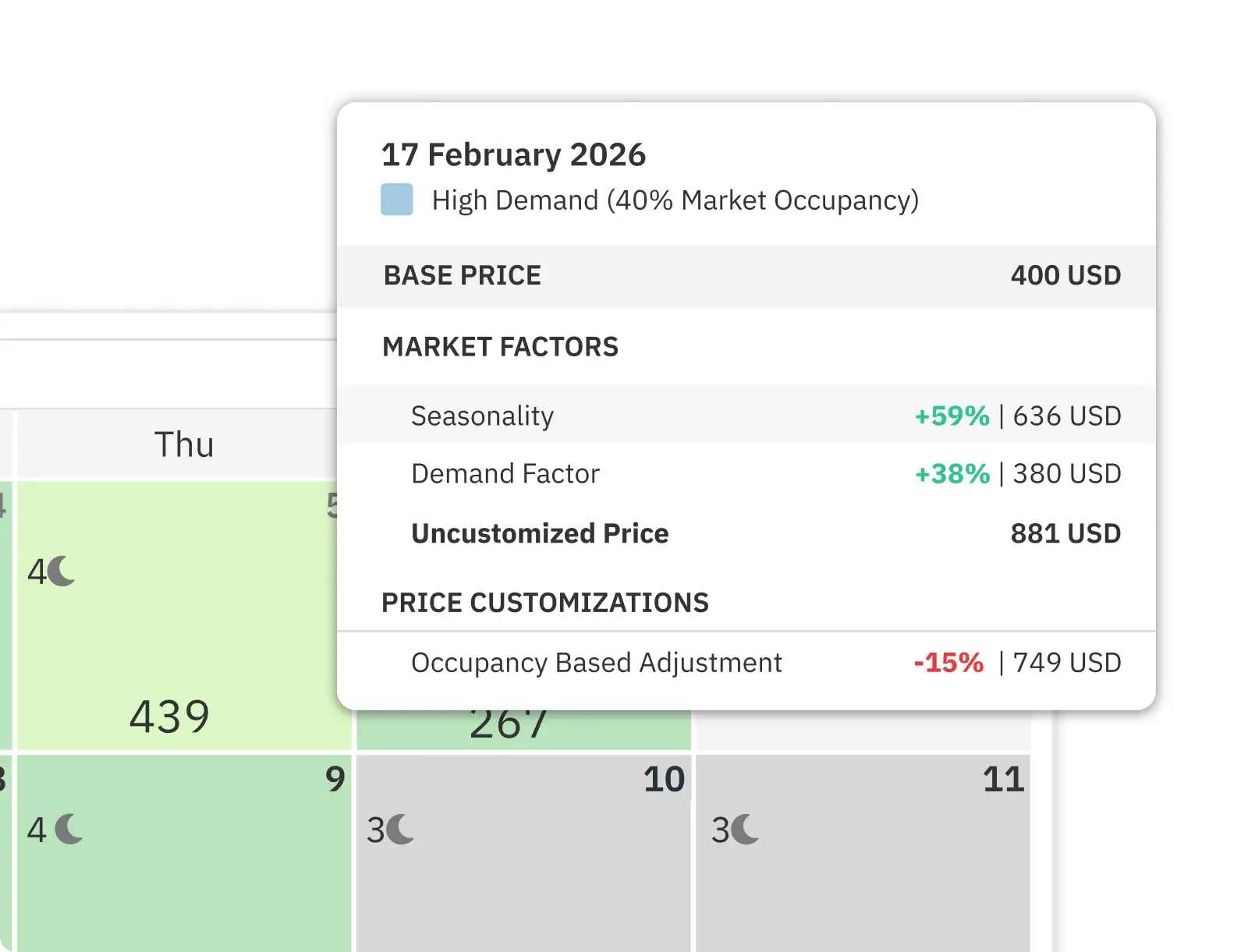
Dynamic pricing tools broadly outperform manual pricing on conversion and ranking. But the edge isn’t just automation — it’s the ability to layer intelligence. Seasonal patterns, day-of-week curves, and competitor rate shifts are factored continuously, not just when you remember to check.
Event-based overrides deserve special attention. For major events — festivals, conventions, sporting events — manual price overrides on top of your dynamic baseline can capture 30–50% more revenue than auto-pricing alone. The key: lift your price ceilings on confirmed high-demand dates. Most hosts leave the default cap in place and forfeit the upside.
| KPI | Manual Pricing | Dynamic Pricing |
|---|---|---|
| Conversion Rate | Inconsistent — often misaligned with demand | Higher — rates match willingness to book |
| ADR | Flat — misses peaks and troughs | Optimized per night, per season |
| Occupancy | Gaps during shoulder periods | Fills shoulder dates via automated drops |
| Revenue | Baseline | +15–30% typical lift |
| Host Time Required | Hours per week | Minutes — set rules, review weekly |
What this means for you
If you’re still pricing manually, you’re almost certainly leaving revenue and ranking position on the table. Dynamic pricing isn’t a premium luxury — it’s a baseline operating standard for competitive hosts in 2026. Tools like PriceLabs handle seasonal pricing, orphan-day rules, and event overrides automatically, so you compete on data rather than instinct.
Optimize Photos and Visual Content for Engagement
Your lead image is your listing’s advertisement. Everything downstream — clicks, conversions, ranking — depends on whether guests stop scrolling.
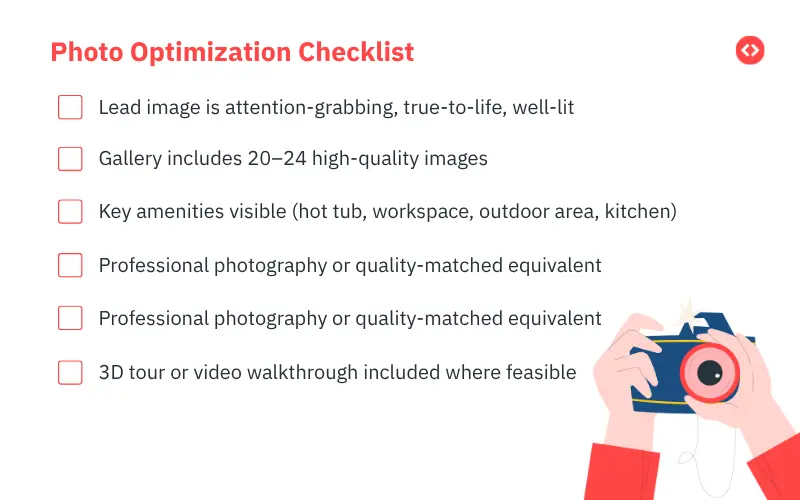
Lead with your strongest image. The first photo largely determines whether guests click through from search results. It should be your highest-impact shot — the one that communicates the core promise of your property in a single frame. Typically, this is a wide-angle view of the primary living space or the most distinctive feature (a stunning view, a pool, a designer kitchen).
Gallery depth matters. Listings with 20–24 high-quality photos perform significantly better than those with fewer images. Think of the gallery as a virtual walkthrough: every room, every amenity, every angle that a guest would want to inspect before booking. Skip the redundant shots of the same couch from three angles.
The data on professional photography is definitive: professional photos can drive approximately 40% more revenue compared to amateur shots. That’s not just a quality signal to the algorithm — it’s a direct conversion lever. If you’re managing multiple properties, a professional shoot pays for itself within the first few bookings
AI-powered photo enhancement tools are increasingly popular — and they can help with lighting, color correction, and staging suggestions. But accuracy is non-negotiable. Enhanced photos that over-promise create negative reviews, which damage your ranking far more than any click-through boost they generate.
Consider adding a 3D virtual tour or 360° photos. Properties using immersive visual content have reported conversion lifts of around 25%. It’s an investment that sets you apart, especially in competitive urban markets.
Craft SEO-Friendly Titles and Descriptions
Your title and opening description are search real estate. Every word should work to match guest intent and trigger clicks.
Airbnb SEO is the practice of using targeted keywords and content strategies to improve your listing’s visibility on the platform’s search page. Unlike Google SEO, Airbnb’s system primarily matches guest intent to listing content — meaning your title and description need to include the exact terms guests search for.
Use targeted, location-specific keywords in both your title and description. Think about what guests type when searching: they search for amenities (“hot tub,” “private parking”), proximity to locations (“walk to convention center,” “steps from downtown”), and use cases (“remote work,” “family reunion”). Build your copy around these terms.
Weak — Generic
“Comfortable 2BR apartment”
No location, no amenities, no differentiation. Invisible in filtered searches.
Strong — Specific
“Fiber internet — ideal for remote work, steps from city dining”
Targeted use case, key amenity, location context. Matches real search behavior.
Explicitly mention key amenities and nearby attractions — hot tub, EV charger, dedicated workspace, walk-to restaurants. These aren’t just descriptive; they’re keywords that improve filter match rates. Guests who use Airbnb’s filters will only see listings that surface for those attributes.
Don’t underestimate content freshness. Regularly updated descriptions signal an active, attentive host to the algorithm. Include practical details that guests actually care about: Wi-Fi speed, parking arrangements, specific distances to landmarks. These details also reduce pre-booking questions, improving your response metrics indirectly.
What this means for you
Think of your title and description as a search-optimized ad, not a creative essay. Lead with your most bookable differentiator, include the keywords guests actually search for, and update quarterly to maintain freshness signals.
Enhance Guest Experience to Drive Positive Reviews
Guest experience is now the center of Airbnb’s ranking logic. Reviews aren’t just feedback — they’re algorithmic fuel.
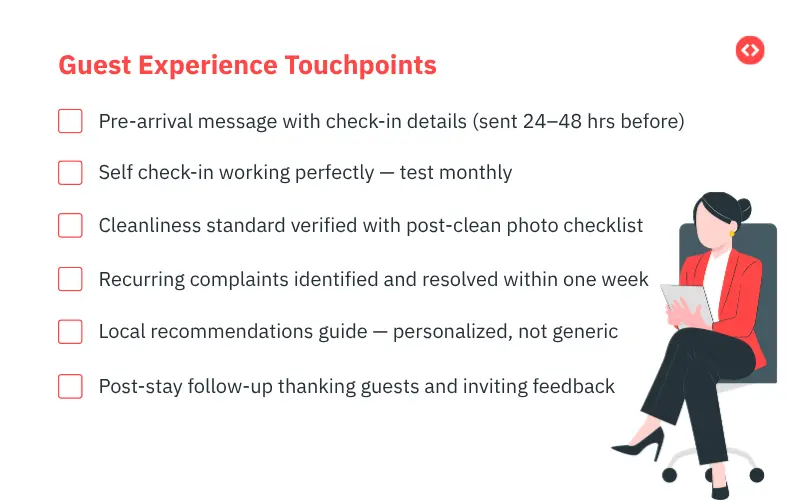
Guest experience is central to Airbnb SEO in 2026 — it directly influences visibility. The algorithm doesn’t just count stars; it reads review text, measures sentiment, and weights listings where guests consistently mention specific amenities or positive experiences. A property where reviews repeatedly mention “spotless,” “great communication,” or “incredible hot tub” builds cumulative relevance in search.
Response speed and consistency are non-negotiable ranking factors. Delayed replies directly reduce trust signals, and the algorithm penalizes sluggish communication. Fast, consistent responses improve your visibility independent of everything else.
Operationally, focus on the details that generate five-star reviews: streamlined and automated check-in (self-check-in is now a guest expectation, not a perk), absolute cleanliness, and proactive resolution of any recurring complaints. If multiple reviews mention the same issue — noisy HVAC, confusing parking, weak water pressure — fix it immediately. Every repeated complaint compounds the algorithmic penalty.
Properties that offer unique local experiences and thoughtful amenities — curated local guides, quality coffee setups, high-end linens — see roughly 25% higher guest satisfaction scores. The ROI on these investments is immediate and measurable through review quality.
Maintain Calendar Hygiene and Availability
An inaccurate calendar doesn’t just frustrate guests — it actively tanks your ranking. Here’s how to treat availability as a competitive lever.
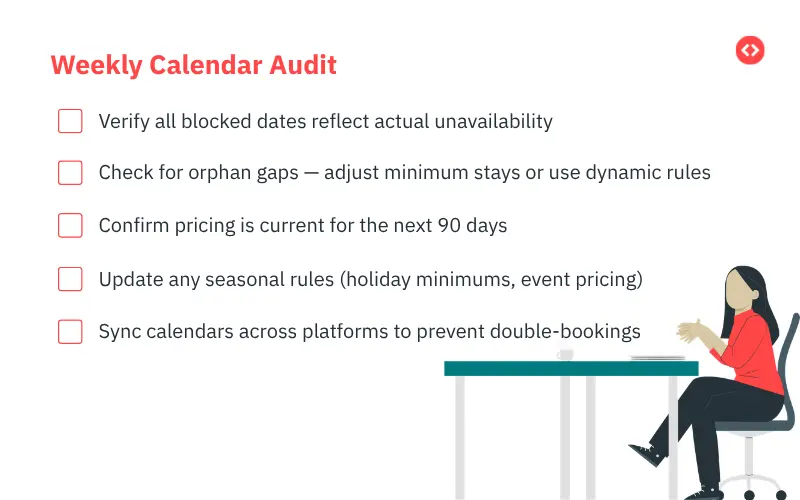
Calendar hygiene is the ongoing process of ensuring your listing’s calendar accurately reflects real availability, minimum stays, and any special rules. It sounds mundane, but an accurate calendar prevents cancellations and sustains higher visibility. Host-initiated cancellations are among the most damaging signals in Airbnb’s algorithm.
Update your calendar frequently, especially during boost periods or when local events approach. Airbnb’s algorithm explicitly rewards fresh calendar activity — it’s a signal that you’re an engaged, active host. Stale calendars drop in placement over time.
Orphan day recovery is one of the highest-ROI calendar tactics. When minimum-stay rules create 1–2 night gaps between existing bookings, those dates become unsellable. Relaxing minimum stays dynamically for these specific gaps — a feature PriceLabs automates — turns dead inventory into revenue.
Enable Instant Book and Streamline Booking Features
Friction kills conversions. Instant Book removes the biggest source of booking friction — and the algorithm notices.
Instant Book allows guests to reserve your listing immediately without waiting for host approval. It’s a convenience feature for guests and a ranking signal for the algorithm. Enabling Instant Book, especially during search boost periods, can strongly improve both visibility and booking likelihood.
Review your booking settings for unnecessary barriers. Excessive guest requirements, overly restrictive house rules, or complex approval workflows all create drop-off points. Each barrier between a guest’s intent and a confirmed booking reduces your conversion rate — which directly impacts search placement.
Use Instant Book strategically. Toggle it on during high-season periods, local events, or when occupancy is lagging. During quieter periods when you want more control over guest screening, you can adjust. The key is that your booking path should be as smooth as possible during the moments when demand is highest.
What this means for you
If you’re not using Instant Book, you’re adding friction at the exact moment a guest is ready to commit. Test it for 60 days and measure your conversion rate change — most hosts see a material improvement.
Monitor Metrics and Iterate Your Strategy
What separates top-performing hosts from the average isn’t one big move — it’s the discipline of weekly measurement and incremental adjustment.
Build a simple weekly tracking habit around five core metrics: conversion rate, ADR, occupancy, response rate, and review sentiment. These are the signals the algorithm weights most heavily, and they’re all within your control.
Core Metrics Dashboard Template
Track these weekly — trends matter more than snapshots
| Metric | Your Value | Target | Status |
|---|---|---|---|
| Conversion Rate | ____% | 2–4% | Review |
| ADR | $____ | Market median +5–10% | Review |
| Occupancy | ____% | 65–80% | Review |
| Response Rate | ____% | >95% | On Track |
| Avg Review Score | ____ ★ | 4.8+ | On Track |
| Wish-List Saves | ____ | Trending up | Review |
Don’t just measure — experiment. A/B test your pricing strategy, swap lead photos, rewrite your opening description. Survey guests at checkout about what influenced their booking decision. Small, data-informed adjustments compound over time into significant performance gains.
Wish-list saves deserve specific attention — they’re a demand signal the algorithm uses to identify trending listings. If your wish-list saves are flat or declining, it typically indicates that your listing is visible but not compelling enough to bookmark. That’s usually a photo or pricing issue.
PriceLabs provides a continuous feedback loop for dynamic rule updates, market positioning analysis, and performance benchmarking — so your pricing strategy evolves with the market instead of lagging behind it.
What this means for you
Treat your listing like a product with a release cycle. Measure weekly, adjust monthly, and invest in the metrics that compound. The hosts who out-earn consistently are the ones who never stop iterating.FAQ
Frequently Asked Questions
How does Airbnb’s ranking algorithm determine search position?
Airbnb’s 2026 algorithm prioritizes listings with high guest engagement, strong reviews, fast host responses, and content that closely matches traveler intent and search filters. It evaluates quality, popularity, and price competitiveness — and it recalculates continuously based on real-time guest behavior.
What are effective ways to get more 5-star reviews?
Set accurate expectations with honest photos and descriptions, then exceed them through fast communication, thoughtful amenities, and flawless cleanliness. Follow up post-stay with a genuine thank-you that invites feedback. Guests who feel cared for rate higher.
How can I analyze my local market to improve my listing?
Compare your listing to 20–30 similar properties in your area. Track their pricing, occupancy, reviews, and amenities. Identify gaps and advantages. Tools like PriceLabs’ Market Dashboard automate this benchmarking so you can focus on strategy, not spreadsheets.
What types of titles and descriptions improve search visibility?
Titles that lead with specific amenities and location context outperform generic descriptions. Include the terms guests actually search — “hot tub,” “walk to downtown,” “remote work setup” — and update your descriptions quarterly to maintain content freshness signals.
How do photos and guest experiences impact Airbnb rankings?
Professional-quality photos drive more clicks, and consistent positive guest experiences drive more bookings and better reviews. Both signals are core to how Airbnb’s algorithm determines relevance and ranking position.