



The short-term rental (STR) landscape has officially entered a new era of professionalization. As we move into 2026, the “low-hanging fruit” of the post-pandemic travel boom has vanished, replaced by a market that rewards precision, quality, and hyperlocal agility.
To help operators navigate this shift, in the recent episode of RevLabs, Kyle Driskell broke down the definitive data shaping the current season. The episode highlights a critical reality: for property managers overseeing 10 or more listings, the challenge is no longer just about filling calendars—it is about maintaining RevPAR optimization strategies in an increasingly fragmented market.
Whether you’re battling the “scaling gap” or trying to outperform the competition for major global events, the following guide distills the core breakthroughs into actionable strategies for professional short-term rental management.

1. The New Quality Standard: Why 4.9 is the New 4.5
In 2025, a definitive trend emerged: quality now determines pricing power. While it has always been known that better reviews lead to more bookings, 2026 data shows a “cliff effect” where even a minor drop in ratings leads to a disproportionate loss in revenue.
The Revenue Cost of Sub-Par Quality
If you are wondering how to increase Airbnb rating from 4.8 to 5.0, the answer lies in the bottom line. In the United States, a property with a 5-star average commands an average daily rate (ADR) of $225. Dropping just 0.1 stars to a 4.9-star average results in a 10% decrease ($200 ADR). Properties falling below 4.5 stars face a “penalty price” of $169 just to remain competitive.
Bridging the Gap with the PriceLabs Listing Optimizer
For professional short-term rental management, maintaining a 5.0-star average across a portfolio is an operational challenge that can’t be solved with manual checks alone. The PriceLabs Listing Optimizer acts as an automated quality-control layer, helping you secure that 5-star status by tackling the factors that lead to sub-par reviews before they happen.
- AI-Powered Content Health Checks: The tool scans your listings for “trust-breakers”—inconsistencies between your photos, amenities, and descriptions. By ensuring guest expectations perfectly match reality, you eliminate the “disappointment gap” that often leads to 4-star “it was fine” reviews.
- Sentiment Analysis & Review Summaries: The Optimizer analyzes guest feedback trends at scale. It identifies recurring complaints (like a “tricky lockbox” or “spotty Wi-Fi”) across your portfolio, allowing you to fix operational issues that are dragging down your average.
- Competitor Benchmarking: To reach 5.0, you must know what the “top 1%” in your hyperlocal market are doing. The tool benchmarks your listing score against the highest-earning properties nearby, showing exactly which vacation rental amenities or description tweaks you need to justify premium pricing.
- Visibility & Ranking Tracking: High-quality listings receive a natural boost from the Airbnb algorithm. The Listing Optimizer tracks your search rank weekly, proving the direct link between quality improvements and your placement on page one.

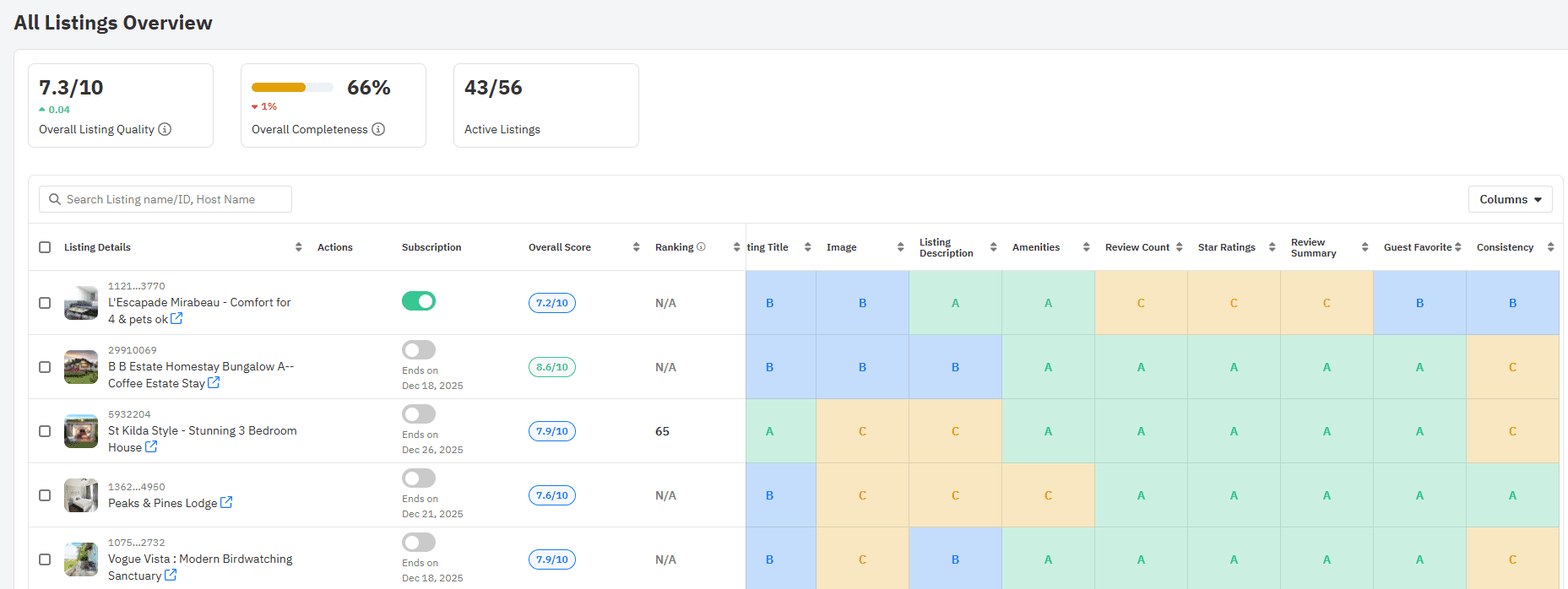
2. Solving the “Scaling Gap” for Guest Favorites
A significant challenge for professional short-term rental management is the “Scaling Gap.” While the U.S. accounts for 37% of Airbnb’s “Guest Favorites,” large portfolio managers (100+ listings) only represent 10% of that share.
Content Auditing at Scale
To bridge this gap, managers are turning to an Airbnb listing audit tool like the PriceLabs Listing Optimizer. To meet Airbnb Guest Favorite requirements in 2026, professional managers should focus on:
- Unique Selling Points (USPs): Tailoring descriptions for “pet owners” or “remote workers.”
- Competitive Benchmarking: Comparing listing scores against hyperlocal top performers.
- Visibility Detection: Prioritizing “C” grade listings for immediate intervention.
Default Title
Maintaining bespoke quality at 10+ listings is impossible manually. Automate your quality control with AI-driven content audits, sentiment analysis, and hyperlocal benchmarking.
Start Optimizing Now3. Navigating the Compressed Booking Window
Short-term rental booking window trends in 2026 show a significant divergence based on destination type. While the national average shrank to 29 days, your strategy must be hyperlocal.
- Urban Compression: In cities like Chicago, the window is shrinking, requiring aggressive last-minute pricing strategies.
- Destination Extension: Markets like Orlando and San Diego are seeing windows extend as families plan “bucket list” trips further out.
The Strategy: High-quality, 5-star properties maintain the pricing power to secure early bookings. Lower-tier units should expect later fills and adjust last-minute discounting accordingly.
4. Capturing Early Demand for 2026 Global Events
One of the most actionable insights for this year is the acceleration of event-based demand. Travelers are booking major events much earlier than in previous cycles.
2026 Event Benchmarks:
- Milan 2026 Olympics rental demand: Market is already 21% booked (vs. 3% last year).
- Super Bowl 2026 short-term rental demand (Santa Clara): 16% of the market is reserved before teams are even announced.
- Mexico City World Cup 2026 accommodation trends: Currently 10% booked, up from 1% last year.
Professional short-term rental management requires automated demand detection to raise rates and implement stay protections before “early bird” inventory is snatched up at standard rates.
5. Moving Toward Dynamic Minimum Stays
The traditional “3-night minimum for summer” is dead. The debate of dynamic minimum stay vs. static rules has been settled by the data: fluidity wins.
The Logic of Dynamic Restrictions:
- Orphan Night Filling: Automatically lowering minimums to fill orphan gaps between bookings.
- Adaptive Occupancy: Stepping down requirements if a listing has zero bookings over 15 or 45 days.
- Event Protection: Keeping 4-night minimums for peak months like July, but reducing to 2 nights as the date approaches if no major event is detected.
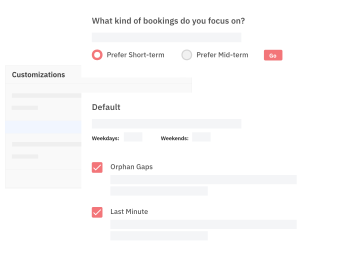
You can use tools like PriceLabs, which offers minimum stay restriction customization, allowing you to set minimum stay rules that will be automatically applied to your booking. You can use the MinStay Recommendation Engine to automate these layers or build a Custom Minimum Stay Profile that perfectly balances your operational capacity with real-time market demand. By setting a minimum stay restrictions, you maintain total control while the algorithm does the heavy lifting of filling your gaps.

6. Forward-Looking Tools: Search-Based Insights
As we progress through 2026, the focus shifts toward “top-of-funnel” data. By analyzing search data, managers can see whether travelers are searching for dates but not converting. This allows you to identify whether your RevPAR vs. ADR balance is off before you actually lose the booking.
Conclusion: Precision at Scale
The theme for 2026 is precision. As the gap between 5-star and 4-star revenue widens, automation is no longer optional—it is the engine of growth. By moving from static rules to dynamic strategies, you ensure your portfolio remains a “Guest Favorite” while maximizing the bottom line.
Frequently Asked Questions
How does a listing optimizer help SEO?
It ensures you hit “rankable” factors for OTA algorithms, such as proper tagging and competitive review counts, increasing your conversion rates.
Can I see exactly what a guest pays on a competitor’s listing?
Yes. Use a Competitor Map to toggle “Guest Prices” to see the “all-in” price, including cleaning fees, to ensure your total checkout price is competitive.
Do I need to manually track 2026 events?
No. Sophisticated revenue management tools use automated signals to identify these events early and adjust your rates automatically.