


Whether you have a spare bedroom, a vacation cabin, or a growing portfolio of properties, becoming an Airbnb host can unlock a powerful income stream. But success in the short-term rental (STR) market isn’t accidental — it’s engineered through strategy, data, and exceptional guest experiences.
This comprehensive guide walks you through everything you need to know: from legally listing your first property to scaling a profitable vacation rental business using dynamic pricing and revenue management best practices.
What is Airbnb Hosting?
Airbnb hosting means renting out a property — or a room within one — to short-term guests via the Airbnb platform. Hosts set their own pricing, availability, and house rules while Airbnb facilitates bookings, payments, and guest communication.
The Airbnb business model is built on peer-to-peer hospitality. Unlike traditional hotels, hosts compete on uniqueness, location, price, and personalisation. This creates an enormous opportunity for hosts who understand the data behind successful listings.
Airbnb operates in over 220 countries with more than 7 million active listings globally. For hosts, the platform offers built-in demand, a global audience, and host protection features — but it also means fierce competition in saturated markets.
Why Start an Airbnb Business in 2026?
The short-term rental market has matured significantly, but it remains one of the most accessible real estate income plays. Here’s why 2026 is still a compelling time to enter:
- Post-pandemic travel rebound: Global travel demand continues to outpace pre-2020 levels, particularly for unique stays and non-urban destinations.
- Rising long-stay demand: Remote work trends have created a booming market for 14–30 day bookings, improving occupancy rates and reducing turnover costs.
- Technology democratisation: Airbnb automation tools and dynamic pricing software have made revenue management accessible even to solo hosts.
- Diversified income: In high-inflation environments, a well-managed STR can outperform both traditional rentals and conventional investments.
Before diving in, it’s worth reading the full pros and cons of Airbnb hosting to set realistic expectations.
Dynamically Price Your Property and Get FREE Custom Reports Tailored To Your Property!
Use PriceLabs Dynamic Pricing to competitively and dynamically price your property according to demand shifts and analyze past performance to set a strong pricing strategy for your property.
Create your Account NowIs Airbnb Hosting Profitable? (Data-Driven Insights)
The honest answer: it depends on your market, property type, and how well you manage pricing and operations. But the numbers are promising for well-run properties.
Here are realistic benchmarks based on current STR market data:
| Market Type | Avg ADR | Occupancy Rate | Annual Revenue (est.) |
| Urban apartment (1BR) | $120–$160/night | 68–75% | $29,000–$43,000 |
| Beach/vacation home (3BR) | $250–$400/night | 55–70% | $50,000–$100,000 |
| Rural cabin/unique stay | $150–$250/night | 60–72% | $33,000–$65,000 |
| City-centre studio | $90–$130/night | 72–80% | $23,000–$37,000 |
ADR (Average Daily Rate) and occupancy rate are your two core KPIs. A host earning $150 ADR at 65% occupancy generates roughly $35,500 in gross revenue annually — before expenses.
Weighing your options? This Airbnb vs. traditional renting comparison breaks down profitability across different scenarios.
Step-by-Step Guide to Becoming an Airbnb Host
Follow these six steps to launch your Airbnb listing the right way — from market validation to delivering a five-star guest experience.
Step 1: Research Your Market
Before buying furniture or drafting your listing, understand your local STR market. Blindly launching a listing is the #1 mistake new hosts make.

Key questions to answer:
- What is the average ADR in your area for comparable properties?
- What is the typical occupancy rate by season?
- Who are your top competitors, and what makes them stand out?
- What amenities are guests filtering for (pool, pet-friendly, parking, workspace)?
- What are the peak and shoulder seasons in your market?
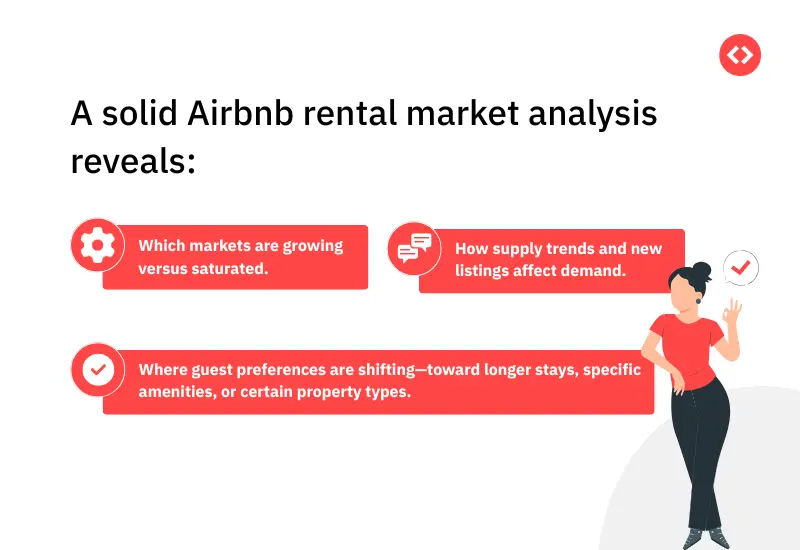
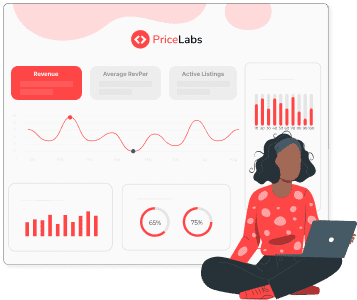
Tools for market research: Airbnb’s own search (incognito mode), AirDNA, Mashvisor, or PriceLabs’ Market Dashboard give you granular data on demand, pricing trends, and competitor performance.

Step 2: Understand Local Regulations & Legal Requirements
STR regulations vary dramatically — from city to city and even neighbourhood to neighbourhood. Ignoring this step can result in fines, forced delisting, or legal liability.
What to research before listing:
- Local zoning laws: Is short-term renting permitted in your zone? Some residential areas restrict it entirely.
- Permits & licences: Many cities require a STR permit, business licence, or both.
- HOA rules: If you own a condo or townhome, your HOA may prohibit STRs regardless of local law.
- Tax obligations: Most jurisdictions require hosts to collect and remit occupancy or transient lodging taxes.
- Insurance: Airbnb’s AirCover provides some protection, but a dedicated STR insurance policy is strongly recommended.
Tax compliance is one of the most overlooked areas for new hosts. Review this guide on tax tips for short-term rentals to avoid costly surprises.
Also stay current with policy changes — the One Big Beautiful Bill’s impact on short-term rentals is a recent example of how legislative shifts can affect hosts.
Step 3: Prepare Your Property
Your property is your product. Guest experience begins before they even arrive — with the photos and listing description that set expectations.
Essential preparation checklist:
- Deep clean every room, including inside appliances and behind furniture
- Fix all maintenance issues (leaky taps, broken fixtures, dead lightbulbs)
- Install a smart lock or key lockbox for self-check-in
- Provide fast, reliable Wi-Fi (test and display the speed in your listing)
- Stock essentials: toilet paper (minimum 2 rolls per bathroom), toiletries, coffee, tea
- Add thoughtful touches: local guide book, extra blankets, phone chargers
- Stage the space for photography — declutter, add plants, ensure good lighting
- Install smoke detectors, CO alarms, and a fire extinguisher (required in most markets)
Step 4: Create a High-Converting Listing
A great property with a weak listing is a guaranteed underperformer. Your listing is your marketing — treat it like one.

Listing optimisation checklist:
- Write a headline that includes your top 2-3 selling points (e.g., ‘Beachfront Studio | Fast Wi-Fi | Self Check-In’)
- Use all 50 photos — exterior, every room, amenities, neighbourhood highlights
- Hire a professional photographer or use natural light with a wide-angle lens
- Write a detailed description that answers the most common guest questions upfront
- Complete every single field in the listing (Airbnb rewards completeness with search visibility)
- Set accurate, generous house rules — clear rules reduce disputes
- Enable Instant Book to increase booking conversion rates by 20–30%
Want to reach Superhost status quickly? Here’s a roadmap to becoming an Airbnb Superhost — a badge that can boost your occupancy by 15–25%.
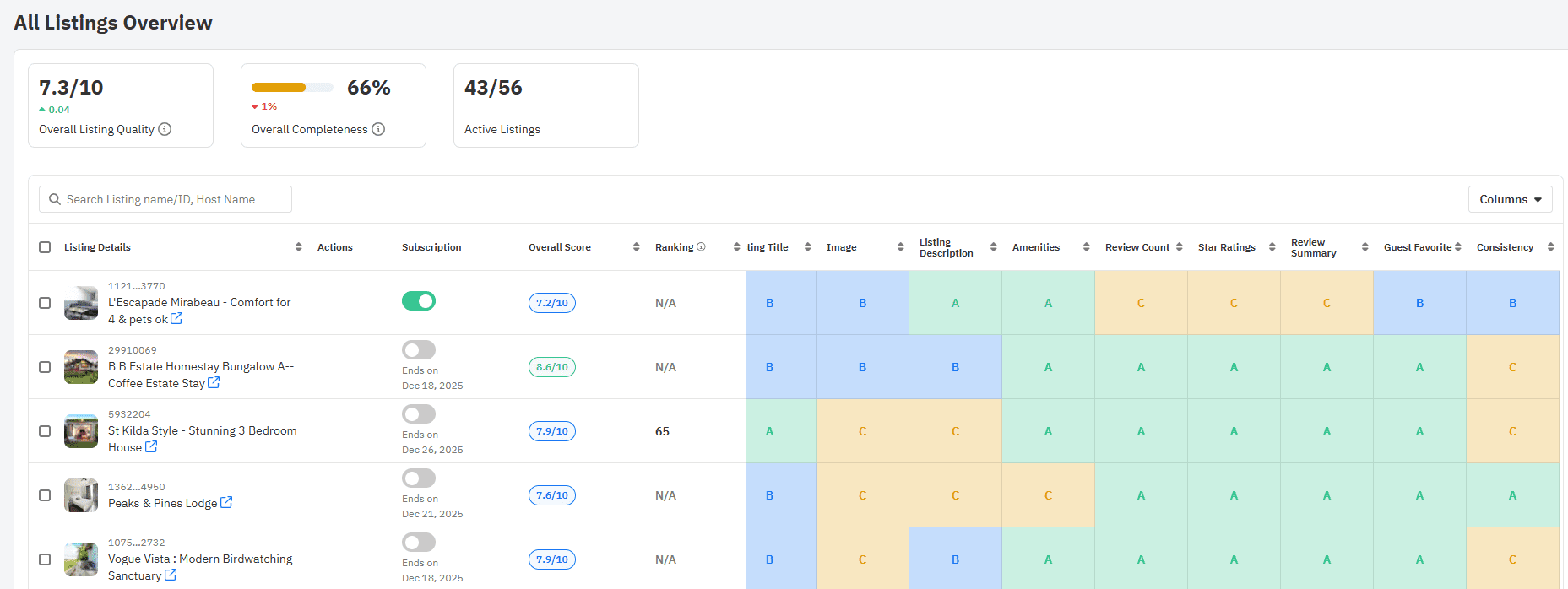
With PriceLabs Listing Optimizer You Can Analyze The Quality Of Your Competitor's Listings.
With PriceLabs Listing Optimizer, you will be able to compare your listing with other listings guests would consider your competition and optimize your listing accordingly.
Create your Account NowStep 5: Set the Right Pricing Strategy
Pricing is the single biggest lever in your STR business. Most new hosts either underprice (leaving money on the table) or overprice (losing bookings to competitors).
Your baseline pricing framework:
- Set a competitive base price: Research 10–15 comparable listings in your area. Price within 5–10% of the median for your first 10 bookings to build reviews.
- Apply seasonal adjustments: Identify your market’s peak, shoulder, and low seasons. Increase rates by 30–50% during peak periods.
- Use gap-filling discounts: Offer 10–15% discounts on 1–2 night gaps between existing bookings to maximise occupancy.
- Implement last-minute pricing: Reduce rates for dates within 3–7 days if they remain unbooked.
- Enable length-of-stay discounts: Weekly (10–15%) and monthly (20–35%) discounts attract longer stays, reducing turnover costs.
Step 6: Optimise Guest Experience
In the STR world, your review score is your most valuable asset. A 4.8+ rating unlocks better search placement, more bookings, and eventually Superhost status.
Five-star experience essentials:
- Send a pre-arrival message 24–48 hours before check-in with all access information
- Provide a clear, simple house manual (digital or physical)
- Respond to all messages within 1 hour (this directly impacts your response rate metric)
- Leave a small welcome touch: a handwritten note, local snacks, or a bottle of wine
- Conduct post-stay outreach: thank guests, invite them to leave a review
- Respond to every review — positive and negative — professionally and promptly
For more guest-experience frameworks, explore these 9 essential guest-communication templates designed for STR hosts.
Airbnb Hosting Costs Breakdown
Understanding your cost structure is fundamental to evaluating profitability.
Here’s a realistic breakdown of what it costs to run an Airbnb:
| Cost Category | Estimated Range | Notes |
| Furnishing & setup (one-time) | $3,000–$15,000+ | Varies hugely by property size and quality tier |
| Airbnb host service fee | ~3% per booking | Applied to the booking subtotal |
| Cleaning fees (per turnover) | $50–$200+ | Depends on property size; often passed to guest |
| Property management (if outsourced) | 15–30% of revenue | Full-service PMs typically charge 20–25% |
| Supplies & toiletries (monthly) | $50–$200 | Higher for larger properties with more turnovers |
| Insurance (STR-specific) | $1,000–$3,000/yr | Above and beyond Airbnb AirCover |
| Pricing/automation software | $20–$100/month | Dynamic pricing tools, PMS, messaging automation |
| Utilities (if host-paid) | $100–$400/month | Electricity, internet, water |
| Taxes (local occupancy tax) | 3–15% of revenue | Varies by jurisdiction; check local rules |
A rough rule of thumb: operating expenses typically consume 35–55% of gross revenue. Build your financial model before you commit to a property.
Be aware that Airbnb’s service fee structure has evolved. Review the latest Airbnb service fee changes to ensure your pricing accounts for current rates.
Dynamically Price Your Property and Get FREE Custom Reports Tailored To Your Property!
Use PriceLabs Dynamic Pricing to competitively and dynamically price your property according to demand shifts and analyze past performance to set a strong pricing strategy for your property.
Create your Account NowAirbnb Pricing & Revenue Management Strategies
Experienced hosts and revenue managers treat pricing as an ongoing discipline, not a set-it-and-forget-it task.
The PriceLabs Revenue Management Framework

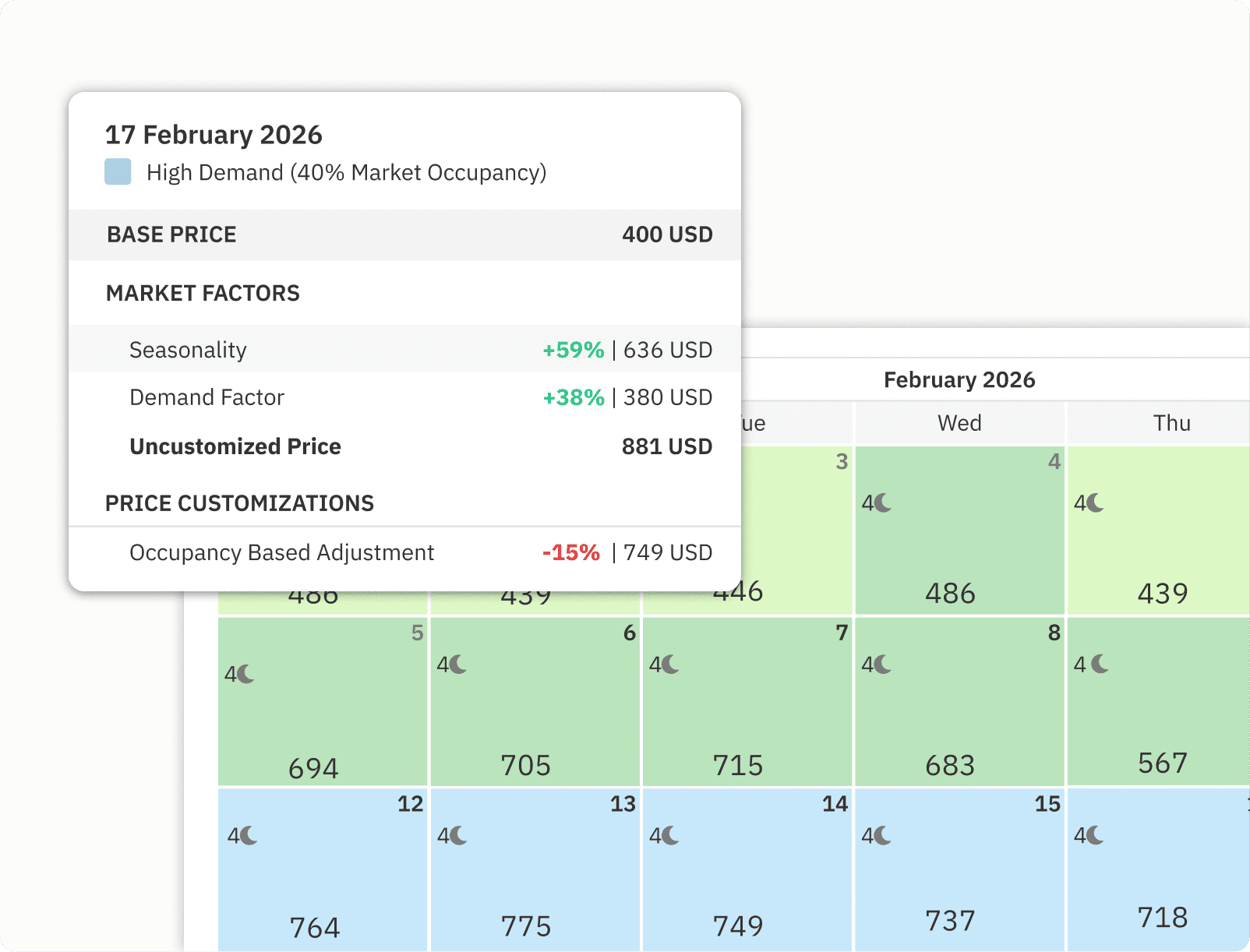
- Anchor your base price: Set a minimum rate that covers all costs and delivers acceptable returns. Never drop below this floor, even in low-demand periods.
- Map your demand calendar: Identify confirmed high-demand dates (local events, holidays, school breaks) 6–12 months in advance and raise rates proactively.
- Monitor your pick-up pace: Compare bookings-on-the-books for future dates against your historical baseline. Slow pick-up = lower prices. Fast pick-up = raise rates.
- React to market signals: Use dynamic pricing software to automatically adjust rates when local competitor availability drops (indicating high demand).
- Review weekly: Spend 30 minutes per week reviewing the next 90 days of pricing. Look for gaps, underpriced peak nights, and over-discounted slow periods.
Also consider your cancellation policy as a pricing lever. A flexible cancellation policy can increase bookings by 20–30% but also increases late cancellations. A strict policy protects revenue but may reduce conversion.
Review the complete guide to vacation rental cancellation policies to find the right balance for your market.
Tools Every Airbnb Host Should Use
The right technology stack can save you 10–15 hours per week and meaningfully improve both guest experience and revenue.
| Category | Example Tools | What It Does |
| Dynamic Pricing | PriceLabs, Beyond, Wheelhouse | Automates nightly rate adjustments based on demand, events, and competitor data |
| Property Management System (PMS) | Hostfully, Guesty, Lodgify | Centralises calendar, bookings, and guest communication across platforms |
| Guest Communication | Hospitable, Smartbnb | Automates check-in messages, review requests, and FAQs |
| Smart Locks | August, Schlage, Yale | Enables remote self-check-in with unique codes per guest |
| Market Research | AirDNA, PriceLabs Market Dashboard | Provides competitor data, ADR benchmarks, and demand forecasting |
| Accounting & Tax | Quickbooks, Stessa, Baselane | Tracks income, expenses, and simplifies tax preparation |
| Cleaning Management | Turno (formerly TurnoverBnB) | Automates cleaner scheduling and property inspections |
Dynamically Price Your Property and Get FREE Custom Reports Tailored To Your Property!
Use PriceLabs Dynamic Pricing to competitively and dynamically price your property according to demand shifts and analyze past performance to set a strong pricing strategy for your property.
Create your Account NowCommon Mistakes New Hosts Make (and How to Avoid Them)
Learning from others’ mistakes is the fastest path to profitability. These are the errors that consistently hold new hosts back:
- Using static pricing year-round: Charging the same rate in August as January in a beach market destroys revenue potential. Implement dynamic pricing from day one.
- Underpricing to get reviews: While a competitive launch price makes sense, many hosts never raise rates after the first reviews. Schedule a pricing review after your first 10 bookings.
- Neglecting the listing’s photos: Bad photos are the silent killer of conversion rates. Professional photography typically pays for itself within 1–2 bookings.
- Skipping a detailed house manual: The more information you provide upfront, the fewer messages you’ll receive — and the better your reviews will be.
- Ignoring local regulations: Launching without a permit may work short-term but creates existential risk. Do the legal homework first.
- Over-relying on a single platform: Hosting exclusively on Airbnb exposes you to policy changes, algorithm shifts, and account suspension risk. Consider listing on Vrbo and direct booking channels as you scale.
- Poor cancellation policy selection: Setting cancellation terms without understanding their impact on booking conversion and revenue protection is a costly error.
- How to Scale from Host to Property Manager
Many successful Airbnb hosts eventually evolve into property managers — managing multiple properties, either their own or on behalf of other owners. Here’s a framework for scaling intelligently.
Phase 1: Optimise Your First Property (0–12 months)
- Achieve Superhost status (4.8+ rating, 90%+ response rate, 10+ reviews)
- Build operational systems: cleaning schedule, maintenance protocols, guest communication templates
- Reach a stable 65%+ occupancy and track all revenue and expenses meticulously
Phase 2: Add Properties Strategically (12–36 months)
- Identify your highest-performing property type and market — replicate it
- Systemise operations with a PMS and automated guest messaging
- Hire and train a reliable cleaning team before you need them
- Evaluate co-hosting arrangements to manage owner properties without capital outlay
Phase 3: Build a Property Management Business (36+ months)
- Formalise as a business entity (LLC or equivalent) with dedicated business banking
- Develop a property owner proposition — what do you offer that DIY hosts can’t?
- Implement a revenue management strategy across your portfolio for maximum ADR and occupancy
- Explore direct booking websites to reduce platform dependency and commission costs
Dynamically Price Your Property and Get FREE Custom Reports Tailored To Your Property!
Use PriceLabs Dynamic Pricing to competitively and dynamically price your property according to demand shifts and analyze past performance to set a strong pricing strategy for your property.
Create your Account NowFrequently Asked Questions (FAQs)
How much does it cost to start an Airbnb business?
Startup costs vary widely. At a minimum, expect $3,000–$5,000 for furnishing a small property already owned, plus ongoing costs for supplies, insurance, and software. If purchasing a property specifically for STR, factor in a 10–20% premium for STR-ready furnishing over standard rental setup.
Do I need permission from my mortgage lender or landlord to host on Airbnb?
Yes. If you have a mortgage, check your loan agreement — some lenders prohibit short-term renting without prior approval. If you’re a renter, you need explicit written permission from your landlord. Subletting without permission can void your lease.
What is a good occupancy rate for an Airbnb?
A 60–70% occupancy rate is generally considered healthy for most markets. Urban properties with lower ADRs often target 70–80%+ occupancy, while luxury or unique properties may operate profitably at 50–60% due to higher nightly rates. The right number depends on your ADR and cost structure.
How does Airbnb pricing strategy work?
Airbnb’s algorithm (Smart Pricing) adjusts rates based on demand signals, but most experienced hosts use third-party dynamic pricing tools like PriceLabs for more granular control. An effective strategy combines a competitive base rate, seasonal adjustments, event-driven pricing, and length-of-stay discounts to maximise both ADR and occupancy.
What are the biggest risks of becoming an Airbnb host?
The primary risks are: regulatory changes (cities increasingly restricting STRs), property damage from guests, income variability (demand seasonality), platform dependency, and rising operational costs. Mitigate these through STR-specific insurance, a diversified booking channel strategy, and building an emergency fund equal to 2–3 months of operating costs.
How long does it take to become profitable on Airbnb?
Most new hosts break even or turn a profit within 3–6 months, assuming a well-priced, well-reviewed listing. The first 1–3 months are typically slower as you build reviews and listing visibility. Properties launched with professional photos, competitive pricing, and Instant Book enabled tend to reach profitability fastest.
What is the difference between an Airbnb host and a property manager?
An Airbnb host typically manages their own property. A property manager (PM) manages STR properties on behalf of multiple owners, earning a management fee (usually 15–30% of revenue). PMs handle everything from listing creation and pricing to guest communication and maintenance coordination.
Ready to Become a Successful Airbnb Host?
The opportunity in short-term rentals is real — but so is the competition. The hosts who win in 2026 and beyond are those who treat their listing as a business: investing in great guest experiences, staying on top of regulations, and using data-driven tools to optimise every aspect of their pricing and operations.
Whether you’re preparing your first listing or scaling to a multi-property portfolio, the fundamentals remain the same: know your market, price intelligently, and deliver exceptional guest experiences consistently.