



Revenue management and yield management are often used interchangeably in the hospitality industry, but they represent fundamentally different strategic approaches to pricing optimization. While yield management focuses on maximizing revenue per available room (RevPAR) through tactical pricing adjustments, revenue management encompasses a broader, holistic strategy that considers the entire guest experience and long-term profitability. For enterprise hosts managing multiple properties or large portfolios, understanding these distinctions is crucial for implementing the right pricing strategy that aligns with business objectives and market positioning.
What is Revenue Management?
Revenue management is a comprehensive strategic discipline that optimizes pricing and inventory allocation across multiple revenue streams to maximize total profitability. Unlike traditional pricing approaches, revenue management considers demand patterns, market segmentation, competitive positioning, and customer lifetime value to make informed decisions about when, how, and to whom to sell rooms.
At its core, revenue management integrates data analytics, market intelligence, and forecasting to predict demand fluctuations and adjust pricing strategies accordingly. This approach extends beyond room rates to encompass ancillary services or short-term rental upsells, packages, and the entire guest experience ecosystem.
Modern revenue management systems, such as PriceLabs, leverage machine learning algorithms and real-time market data to automate pricing decisions while maintaining strategic oversight. For enterprise hosts, this means having centralized control over pricing strategies across multiple properties while allowing for local market customization.
What is Yield Management?
Yield management is a tactical pricing strategy focused on maximizing revenue from a fixed inventory by selling the right product to the right customer at the right time and price. Originally developed by the airline industry, yield management in hospitality specifically targets RevPAR optimization through dynamic pricing adjustments based on demand forecasting.
The fundamental principle of yield management revolves around the perishable nature of hotel inventory—unsold rooms cannot be stored for future sale. This creates urgency around optimizing occupancy rates and average daily rates (ADR) to achieve maximum revenue per available room.
Yield management typically employs historical booking patterns, advance booking curves, and demand segmentation to determine optimal pricing strategies. The approach focuses on short-term revenue maximization, often adjusting rates multiple times per day based on booking pace and remaining inventory.
Key Differences Between Revenue Management and Yield Management
Scope and Strategic Focus
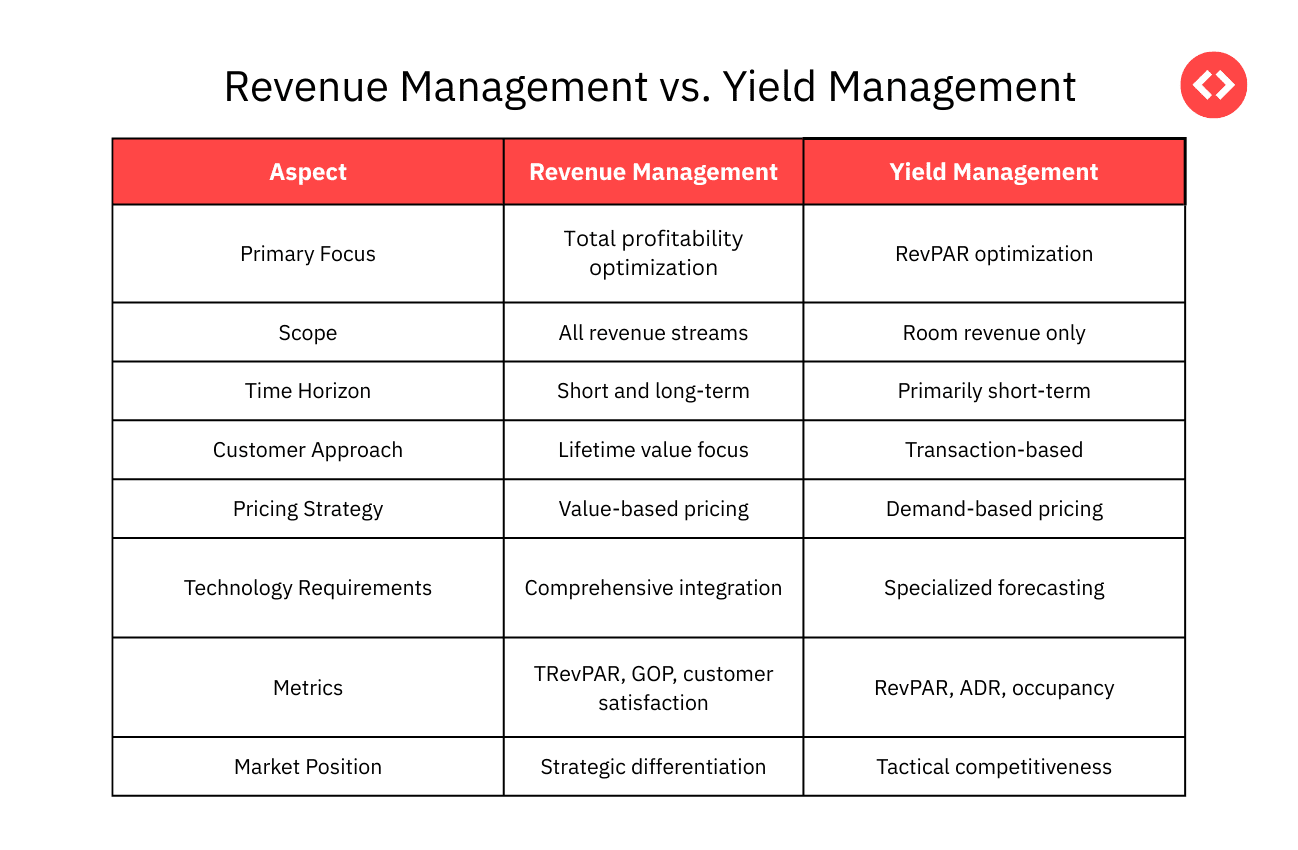
Revenue management takes a holistic approach to profitability, considering total revenue optimization across all property touchpoints. This includes room revenue, food and beverage, spa services, meeting spaces, and ancillary offerings. The strategy emphasizes long-term guest relationships and lifetime value over short-term revenue spikes.
Yield management maintains a narrower focus on room revenue optimization, primarily concerned with maximizing RevPAR through tactical rate adjustments. While effective for immediate revenue gains, this approach may not account for broader profitability implications or guest satisfaction.
Time Horizon and Planning
Revenue management operates with both short-term and long-term perspectives, incorporating seasonal trends, market cycles, and strategic business objectives into pricing decisions. This approach enables proactive planning and sustainable growth strategies that align with the overall business goals.
Yield management typically focuses on immediate to near-term revenue optimization, responding to current market conditions and booking patterns. While this provides agility in competitive markets, it may lack the strategic depth needed for long-term success.
Technology and Data Integration
Revenue management systems integrate multiple data sources, including competitive intelligence, market demand indicators, customer segmentation data, and operational metrics. These platforms provide comprehensive dashboards that enable strategic decision-making across multiple properties and revenue streams.
Yield management tools primarily focus on booking data, historical performance, and demand forecasting specific to room inventory. While sophisticated in their analytical capabilities, these systems may not provide the comprehensive market view needed for strategic revenue optimization.

Benefits of Revenue Management for Enterprise Hosts
Comprehensive Profitability Optimization
Revenue management enables enterprise hosts to optimize profitability across their entire portfolio by simultaneously considering all revenue streams. According to industry research, properties implementing comprehensive revenue management strategies see average revenue increases of 15-20% compared to those using traditional pricing methods. Market reports of Mexico and Poland also points to the fact that properties using dynamic pricing earn significantly more revenue as compared to those using static pricing strategies.
This holistic approach enables cross-selling opportunities and package optimization, significantly increasing guest spending beyond room rates. Enterprise hosts can leverage economies of scale to implement sophisticated revenue management systems, like those offered by PriceLabs Dynamic Pricing Software, across multiple properties while maintaining local market sensitivity.


Enhanced Guest Experience and Loyalty
By focusing on value-based pricing rather than purely demand-driven rates, revenue management strategies can improve guest satisfaction and loyalty. Properties that implement guest-centric revenue management report 25% higher customer retention rates and increased positive review scores.
Revenue management’s emphasis on long-term relationships enables enterprise hosts to develop sophisticated loyalty programs and personalized pricing strategies that reward repeat guests while maintaining profitability.
Strategic Market Positioning
Revenue management provides enterprise hosts with the tools to position their properties strategically within their competitive set. Rather than simply reacting to competitor pricing, revenue management enables proactive market positioning that differentiates properties based on value proposition and guest experience.
Move Beyond Yield. Master Portfolio Profitability.
Don't limit your enterprise to tactical yield management. Our AI-driven platform delivers the strategic depth of holistic Revenue Management, optimizing rates and total profitability across your entire portfolio.
Start Free TrialBenefits of Yield Management for Enterprise Hosts
Rapid Revenue Optimization
Yield management excels in environments requiring quick responses to market changes and demand fluctuations. Properties implementing dynamic yield management strategies can capture revenue opportunities during high-demand periods while maintaining competitive positioning during slower periods.
For enterprise hosts operating in volatile markets or seasonal destinations, yield management provides the agility needed to maximize revenue from available inventory quickly and efficiently.
Simplified Implementation and Management
Yield management systems are typically easier to implement and require less complex integration than comprehensive revenue management platforms. This makes yield management an attractive option for enterprise hosts seeking immediate revenue improvements without extensive system overhauls.
The focused nature of yield management also simplifies staff training and operational procedures, enabling faster adoption across multiple properties within an enterprise portfolio.
Cost-Effective Revenue Enhancement
Yield management can provide significant revenue improvements with relatively modest technology investments. Properties that implement basic yield management strategies often see higher RevPAR within the first year.
When to Use Revenue Management vs Yield Management
Revenue Management is Optimal When:
Enterprise hosts should prioritize revenue management strategies when operating in mature markets with established customer bases and multiple revenue streams. Properties with significant food and beverage operations, meeting facilities, or spa services benefit most from comprehensive revenue management approaches.
Revenue management is also ideal for enterprise hosts focused on brand building and long-term market positioning. Luxury properties and brands seeking to differentiate based on service quality and guest experience should implement revenue management strategies that support these objectives.
Yield Management is Preferable When:
Yield management strategies work best for enterprise hosts operating primarily room-focused properties in highly competitive markets. Limited-service hotels, extended-stay properties, and vacation rentals often benefit more from yield management’s focused approach to room revenue optimization.
Properties in emerging markets or those undergoing rapid expansion may find yield management’s simplicity and quick implementation timeline advantageous for establishing market presence and generating immediate revenue improvements.
Implementing the Right Strategy for Your Enterprise
Assessment and Strategy Selection
Enterprise hosts should begin by conducting comprehensive assessments of their property portfolios, market positions, and business objectives. Properties with diverse revenue streams and established market presence typically benefit from revenue management strategies, while newer or simpler properties may find yield management more appropriate.
Consider factors such as the competitive landscape, customer segmentation, operational complexity, and technology infrastructure when selecting between revenue management and yield management approaches.
Technology Infrastructure and Integration
Successful implementation requires a robust technology infrastructure capable of supporting chosen strategies. Revenue management implementations require comprehensive integration with property management systems, whereas yield management may operate with more limited system requirements.
Enterprise hosts should evaluate existing technology capabilities and determine necessary upgrades or integrations before implementing either strategy. Cloud-based solutions often provide the scalability and flexibility needed for enterprise-level implementations.
Staff Training and Change Management
Both revenue management and yield management require specialized skills and ongoing training. Revenue management implementations typically require more comprehensive training programs due to their broader scope and strategic complexity.
Develop training programs that address both technical system usage and strategic decision-making processes. Regular training updates ensure staff remain current with evolving market conditions and system capabilities.
Conclusion
The choice between revenue management and yield management depends on your enterprise’s specific objectives, market position, and operational complexity. Revenue management offers comprehensive profitability optimization, ideal for established properties with diverse revenue streams, while yield management provides focused room revenue optimization, suitable for competitive markets that require rapid response capabilities.
Successful enterprise hosts often implement hybrid approaches that leverage yield management tactics within broader revenue management strategies. This combination provides both tactical agility and strategic depth necessary for sustainable long-term success.
Regardless of the chosen approach, consistent implementation, ongoing optimization, and regular strategy assessment ensure maximum effectiveness. As markets evolve and technology advances, enterprise hosts must remain flexible and ready to adapt their revenue optimization strategies to maintain competitive advantage and profitability.