



In the fast-paced world of short-term rentals (STRs), managing a handful of listings with manual price tweaks is one thing—managing a scaling portfolio is another. To truly scale, property managers must shift from listing-level guesswork to short-term rental market insights for portfolio management.
As we navigate the selective travel landscape of 2026, guests are prioritizing trust, ease, and value. This guide will show you how to use vacation rental seasonality strategies and data-driven methods to identify underperforming rental listings, maintain a competitive edge, and achieve optimized RevPAR.
Understanding Portfolio-Level Seasonality in 2026
Portfolio-level seasonality is the practice of analyzing demand and performance metrics across your entire inventory rather than in isolation. While an individual beach house peaks in summer, urban properties often see stable base rates year-round with sharp spikes during business conferences or fashion events.
Analyzing these patterns at scale is critical for:
- Scalable Pricing: Applying data-driven pricing logic across dozens of units to avoid being priced out of the market.
- Owner Trust: Providing high-level context that reassures owners during “dip” months by showing market-wide trends.
- Operational Excellence: Scheduling cleaning crews and maintenance during predicted occupancy troughs to protect margins.
Ready to start mastering your portfolio’s potential?
Don’t let seasonal shifts catch you off guard. Leverage the industry’s most powerful short-term rental market insights for portfolio management to outpace your competition and optimize your revenue year-round.
Start Your free trialAnalyzing Market Insights to Spot Underperforming Listings
One of the greatest benefits of portfolio-level analysis is identifying underperforming rental listings before they drain your profitability.
Key Performance Indicators (KPIs) to Watch:
- Occupancy vs. Market: If a listing’s occupancy is consistently below the neighborhood average, it likely has a visibility or pricing issue.
- ADR (Average Daily Rate): High nightly rates are great, but if they lead to empty calendars during the low season, your overall revenue suffers.
- RevPAR (Revenue per Available Room): This is the “gold standard” metric—it combines occupancy and rate to show the true earning power of every available night.
Data Insight: Monitor your booking window (the time between reservation and check-in). A longer window than the market average may indicate that your prices are too low, while a window that is too short suggests you are pricing yourself out of early-bird demand.
Leveraging Data for Vacation Rental Seasonality Strategies
Static pricing is no longer effective in the “sharpening” market of 2026. Success now hinges on the ability to react in real-time to market shifts.
1. Define Seasons with Data, Not Intuition
Don’t guess when your “low season” starts. Analyze at least 24–36 months of historical occupancy to document your true peaks and troughs.
- Peak Season: Typically June–August and November–February in many markets.
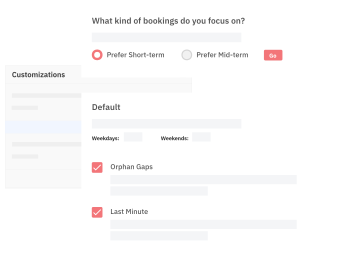
- Shoulder/Low Season: Requires aggressive revenue management, such as reducing minimum stay restrictions to attract weekend travelers.

2. Implement Dynamic Pricing for Short-Term Rentals
Dynamic pricing for short-term rentals lets you adjust rates in real time based on local competition, upcoming events, and supply shifts.
- Automation: Tools like PriceLabs Dynamic Pricing automatically adjust rates daily, keeping you competitive 24/7.
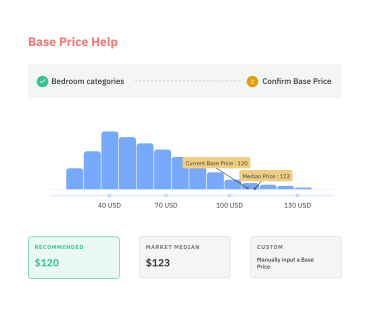
- Base Price Optimization: Use the PriceLabs Base Price Help Tool to find the ideal average rate for each listing based on its quality and neighborhood.

Data-Driven Decision Making: Operationalizing Your Portfolio Strategy
Executing a sophisticated seasonality strategy across a diverse portfolio manually is nearly impossible. To transition from reactive management to proactive revenue optimization, you need a centralized “command center” that bridges the gap between raw market data and your daily pricing decisions.
By integrating your portfolio with PriceLabs, you can automate the heavy lifting of data analysis while maintaining full strategic control over your revenue goals.
- Holistic Performance Benchmarking via Market Dashboards: Instead of guessing how the market is moving, use PriceLabs Market Dashboards to gain a consolidated view of essential vacation rental KPIs like estimated revenue, average RevPAR, and average occupancy. This allows you to compare your portfolio’s health with real-time market trends, helping you determine whether a dip in bookings is a property-specific issue or a broader market shift.
- Dynamic Lead-Time Adjustments with the MinStay Recommendation Engine: Static stay requirements often result in “orphan days” that hurt your occupancy. PriceLabs uses a MinStay Recommendation Engine to suggest Length of Stay (LOS) restrictions based on actual guest booking patterns in your specific submarket. This ensures your properties remain visible to the right guests at the right time, automatically relaxing requirements as the stay date approaches to fill remaining gaps.
- Automated Demand Sensing with the Events and Holidays Calendar: Manually tracking every local festival, school holiday, or major event (like the 2026 FIFA World Cup) across multiple regions is a significant operational burden. PriceLabs’ hyper-local algorithms automatically detect these demand surges, adjusting your rates and stay restrictions to capture the premium pricing these dates command without requiring manual research for every market.
- Base Price Optimization: Setting the right starting point helps your pricing algorithm to price your property more accurately. Use the PriceLabs Base Price Help Tool to determine the ideal foundational rate for each listing. By analyzing the quality of your units alongside neighborhood data, you ensure your seasonal adjustments are building on a mathematically sound baseline.
Bottom Line
Adaptability is the key to managing the slow season or an economic slowdown. By building a repeatable seasonality engine supported by short-term rental market insights, you eliminate pricing guesswork and stay ahead of the competition.
Frequently Asked Questions
1. Why am I getting fewer bookings on Airbnb?
Common reasons include inaccurate descriptions, poor-quality photos, high competition, or uncompetitive nightly rates. Use the PriceLabs Listing Optimizer to identify the specific gap in your listings.
2. How do I increase midweek bookings?
Consider launching weekday-specific deals, targeting business travelers, or reducing your minimum length of stay for midweek dates.
3. What is a good ROI for a short-term rental?
Generally, a healthy ROI sits between 8% and 10%. You can calculate yours using the formula: ROI = (Annual Rental Income – Annual Expenses) / Total STR Investment.
4. How do local events impact my portfolio?
Large events surge demand, allowing you to charge premium prices. Using the Events and Holidays Calendar ensures you set the right minimum stay restrictions to avoid leaving unbooked “orphan” gaps.