Get started with PriceLabs now!
Want to learn what PriceLabs can do for you? See for yourself with a free trial. Get started now!

You watched a stadium announcement drop on a Tuesday and spent the rest of the week second guessing your rates. Price too high and the calendar sits empty while competitors fill up. Price too low and you explain to an owner why their property earned less during the biggest weekend of the year. Event pricing vacation rentals is the part of the job where instinct and data disagree most often, and where owners notice the outcome fastest. One event week can swing a month of revenue estimates.
Events do not behave like holidays. They appear with little warning, they move demand into neighbourhoods you would not expect, and they sometimes fail to show up at all. This guide covers the booking patterns behind event demand, the mistakes that cost money most often, and a working process built on dynamic pricing rather than guesswork. Everything here is written for managers running 6 to 49 properties who need a repeatable method and a clear story for owners.
Event pricing vacation rentals means adjusting nightly rates and stay restrictions around dates when a concert, tournament, conference or festival pulls extra travellers into your market. It differs from holiday pricing because event demand is announced late, concentrated in specific dates, and unevenly distributed across a city. The right approach tracks live booking activity for those dates instead of applying a fixed premium. That is what makes data driven pricing the practical basis for dynamic pricing for local events.
That distinction matters more than it sounds. Holiday demand repeats on a schedule you can plan a year ahead, which is why annual planning works well for Christmas and school breaks. Event demand arrives on its own timetable and rewards managers who react within days rather than quarters.
Regular seasonality gives you history. You know roughly what last July looked like, so you can set a base price and let pricing automation handle the daily movement. Events strip that history away, because a first time festival has no comparable prior year to learn from.
Event demand also lands unevenly. A downtown arena show fills properties within walking distance long before it touches the suburbs. PriceLabs analysis of the Eras Tour and the Super Bowl showed how sharply demand clusters around venues and then spills outward as the closer inventory sells.
Then there is the failure case. Some events simply do not deliver the demand everyone expected, and a market that priced for a sellout ends up chasing bookings in the final fortnight. That is the core of vacation rental demand uncertainty, and it is why a fixed event premium is a risky default. Planning for vacation rental demand uncertainty means deciding your downside move before you need it. Managers who watch pacing reports through the window catch the shortfall while there is still time to correct.
Most lost revenue in event pricing vacation rentals traces back to the same three habits. None of them look like errors at the time, which is what makes them persistent. Reviewing them against your own property management KPIs after each event is the fastest way to break the pattern.
The announcement lands and rates triple overnight. Experienced event travellers have learned to wait, so early premiums often sit unsold while the market resets around you. Set a firm floor, move the ceiling gradually, and let competitor price tracking tell you when the market is genuinely absorbing higher rates.
Graduations, regional tournaments, trade shows and minor league playoffs rarely make the news, yet they sell out mid sized markets. These are the dates where a manager watching comp set occupancy beats one watching headlines.
Event demand moves through the booking window in stages, so a rate set at announcement is stale within a month. Weekly review is the minimum through an event window, and daily review is better for the dates carrying the most revenue. The same discipline that drives strategy adjustments in normal months applies with more urgency here.
The 2026 FIFA World Cup ran from 11 June to 19 July across sixteen host cities in the United States, Canada and Mexico, closing with the final at MetLife Stadium in New Jersey. It was the largest edition ever staged, with 48 teams and 104 matches, and it spread demand across a continent rather than concentrating it in one country.
For host market operators it was the broadest live test of event pricing vacation rentals in years, and a useful stress test of market entry timing. For managers in host markets, it was the clearest recent test of dynamic pricing for local events.
Two patterns are worth carrying forward. First, group stage dates and knockout dates behaved differently, because knockout fixtures were confirmed only days ahead and produced compressed, late booking surges. Second, host cities that were eliminated early saw demand fall away quickly, which rewarded managers who had kept their pricing responsive instead of locking in tournament length premiums. Dynamic pricing for local events handled that reversal far better than a fixed schedule, which is the case for channel diversification as well.
The same logic applies to what is coming. The Men's Rugby World Cup runs in Australia from 1 October to 13 November 2027, the FIFA Women's World Cup runs in Brazil from 24 June to 25 July 2027, and Los Angeles hosts the Olympics in 2028. PriceLabs data from the Paris Olympics remains the closest guide to how a host city calendar actually fills, and it is worth reading before you set anything for 2028.
Here is the practical event pricing vacation rentals sequence, using features that exist in the product today. It assumes you already have a base price you trust and a working pricing foundation underneath it.
PriceLabs maintains a database of events, holidays and high demand dates for your market, viewable from the Pricing Calendar and Multi Calendar. It shows covered dates alongside the average price set in the market, which gives you a reference point before you touch anything. The events and holidays table also lets you report an event that is missing so the team can review and add it.
The Hyper Local Pulse algorithm monitors booking and occupancy activity in your market and raises prices when it detects a surge, whether or not an event is recorded anywhere. A small town food festival that never reaches a listing site still moves your rates if it moves bookings. The data behind those signals comes from live market activity rather than published event calendars.
Overrides let you set fixed rates, floors or stay restrictions for named dates, and you can record the reason for each one. Use them for the handful of dates where you know something the market does not, and let the algorithm handle the rest. Reviewing your customization options once a quarter keeps this from turning into override sprawl.
A three night festival supports longer minimums, while a single match night needs short minimums so you can fill the shoulder nights around it. Getting this wrong is a common source of orphan gaps, which is a bigger problem across a portfolio than on a single listing. Multi unit setups need particular care here.
Compare pickup for your event dates against the same point in a normal month. If the dates are filling faster than the market, you have room above your current rate. Portfolio Analytics makes this readable across a whole portfolio rather than listing by listing.
Agree in advance what you will do if the dates are undersold at fourteen days out. Last minute pricing rules let you set that reduction as a policy rather than a panic decision.
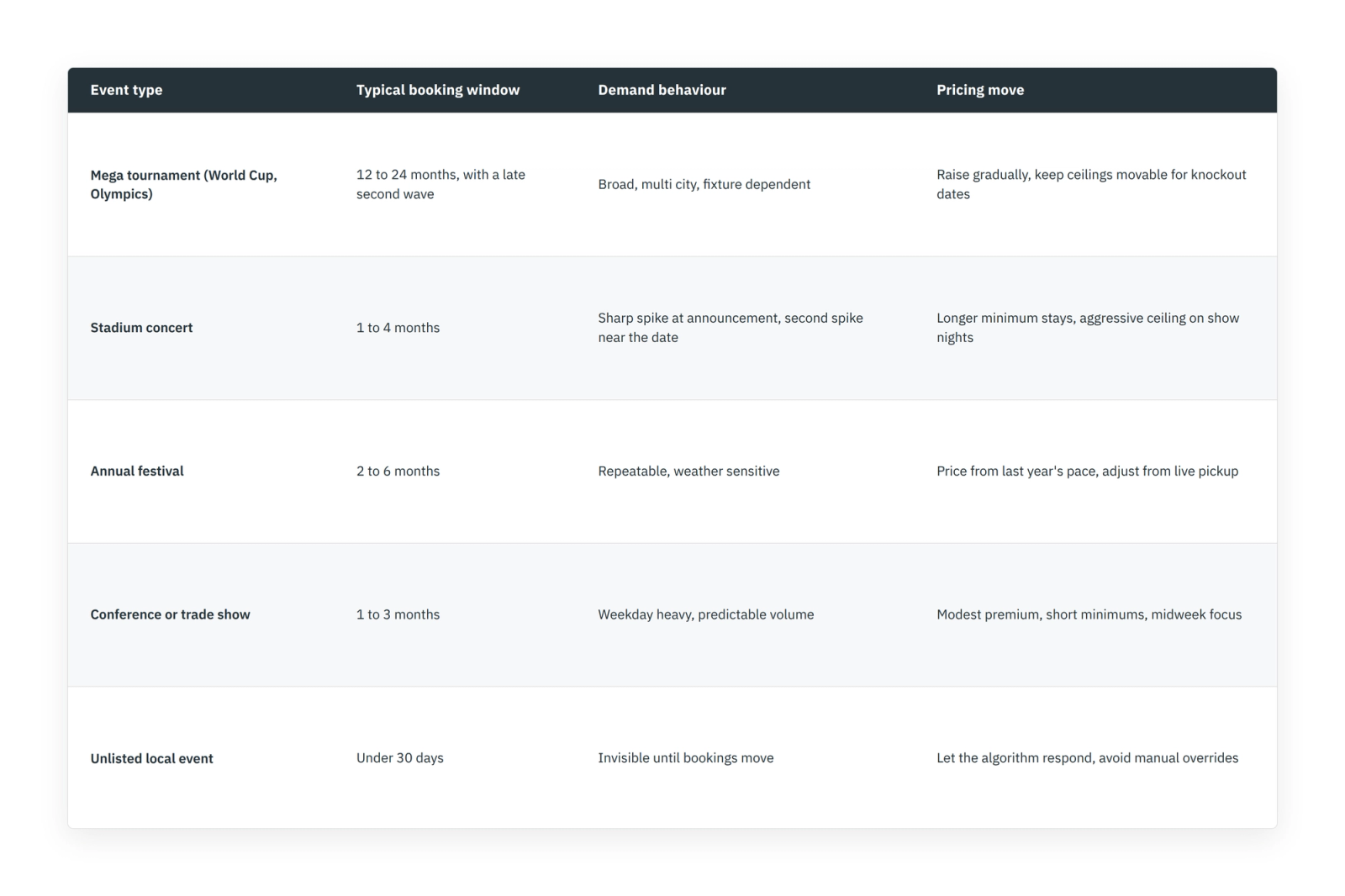
Different events produce different booking windows, and matching your pricing move to the pattern matters more than the size of the event. The table below summarises what to expect and what to do, from stadium concerts through to festival demand patterns. It is a starting frame, and your own market data should override it wherever the two disagree, which is exactly what report builder outputs are for.
An empty calendar at a high rate and a full calendar at a low rate are both failures, and event pricing vacation rentals makes the trade off sharper. The useful question is how much rate your market will absorb before pickup stalls. Tracking occupancy against ADR through the booking window answers it better than any rule of thumb.
Test rate sensitivity while you still have runway. Raise rates six to eight weeks out and watch pickup for the following fortnight. If pickup holds, you have more room, and if it stops, you have found the ceiling for those dates. This is real time price optimization in its simplest form, and managers who run the test build a feel for their market that no default setting replicates, and it feeds directly into revenue management decisions across the rest of the year.
Resist matching a race to the bottom. If competitors are cutting hard two weeks out and their occupancy is not moving, the cut is not working and copying it just lowers your ADR. Compare your position against the comp set rather than against the loudest competitor, and treat occupancy tactics as a last resort rather than a first response.
Four numbers tell you almost everything during an event window. Watching them weekly turns real time price optimization from an abstraction into a routine, and it is the habit that separates strong vacation rental event pricing strategies from guesswork. They also give you the vocabulary to explain decisions to owners, which matters as much as the decisions themselves when you are reporting to owners.
Booking lead time tells you how far ahead travellers are committing, and a shortening lead time on event dates signals a late surge rather than weak demand. Market occupancy shows what share of comparable listings is already sold, which is your best read on whether you are priced correctly. Both are visible through market dashboards at the market level rather than the listing level.
ADR against a normal period shows whether you are actually capturing an event premium or just feeling like you are. Competitor minimum stays reveal how the market is shaping supply, and a market moving to three night minimums is telling you something about expected demand. Feeding all four into your regular performance tracking means the post event review writes itself.
Festival demand patterns in particular reward this discipline, because weather and programming changes shift them year to year. Reading festival demand patterns against last year's pickup is the fastest way to price a repeat event. The 2024 solar eclipse is a useful reminder that a single day event can reshape an entire regional market, and PriceLabs eclipse data showed how quickly those windows opened and closed.
Start adjusting as soon as the event is confirmed, but move in steps rather than jumping to a peak rate. Most event demand builds through the final two months, so a rate set at announcement should be reviewed at least monthly and weekly inside thirty days. Watching booking pace against the market tells you which direction to move, and a stalling booking pace is the earliest warning you will get. Slow pickup signals are worth acting on immediately.
Reduce your minimum stay first, then your rate. Shorter stays widen the pool of travellers who can book you, and that often recovers occupancy without cutting ADR as far. Set the trigger point in advance so the decision is a policy rather than a reaction, and record it alongside your other pricing goals.
No. PriceLabs maintains its own events and holidays database for your market, and you can report a missing event through the Report Event button for the team to review. For dates you want to control directly, date specific overrides are the right tool. Managing this well matters most in larger portfolios.
Holiday demand repeats on a fixed calendar, so you can plan it a year ahead with reasonable confidence. Event demand is announced late, varies in size, and sometimes fails to appear, which means it needs live data rather than a stored plan. That is the practical difference behind most vacation rental event pricing strategies, and it is why event pricing vacation rentals needs a live process rather than an annual plan. A working listing strategy should account for both.
How do I explain event pricing decisions to sceptical owners?
Show the market data alongside your rate, not the rate alone. Owners accept a lower than expected event rate when they can see comp set occupancy and pickup pace supporting it. Owner conversations go better when the numbers arrive before the questions do.
Event pricing vacation rentals rewards managers who build a routine instead of reacting to headlines. Check the events table, let the algorithm handle the demand you cannot see, override only where you have real conviction, and review pickup every week through the window. The events themselves will keep surprising you, and your process should not. Consistent performance review after each event is what turns one good week into a method.
Start with one upcoming event in your market and run the full sequence end to end. If you want the wider context behind these decisions, the dynamic pricing guide covers the fundamentals that event weeks stress test.
Event pricing decisions still rest on the fundamentals in our complete guide to vacation rental revenue management.
Want to learn what PriceLabs can do for you? See for yourself with a free trial. Get started now!