
Get started with PriceLabs now!
Want to learn what PriceLabs can do for you? See for yourself with a free trial. Get started now!

The short-term rental (STR) market in Albania is currently navigating a period of rapid expansion and maturation. As of early 2026, the market is characterized by a significant surge in supply, with active listings growing by 22% year-over-year. This growth reflects Albania’s rising status as a premier Mediterranean destination, yet it brings a new level of competitive pressure for professional hosts and property managers.
While supply is increasing, demand—measured by booked nights—has shown impressive resilience, also growing by 22%. This equilibrium suggests that the market is successfully absorbing new inventory, particularly during the high-demand summer months. However, the consistent average occupancy rate of 26% across the last two years indicates that the “off-season” remains a challenge that requires sophisticated revenue management.
Revenue performance presents a nuanced picture. While Average Daily Rates (ADR) in USD have seen a healthy 9% increase, the local currency (ALL) performance remains flat or slightly negative due to exchange rate fluctuations. This highlight’s a critical reality for Albanian operators: success is no longer just about filling rooms; it is about strategic rate positioning and protecting margins against macroeconomic shifts.
For property managers, the market is transitioning from a “growth-at-all-costs” phase to one where professionalization and data-driven strategy are the primary differentiators. Those utilizing advanced dynamic pricing are already seeing significant revenue premiums compared to those using static or limited pricing models.
Key Headline Insights:
Albania’s market performance over the 2025–2026 period reveals a market successfully pushing rates despite increased competition. While the Average Daily Rate (ADR) in USD rose from $64 to $70, the story changes when viewed through the lens of the local currency. In Albanian Lek (ALL), the average rate actually fell by 1%. This suggests that while international travelers are paying more in their home currencies, local revenue yields are being squeezed by currency valuation shifts.
| Metric | 2024–25 (Avg) | 2025–26 (Avg) | YoY Change |
|---|---|---|---|
| ADR (USD) | $64 | $70 | +9% |
| ADR (ALL) | 5,878 ALL | 5,846 ALL | -1% |
| Occupancy | 26% | 26% | 0% |
| RevPAR (USD) | $18.50 | $20.00 | +8% |
| RevPAR (ALL) | 1,691 ALL | 1,674 ALL | -1% |
Occupancy has remained remarkably stable at an annual average of 26%. This stability in the face of a 22% supply increase is a strong signal of robust underlying travel demand. However, RevPAR followed the same divergent path as ADR—growing in USD terms but declining slightly in ALL.
What this means for property managers:
Operators must look beyond simple occupancy metrics. Because local costs (cleaning, maintenance, staff) are paid in Lek, the flattening of ALL-denominated revenue means margins are tighter than the USD growth suggests. Managers should prioritize aggressive ADR growth in the peak season to subsidize the lower-margin shoulder months.
The Albanian STR market is experiencing a massive influx of new inventory. Between February 2024 and January 2026, the market grew significantly, yet demand has managed to keep pace.
| Metric | Feb 2024 – Jan 2025 | Feb 2025 – Jan 2026 | Growth |
|---|---|---|---|
| Avg. Active Listings | 24,467 | 29,913 | +22% |
| Total Booked Nights | ~3.3M | ~4.0M | +22% |
| Host Category | Listings Count | % of Market |
|---|---|---|
| Individual (1 listing) | 20,913 | 51% |
| Small (2–10 listings) | 10,469 | 26% |
| Medium (11–50 listings) | 4,174 | 10% |
| Large (50+ listings) | 5,458 | 13% |
Is the Market Saturated?
Typically, a 22% supply jump would lead to a “race to the bottom” in pricing. However, Albania’s matching 22% growth in booked nights—peaking at 405,780 nights in August 2025—indicates that demand is absorbing new builds. The market is becoming highly fragmented, with 51% still managed by individual hosts.
Operator Strategy Implications:
The high percentage of individual hosts creates a vacuum for professional property managers. Professionalized services and PriceLabs Dynamic Pricing allow pros to outcompete casual hosts who often misprice their units during high-demand compression periods.
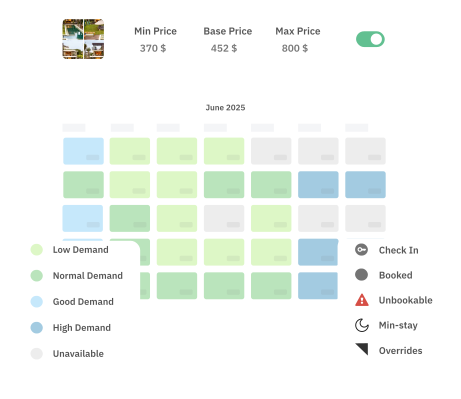
Albania remains a classic “peak and valley” seasonal market. Occupancy swings from winter lows to massive summer peaks, requiring a flexible pricing strategy.
| Month | Occupancy % | Median Booking Window | Median LOS |
|---|---|---|---|
| January/February | 13% | 7–8 Days | 4.5–6 Days |
| May (Shoulder) | 24% | 15 Days | 4 Days |
| July (Peak) | 45% | 23 Days | 5 Days |
| August (Peak) | 56% | 25 Days | 5 Days |
| September (Shoulder) | 36% | 19 Days | 5 Days |
| November/December | 14% | 8–11 Days | 5 Days |
What this means for property managers:
Dynamic pricing is critical during the shoulder months (May and September). During these periods, occupancy is high enough (24–36%) to yield significant revenue if priced correctly. Strategic “gap filling” and LOS-based discounts (e.g., offering a discount for stays of 6+ nights) can significantly improve off-season yields.eptember). During these periods, occupancy can still reach 24-36%. Strategic “gap filling” and LOS-based discounts can significantly improve off-season yields.
The most striking data point in the 2026 report is the performance gap between properties using high-level dynamic pricing and those using static pricing.
| Pricing Strategy | Average Occupancy | Average ADR (ALL) | Average RevPAR (ALL) |
|---|---|---|---|
| High Dynamic | 49% | 7,731 ALL | 4,311 ALL |
| None (Static) | 19% | 5,587 ALL | 1,135 ALL |
Properties utilizing high dynamic pricing models achieved an average occupancy of 49%, compared to just 19% for those with no dynamic pricing. Even more impactful is the RevPAR difference: High-DP properties earned 280% more revenue per available room than static-priced units.
Insight: Static pricing in Albania often results in properties being “priced out” during the low season and leaving money on the table during the high-demand summer peaks.
The Albanian government and tourism boards have been aggressively marketing the “Albanian Riviera” and the country’s mountain tourism. Significant infrastructure projects, including the expansion of international flight routes into Tirana and the development of the Vlora International Airport, are expected to continue driving the 22% demand growth seen in the data.
Regulatory Environment:
While Albania has historically had a relaxed regulatory environment for STRs, there are increasing discussions regarding formal registration and tax compliance for hosts. Professional managers who get ahead of these regulations by ensuring their portfolios are fully compliant will be better positioned for long-term stability.
The next 6–12 months for Albania look promising but competitive. We expect supply to continue its upward trajectory, potentially crossing the 35,000-listing mark by 2027.
Risks to Monitor:
Early Signals to Track: Keep a close eye on 2026-27 Pacing data. Early indicators show that July 2026 is already seeing a 9% pacing occupancy, which is significantly ahead of previous years at this stage.
Demand begins to climb in May, but the true pricing power lies in July and August, where occupancy jumps to over 50% and ADRs peak at 12,000+ ALL.
It automatically lowers rates to stay competitive during the 13% occupancy winter months while aggressively raising them during summer festivals and peak beach season, ensuring you never miss a high-value booking.
The market average is 5 days, suggesting guests are primarily holidaymakers rather than short-term business travelers.
While listings grew 22%, demand grew by the same amount, meaning the market is currently in a healthy state of absorption.
Want to learn what PriceLabs can do for you? See for yourself with a free trial. Get started now!


