
Get started with PriceLabs now!
Want to learn what PriceLabs can do for you? See for yourself with a free trial. Get started now!

A 30-day inquiry lands in your inbox. You stare at it for a moment. Is this good for me? You know it's a month of guaranteed occupancy — no turnover chaos, no back-to-back check-ins. But your monthly discount is set to 25%, and you're not sure whether that's leaving money on the table in July or whether it's realistic for a slow November. That uncertainty is exactly what a static discount creates. An extended-stay dynamic pricing strategy replaces that guesswork with a seasonally aware framework — one that adjusts your weekly and monthly discount percentages based on real market demand instead of a number you set once and forgot. Dynamic pricing for vacation rentals handles short-stay nightly pricing automatically — but extended-stay discounts need their own logic to work correctly.
Extended-stay dynamic pricing means automatically adjusting your weekly and monthly discount percentages based on seasonal demand — offering deeper discounts during slow periods to fill the calendar and shallower discounts to protect revenue during peak season when shorter bookings at full price are available. Rather than setting one static discount year-round, the goal is a tiered framework: different discount depths for 7–13 night, 14–27 night, and 28+ night stays, adjusted by season.
Extended-stay demand is growing. Remote workers, digital nomads, corporate relocators, and traveling healthcare workers are searching for 7–30+ night stays in markets that were built around weekend getaways. New hosts building their listing strategy from scratch have an opportunity to capture this segment from day one — if their pricing is structured correctly. If you're focused on the operational side of this rather than just the discount math, these tactics for securing longer vacation rental stays cover the guest-facing strategies that work alongside your pricing.
On Airbnb, an extended stay is typically a booking of 7 nights or more (weekly), 14+ nights (bi-weekly), or 28+ nights (monthly or medium-term). Most hosts handle extended-stay pricing by setting a single discount percentage in their Airbnb settings — say, 20% off for monthly stays — and leaving it there. That's a static discount, and it's a blunt instrument.
In July, when your market has a two-week waitlist for peak-week bookings, a 20% monthly discount is giving away revenue you didn't need to sacrifice. In February, the same 20% discount may not be enough to attract a remote worker who's comparing three similar listings. Mid-term rental pricing strategy requires a different approach depending on where you are in the seasonal cycle.
The case for dynamic pricing for long stays comes down to one data point: properties using dynamic pricing earn 10–40% more annually on average compared to static pricing across all booking types. That gap is even wider in the extended-stay segment, where static discounts systematically under-earn in peak season and over-discount in off-peak. Proven pricing tactics for Airbnb hosts consistently show that seasonal-aware discount structures outperform fixed percentages.
It's also worth knowing that Airbnb highlights listings with weekly or monthly discounts of 10% or higher in search results — displaying a discount badge that improves visibility. That means your discount depth directly affects how many eyes see your listing during an extended-stay search, not just what those guests pay when they book. Airbnb Smart Pricing does not offer season-aware length-of-stay discount tiering — it adjusts nightly rates but doesn't dynamically recalibrate your extended-stay discount depth based on seasonal demand. Third-party tools like PriceLabs fill that gap.
When a 30-day booking inquiry arrives, the mental math most hosts do is: "My nightly rate drops by 25% — is that worth it?" But that calculation misses the operational savings that make extended stays financially compelling even at a lower nightly rate. Calculating your actual Airbnb income requires accounting for the full cost structure, not just the nightly rate.
Consider a listing at $200 per night with a $120 cleaning fee and an average stay of 2.5 nights. Gross revenue for the average booking: $500. After one cleaning at $120, net is $380. Net per night: $152. Now compare a 28-night booking at a 20% monthly discount: $160 per night, one cleaning, $120. Gross: $4,480. Net: $4,360. Net per night: $155.70. Same or slightly better net per night — with a fraction of the turnover work, guest communication, and wear-and-tear pace. This is the core argument for an extended-stay dynamic pricing strategy grounded in real cost math.
The variable that changes this calculation most dramatically is your cleaning fee and turnover cost. High-turnover markets where cleaners charge $150+ per visit have a much stronger economic case for mid-term rentals than lower-cost markets. Calculate your own break-even discount before setting any percentage — it's specific to your cost structure.
The Airbnb weekly discount pricing you set should start from this break-even calculation — not from what your competitors are offering or what feels like a round number. Vacation rental extended stay rates that are calibrated to your actual economics protect your margin even as the nightly rate drops.
The most effective extended-stay pricing framework is a 3x3 matrix: three stay-length tiers crossed with three demand seasons. Each cell has its own discount range, and those ranges shift based on where you are in the seasonal cycle. This is what a tiered discount structure vacation rental approach looks like in practice. Minimum stay rules and extended-stay pricing work together — you can't optimize one without considering the other.
These are starting ranges — adjust based on your market's specific demand profile. In very high-demand peak markets (beach properties in July, ski cabins in February), even the weekly discount might be 5–10% rather than the 10–15% shown above. In extremely slow off-peak markets, 40%+ monthly discounts may be necessary to attract any extended-stay bookings at all. Extended stay occupancy optimization requires calibrating to your specific market, not a generic table. Airbnb pricing tactics that work start with market-specific calibration, not assumptions.
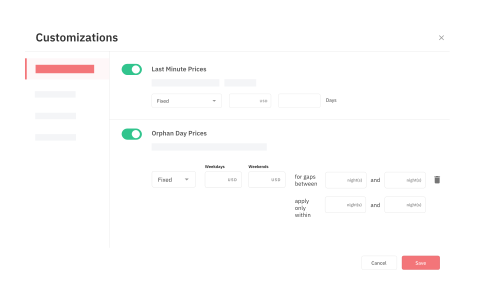
A few mechanics to keep in mind. Airbnb shows a discount badge on listings with 10%+ weekly or monthly discounts — this improves visibility in extended-stay searches, so make sure your weekly discount is at least 10% in every season. During peak season, consider raising your minimum stay to 7+ nights so your premium-priced calendar fills with higher-value extended bookings rather than discounted short-stay bookings. Last-minute pricing strategy interacts with extended-stay logic too — if a gap in your calendar is too short for extended-stay guests but too long to leave empty, last-minute short-stay rules can fill it.
Your extended-stay dynamic pricing strategy should reflect who is actually searching for your listing in each season. Extended-stay guest segments have different lead times, price sensitivities, and booking triggers — and pricing them with the same approach misses money in both directions.
Remote workers and digital nomads typically book 14–60 days in advance and are highly price-sensitive in shoulder and off-peak seasons. They're comparing multiple cities and multiple listings within each city. In slow season, a competitive monthly rate converts; in peak season, they're often willing to pay closer to short-stay equivalent because they value certainty and stability. Fast WiFi and a dedicated workspace are often the deciding factors — amenity-driven more than purely price-driven.
Corporate relocators have larger budgets but require specific amenities and amenities standard: reliable high-speed internet, full kitchen, dedicated workspace, professional check-in process. They often book through a corporate travel manager, which means lead times can be 30–90 days.
Mid-term rental pricing Airbnb strategy for this segment should factor in the premium those guests will pay for the right setup — don't discount into this segment when they'd happily pay closer to full price.
Traveling healthcare workers (travel nurses in particular) book on short lead times — often 1–3 weeks — because their assignment placements are confirmed close to start date. They're reliable tenants but often price-constrained by assignment stipends. In markets near major medical centers, this segment can fill significant off-peak occupancy at competitive monthly rates.
Snowbirds and families in transition book months in advance and are less price-sensitive than remote workers — they've made the decision to go and are looking for the right fit. Understanding which guest segment dominates your off-peak demand curve helps you calibrate discount depth. A beach condo in Florida popular with snowbirds has a fundamentally different off-peak demand profile than an urban apartment targeting remote workers in the same period.
The fundamental limitation of Airbnb's built-in extended-stay discount tool is that it sets one percentage for each stay length — and that percentage applies equally in July and January, in peak demand and dead season. The dynamic pricing strategy that actually captures extended-stay revenue requires season-aware length-of-stay discount rules that adjust without manual intervention. PriceLabs provides exactly that infrastructure. For dynamic pricing tools for mid-term rentals, this is the key differentiator.
Custom Pricing Rules in PriceLabs let you set length-of-stay discount rules that are tied to seasonal profiles — High Season, Shoulder, Off-Peak — so your extended-stay discounts automatically deepen in slow periods and shallow out in peak periods. Set this up once. It runs automatically from that point forward, recalibrating with every booking window that opens.
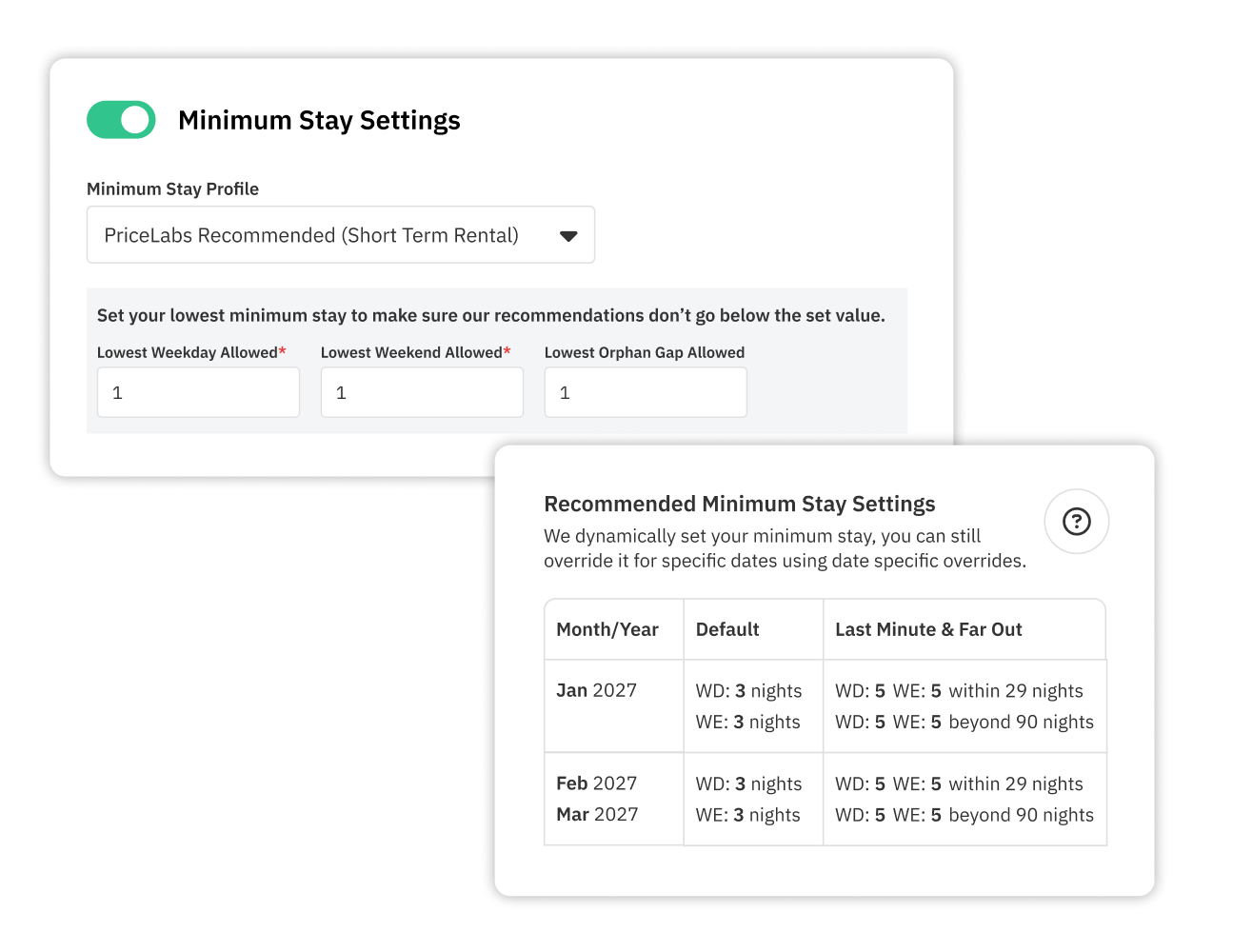
Smart Minimum-Stay Adjustments work alongside your extended-stay pricing. In peak season, the system can automatically raise minimum stays to 7 nights or more — ensuring your premium calendar fills with extended-stay bookings rather than being fragmented by short-stay bookings. In slow periods, minimum stays drop to catch orphan days and last-minute flexible guests who would have been blocked by a rigid minimum stay setting. The deeper guide to pricing for mid-term stays covers the full configuration logic for these rules. PriceLabs' orphan gap tools handle these short unbookable windows using the same seasonal-awareness logic described here, just applied to much shorter gaps.
The Hyper Local Pulse (HLP) Algorithm monitors local demand signals continuously. If extended-stay demand in your market surges — a major employer announces a 3-month office renovation project and remote workers flood the area — PriceLabs adjusts pricing in response without you needing to act. The algorithm knows your market's demand curve at a hyperlocal level, which means your extended-stay discounts are always calibrated to what's actually happening in your submarket, not a national average. Market dashboard benchmarking tools complement this by showing you how your extended-stay rates compare to similar nearby listings at any point in the season.
All discount rules sync to Airbnb, VRBO, Booking.com, and 150+ PMS and channel manager integrations instantly — so your extended-stay pricing is consistent across every platform where guests are searching for longer stays.
An extended-stay dynamic pricing strategy is not a set-and-forget system. It's a system that requires quarterly calibration as remote work trends, corporate relocation patterns, and seasonal demand cycles shift. The metrics that tell you whether your strategy is working are specific — and different from the ones you track for short-stay performance. Portfolio analytics tools make this quarterly review manageable rather than time-consuming.
Key metrics to track for extended-stay performance:
Adjustment thresholds to guide your quarterly review: if extended-stay bookings drop below 20% of total nights during off-peak, consider deepening your monthly discount tier or lowering your minimum stay threshold. If extended-stay bookings are 60%+ of your peak season bookings, consider reducing discounts — you may be giving away revenue to guests who would have paid closer to full nightly rates.
The complete vacation rental revenue management framework gives you the context for interpreting these thresholds in your specific market. The Airbnb weekly discount pricing level and monthly rental discount Airbnb settings both warrant quarterly review — they're not set-once decisions.
Extended-stay dynamic pricing is the practice of automatically adjusting your weekly and monthly discount percentages based on seasonal demand and market conditions — rather than setting a single static discount that applies year-round. The goal is to offer deeper discounts during slow periods to fill the calendar, while reducing or removing discounts during peak season when shorter bookings at full price are available. The extended-stay dynamic pricing strategy replaces a fixed percentage with a seasonally responsive discount framework.
As a starting framework for Airbnb weekly discount pricing: offer 10–15% for 7–13 night stays in peak, 15–20% in shoulder, and 20–25% in off-peak. For monthly stays: 20–25% in peak, 30–35% in shoulder, and 35–40% in off-peak. The right percentage depends on your cleaning fee, turnover cost, and local demand — calculate your break-even discount before setting these rates.
Airbnb displays a discount badge on listings that offer discounts of 10% or higher for weekly or monthly stays, which improves visibility in search results. Listings without meaningful extended-stay discounts may be filtered out when guests specifically search for extended-stay options — making discount depth a search visibility factor, not just a conversion factor.
Use a dynamic pricing tool with season-aware length-of-stay rules. In peak season, set shallower extended-stay discounts (10–20%) and consider raising minimum stays to 7 nights so your calendar fills with higher-value extended bookings rather than discounted short-stay bookings. Tools like PriceLabs automate this adjustment based on real-time demand signals in your local market.
Often yes. A 20–25% monthly discount typically results in the same or slightly higher net revenue per night once you subtract cleaning fees, turnover costs, and management time from shorter-stay scenarios. Extended stays also reduce vacancy risk during slow seasons and simplify operations significantly. Calculate your break-even discount based on your actual costs before deciding — the answer is property-specific, not universal.
An extended-stay dynamic pricing strategy is not about setting a permanent discount — it's about building a seasonally aware framework that earns more during slow periods and protects revenue during peak ones. The tiered structure is straightforward: three stay lengths cross three seasonal periods to create nine pricing cells, each with its own discount range that adapts automatically to current demand.
Remote work and digital nomad demand are structural trends, not cyclical blips. Extended-stay bookings will matter more, not less, over the coming years. If you're managing your extended-stay discounts manually in Airbnb's settings, you're likely leaving revenue on the table for at least half the year. PriceLabs automates the seasonal adjustment so your discounts are always calibrated to what the market actually supports.
Want to learn what PriceLabs can do for you? See for yourself with a free trial. Get started now!