
Get started with PriceLabs now!
Want to learn what PriceLabs can do for you? See for yourself with a free trial. Get started now!

You're managing 8 properties and two new owner clients approach you at the same time. The instinct is to say yes to both immediately — that's growth, that's what you're working toward. But the question worth asking before you sign those contracts is: are your current operations actually ready to absorb two more properties without degrading the performance of the eight you already manage? Multi-property portfolio strategy for vacation rental operators is not just about acquiring new properties. It is about knowing when your systems are ready to scale and when growth will simply amplify the gaps you already have.
Premature expansion is the most common reason STR management businesses stall or plateau. Revenue stays flat despite more properties because quality drops, reviews suffer, owner relationships fray, and the PM ends up doing more work for the same net income. This guide covers the operational readiness signals that indicate genuine expansion readiness, the key metrics to track, how to evaluate new markets, how to scale operations, and how geographic diversification reduces long-term business risk.
The most reliable test of expansion readiness is this: can your current portfolio run for 72 hours without requiring your direct intervention? If a guest has an issue at midnight on a Saturday and you're unavailable for 48 hours, does your system handle it? If a cleaning team misses a checkout, does your process catch and correct it without you finding out three days later from a guest review? If not, adding properties amplifies the existing operational gaps rather than growing revenue.
The five systems that must be functional before expanding:
Staff capacity is the second dimension of operational readiness. The industry benchmark for well-systemized PM operations is approximately one full-time operations manager per 15 to 20 properties, with cleaning and maintenance contractors scaled per property. How many properties before hiring STR staff is not a fixed number — it depends entirely on how automated your systems are. A fully automated operation can sustain 15 to 20 properties per manager; a partially manual one will hit capacity at 8 to 10. Vacation rental automation directly determines where your staffing threshold sits.
Financial readiness for expansion is often underestimated. New property onboarding has real upfront costs: photography, initial supplies, cleaning equipment if needed, any required permit fees, and the working capital gap between the first booking and the first owner disbursement. Expanding while current properties are already cash-flow-stressed is a path to a liquidity problem, not a growth strategy. Cash flow planning should model the onboarding cost of new properties against current reserves before committing to new contracts.
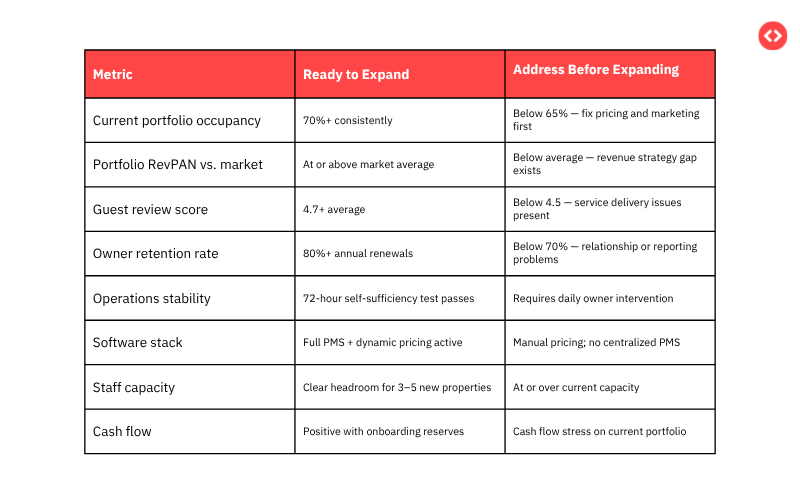
When to expand vacation rental portfolio is ultimately a data question. The metrics below give you an objective answer independent of how optimistic or cautious you are feeling at any given moment.
Occupancy rate threshold: Current portfolio should be consistently achieving 70% or higher occupancy before adding properties. Below this level, the issue is pricing or marketing quality, not a lack of inventory. Adding properties to a portfolio with sub-65% occupancy means bringing the same underperformance problem to more units. Occupancy rate benchmarks should be evaluated per property type and market, not as a blended average that can hide underperforming properties.
Revenue Per Available Night (RevPAN) vs. market benchmark: If your portfolio RevPAN is at or above the market average for your property type, you are ready to replicate. If it is below, the revenue model needs to be fixed before expansion. PriceLabs Market Dashboards provide the benchmarking data to compare your performance against the market directly.
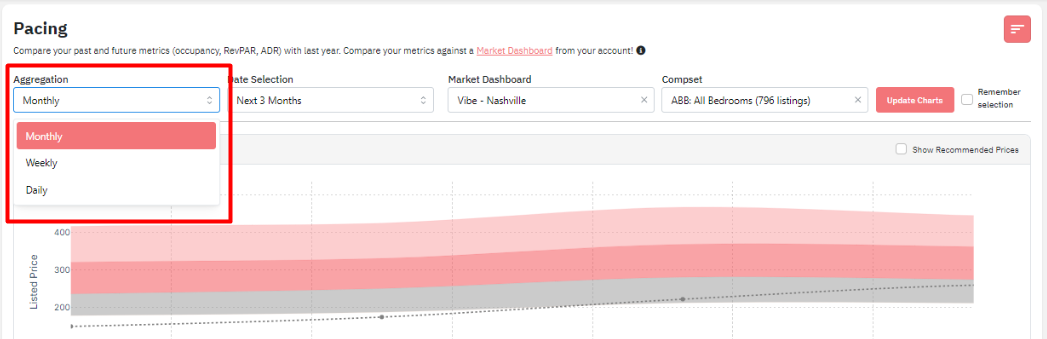
Booking pace: Are properties booking out 30 to 60 days in advance at healthy rates? Forward-looking booking pace is the best leading indicator of revenue health and the earliest signal of whether a season will outperform or underperform historical norms. PriceLabs' pacing analysis and future pricing insights give PMs a real-time view of how each property's booking pace compares to historical norms, making it possible to adjust pricing proactively before a slow period becomes a revenue loss. Vacation rental portfolio growth decisions based on forward-looking data are more reliable than those based on trailing averages. Seasonality patterns visible in pacing data reveal whether your current properties are at full potential before you commit to more.
Guest review score: A portfolio-wide average of 4.7 or higher on Airbnb signals that your operational quality is high enough to replicate. Below 4.5, there are service delivery gaps that will follow new properties into the portfolio and compound the problem.
Owner retention rate: Are existing property owners renewing their management contracts? High retention (80%+ annual renewals) is the strongest evidence that your management delivers measurable value. Low retention is a warning signal that owner satisfaction problems will transfer to new clients. Property management businesses that grow through referrals from happy existing owners grow more sustainably than those built on marketing alone.
Expansion into a new market requires a different research process than adding a property in your existing market. You are not just evaluating a single property. You are evaluating whether the entire market environment will support sustainable operations and revenue performance for you as a PM entering from outside.
Demand fundamentals first: look for markets with multiple, year-round demand drivers rather than purely seasonal markets that go to near-zero in the off-season. A beach market with a 3-month peak season and 9 months of low occupancy creates significant cash flow management challenges for a PM who needs to pay contractors and overhead year-round. Markets with overlapping demand sources (outdoor recreation plus a food and culture scene, or a beach market plus winter golf demand) provide more stable annual revenue. STR analytics for market evaluation should pull at least 18 to 24 months of demand history to see full seasonal patterns.
Regulatory environment: STR regulations are tightening in markets globally, and a regulatory change in year one of a new market entry can destroy the business case entirely. Before committing to any new market, research current STR permit requirements, any pending legislative proposals, and the regulatory trajectory over the past 3 to 5 years. Vacation rental investment strategy in any new market must include a regulatory stability assessment as a core input, not an afterthought.
Supply and demand balance: use PriceLabs Market Dashboards to view occupancy rates, ADR, RevPAN, and supply growth for any target market. Markets with strong occupancy and limited new supply growth are the best expansion targets. Markets adding more than 12 to 15% new STR listings annually will likely see rate compression within the next 12 to 24 months. How to evaluate a new vacation rental market before expanding requires this supply trend data, not just point-in-time occupancy. Market Dashboard research is the foundation of any serious expansion decision.
Operational logistics: expanding geographically means building a new operations network from scratch — reliable cleaners, a maintenance contractor, local emergency contacts, and a property access system. Expect 60 to 90 days of operational ramp time before new market properties reach full performance. Building those vendor relationships before the first booking, not after the first property goes live, is the difference between a smooth launch and a stressful first month. Property management operations guidance consistently identifies vendor relationships as the hardest part of new market entry to build quickly.
At 10 or more properties, a full Property Management System is not optional — it is the infrastructure that makes further growth financially viable. Without a PMS, operations scale by headcount alone: each new property requires proportionally more manual communication, coordination, and reporting. With a full PMS, each new property adds primarily variable costs (cleaning, supplies) while fixed operational costs (communications, reporting, calendar management) remain largely constant. Automation is the mechanism that changes the unit economics of scaling.
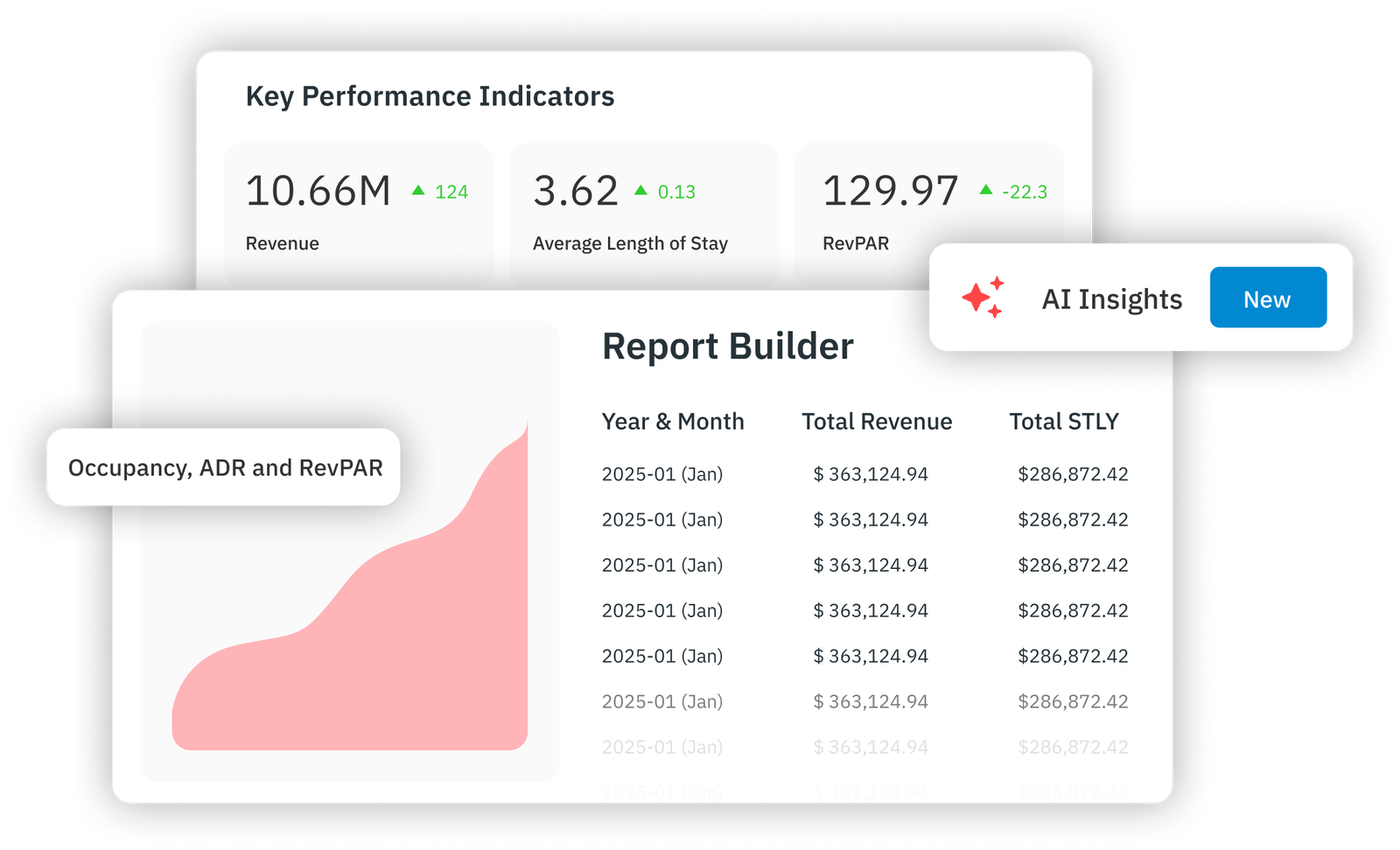
Pricing at scale is where PMs who rely on manual rate management hit a wall. Managing pricing for 25 properties across two markets, 30-plus nights out, accounting for local events, seasonal patterns, and competitor availability is not possible manually without a dedicated pricing analyst. Tools for managing a growing short-term rental portfolio must include a dynamic pricing platform as the core revenue management layer. PriceLabs' bulk update capabilities and API integrations allow PMs to apply pricing rules, minimum stay adjustments, and seasonal overrides across an entire portfolio with minimal effort. How to add properties to STR portfolio efficiently requires this capability already in place before the portfolio grows beyond 10 to 12 units. Portfolio Analytics gives PMs a single-view dashboard of revenue, occupancy, and ADR across all properties — making it straightforward to identify underperformers and intervene before they drag portfolio-wide results.
Standard Operating Procedures become essential at 15 or more properties. Everything that can be documented — guest issue escalation protocol, cleaning standards checklist, maintenance request workflow, owner communication templates — should live in written SOPs rather than in any individual team member's memory. Institutional knowledge that lives only in people's heads is operational risk. SOPs make training new staff faster, reduce errors, and create the consistency that drives review scores.
A property manager with all properties in one market is exposed to risks that geographic diversification eliminates: local regulation changes, a one-off slow tourism season, a competing supply surge, or a single large employer leaving the area. Property management portfolio expansion tips from experienced operators consistently include market diversification as a risk management practice, not just a growth strategy.
The complementary seasons strategy is the most practical approach: pair a beach market (peak summer demand) with a mountain or ski market (peak winter demand) so that portfolio occupancy stays elevated year-round. The revenue from one market's peak season funds the other's slow season, stabilizing cash flow across the full year. This diversification also gives you two markets' worth of demand data to compare and learn from. Multi-property portfolio management across complementary seasonal markets is an advanced strategy that most PMs arrive at after experiencing the vulnerability of single-market concentration.
Most growing PMs find 2 to 3 markets manageable with the right technology stack. The operational complexity of each additional market is manageable when pricing, communications, and reporting are centralized. What cannot be centralized are the local vendor relationships and the local market knowledge that come from being present in each market. Beyond 3 markets, consider a regional operations structure — a point person in each major market area who handles local vendor management and property inspections while the PM organization handles revenue management, reporting, and owner relations centrally. Property management at scale requires separating the activities that need local presence from those that can be managed remotely and systematized.
When current properties are consistently achieving 70%+ occupancy at or above market ADR, operations run without constant owner intervention, guest review scores average 4.7 or higher, and data shows strong demand in the target expansion market. Expanding before operational systems are automated is the most common and costly mistake growing property managers make.
The key expansion readiness metrics are occupancy rate (70%+ target), RevPAN vs. market benchmark (at or above), guest review score (4.7+), and owner contract renewal rate (80%+). PriceLabs Portfolio Analytics tracks revenue and occupancy performance across your entire portfolio in real time, making these metrics visible without auditing each property individually.
The most effective channels are referrals from existing happy owners, the Airbnb co-hosting marketplace for initial client acquisition, local real estate agent partnerships, and targeted outreach to owners with poorly performing listings where you can demonstrate a clear performance improvement opportunity. A strong local web presence and consistent content marketing also generate inbound leads from owners actively searching for professional management.
At 20+ properties you need: a full-service PMS (Hostaway, Guesty, or Lodgify) for centralized reservations and communications; PriceLabs for dynamic pricing across all properties; a cleaning management app (Turno or Properly); and owner reporting tools. This stack typically costs $300 to $700 per month total — approximately $15 to $35 per property — and enables one manager to effectively oversee 20+ properties with consistent service quality.
Expanding before operational systems are automated. When guest communications, pricing, cleaning coordination, and owner reporting are still manual, adding properties adds proportional labor cost and error risk without improving margin. The PMs who scale profitably invest in automation first — then add properties to the system, not the other way around.
Related reading: for aparthotel-specific inventory strategies, a common next step for growing portfolios, see managing multi-unit inventory for aparthotels.
Want to learn what PriceLabs can do for you? See for yourself with a free trial. Get started now!