Get started with PriceLabs now!
Want to learn what PriceLabs can do for you? See for yourself with a free trial. Get started now!

In the rapidly evolving short-term rental (STR) landscape, the difference between a highly successful property manager and a struggling one often isn’t just the software they use—it’s how they manage their most important stakeholders: the property owners.
As we navigate economic volatility and a “K-shaped” recovery—where high-end, well-managed properties thrive while average listings feel the pinch—the traditional “firefighter” approach to property management is no longer enough. To truly scale, property managers must embrace vacation rental owner communication as a core strategy, shifting from being mere service providers to becoming true revenue management partners.
Key Takeaways:
Professional property management is increasingly about navigating the “squeeze”—where revenue growth may be modest, but operational costs (insurance, labor, utilities) are climbing significantly. This requires moving away from reactive, “fire-putting-out” communication and embracing a proactive, data-informed strategy that builds trust before the first guest even checks in.
Revenue management isn’t just about adjusting levers in a dashboard; it’s about acknowledging the role the owner plays in the property’s potential. When owners feel like informed partners, they are more willing to invest in necessary upgrades—from fresh decor to high-value amenities—which ultimately makes your job as a manager easier.
Most managers wait for an owner to ask, “Why is my calendar empty?” A proactive manager identifies the “problem” (e.g., a naturally slow booking window or a temporary market dip) and communicates the solution to the owner before they even notice the gap.
While revenue managers live in KPIs, RevPAR, and analytics, owners live in results. Pushing a wall of raw data at an owner can be overwhelming. Instead, practice effective vacation rental owner reporting by leading with a narrative. Tell a story supported by the data to make your insights relatable and actionable.
Implementing a structured “Communication Rhythm” ensures that owners feel constantly informed without draining your operations team’s bandwidth.
| Phase | Frequency | Format | Focus |
|---|---|---|---|
| Onboarding (Day 1-60) | High (Weekly) | Drip Emails & Loom Videos | Establishing the “Booking Velocity” and “Occupancy-First” mindset. |
| Operational Growth | Monthly | Macro Newsletters | Market trends, seasonal observations, and a general “State of the Union.” |
| Strategic Alignment | Quarterly | Strategy Calls | Deep dives into long-term goals and performance vs. local comp sets. |
| The “Quick Win” | Ad-hoc | Screenshots / SMS | Sharing a YoY booking win or a jump in search ranking visibility. |
Don’t wait for questions. If you are changing a restrictive cancellation policy or identifying that listing photos need a refresh, tell the owner why you are doing it and how it increases their revenue ceiling. This “offensive” approach positions you as the STR expert and the “hero” when performance climbs.
During the first 30–60 days, new vacation rental owners are often anxious. Industry experts, like Michael Savage of Synergy Stays, recommend a structured “drip” approach to explain your dynamic pricing strategy. Explain that you first build booking velocity through an “occupancy-forward” approach, and then fine-tune the Average Daily Rate (ADR) once the booking platforms’ algorithms recognize the listing’s popularity.
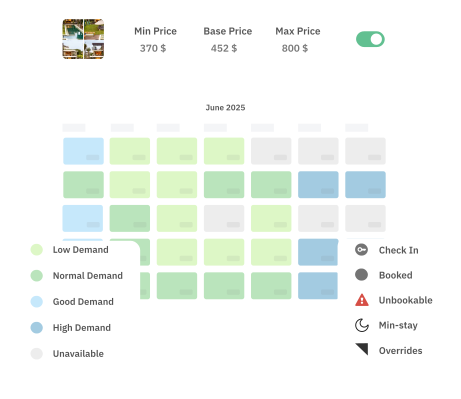
Owners frequently ask: “Why did my neighbor’s house book this weekend for more money than mine?”
The Strategy: Explain the variables beyond just bedroom count. Consumer psychology plays a huge role—even the color scheme of a living room or the quality of a lead photo on a specific day can shift an algorithm.
The Action: Pivot the conversation back to the “Macro” view. Zoom out using tools like the PriceLabs Market Dashboard to show how their property fits into the wider market puzzle, rather than reacting to micro-events.
Lead with market data, not personal opinions. Use market dashboards to show them that “Class A” properties (those with modern decor and premium amenities) are achieving significantly higher ADRs. Frame the investment as a necessary step to stay competitive in today’s STR market.
Standardize a monthly “macro” report to show owners you are monitoring the broader market, but save the deep-dive, property-specific strategy calls for a quarterly basis. This protects your team’s time for actual revenue management tasks.
Use the “Plant Analogy.” Explain that a property needs a steady “watering” of bookings to stay healthy and visible in OTA algorithms (like Airbnb or Vrbo). High minimum stays can “dehydrate” the listing’s visibility. Show them data on “Orphan Gaps” to prove how much revenue is being left on the table.
Leverage dedicated STR reporting software (like PriceLabs Owner Analytics) to automate the heavy lifting of data delivery. This frees up your team’s manual bandwidth to craft the narrative, record personalized videos, and nurture the human relationship.
Compare it to airline or hotel pricing. Explain that static pricing leaves money on the table during high demand and results in empty calendars during low demand. Emphasize that dynamic pricing algorithms analyze millions of data points daily to find the perfect price for their specific property, maximizing their overall yearly revenue.
Waiting for the owner to reach out first. If an owner is the one pointing out an empty calendar, the property manager has already lost the high ground. The biggest key to owner retention is proactive communication that identifies and addresses gaps before the owner has to ask.
This fits within our broader guide to vacation rental property manager fees and owner relations.
Related reading: for building that proactive relationship with data specifically, see building trust with property owners with data.
Proactive owner communication is one part of the fundamentals covered in our complete guide to property management.
Want to learn what PriceLabs can do for you? See for yourself with a free trial. Get started now!