Get started with PriceLabs now!
Want to learn what PriceLabs can do for you? See for yourself with a free trial. Get started now!

Most property managers who adopt a pricing tool keep one habit from the manual era. They open the calendar, see a rate they would not have picked, and change it. The tool still runs, but it now runs around a growing pile of manual overrides. Understanding what actually changes when you move off manual pricing is the first step to breaking that habit.
This guide covers the dynamic pricing best practices that reduce override dependence without giving up control. The goal is not zero overrides. It is fewer overrides, each one deliberate, with the recurring cases converted into rules your system applies on its own. For the wider context, the complete guide to vacation rental revenue management covers where pricing sits in the broader strategy. For the full walkthrough of setting these boundaries up in the first place, see how to customize PriceLabs and track your goals.
Every set of dynamic pricing best practices starts in the same place, which is understanding what you give up when you intervene. Automated pricing is not a suggestion engine you approve line by line. It is a daily recalculation, and an override removes one date from that calculation entirely, as the breakdown of how the forecasting works explains.
An override is not a nudge. It replaces the algorithm's output for that date with a fixed number. As the PriceLabs team puts it, a fixed price override blindfolds the pricing algorithm for that night. The rate stops responding to booking pace, competitor moves, or a demand surge you did not anticipate.
That matters most on the dates you care about most. Managers override holidays and event weekends precisely because those nights are valuable. If demand climbs past your estimate, the fixed rate books instantly and you never see the premium the market was willing to pay. The same logic applies in reverse when demand softens and the fixed rate sits unsold, which is the drift that slow season tactics are designed to catch.
At two properties, overriding is a small tax on your time. At twenty, it becomes the job. Each exception you set is one you have to remember, revisit, and explain when an owner asks about a soft month. Managers running multi unit portfolios usually find manual overrides accumulate faster than the portfolio grows.
There is a second cost that is easier to miss. A portfolio full of ad hoc exceptions has no consistent strategy to evaluate. You cannot tell whether your approach is working, because there is no single approach running. Revenue management automation only pays off when it is allowed to run consistently, and a data driven revenue management strategy depends on having something stable enough to measure.
The most common reason managers override is a fear of losing control, and the fix is structural rather than behavioural. Minimum and maximum prices define the range the algorithm can move inside. Setting those boundaries first means automation works within limits you chose, so there is nothing to protect against day to day.
Your base price sits at the centre of that range and does most of the work. Calibrate it against your own booking history and your comp set rather than a number that felt right at setup. Market Dashboards show what comparable listings in your area are actually achieving, which is the reference point that makes a base price defensible.
Here is the diagnostic question worth asking every time you reach for an override. Will I do this again next year? If the answer is yes, it belongs in your configuration rather than your calendar. Seasonal profiles, minimum stay rules, and last minute and far out price adjustments already handle most of what managers reach for manual overrides to fix.
Orphan nights are the clearest example. Filling a two night gap between reservations requires checking every calendar daily, which nobody sustains at scale. Orphan day gap filling applies the discount automatically the moment the gap appears, catching revenue a manual process reliably misses.
Some dates genuinely need a hand on them, and that is what the feature exists for. Date Specific Overrides let you set an exception for a defined window rather than editing rates one night at a time. The distinction that matters is scope: a bounded exception is a tool, an open ended one is a leak.
The setting worth knowing is the last minute erase rule. Configured to clear overrides inside a set number of days, it hands the calendar back to the algorithm as the date approaches and pickup data arrives. The release notes covering override behaviour walk through exactly how the erase window resolves.
One of the most overlooked dynamic pricing best practices is simply reviewing less often. Opening the calendar daily invites intervention. Reviewing weekly against pacing data invites analysis, which is a different activity with a different outcome. Pacing reports show how each date is filling relative to the same date last year, which is the signal that tells you whether a rate needs attention.
When a date is genuinely off pace, the better response is usually a rule change rather than a one night edit. Adjust the seasonal profile, the minimum stay, or the discount curve so the correction applies everywhere the pattern occurs. Fine tuning the strategy over the first few months is what calibrates a generic setup to your specific market.
Dynamic pricing best practices do not mean never intervening, and treating them that way is its own failure mode. The point of revenue management automation is to make intervention rare and considered rather than reflexive, a balance the portfolio level controls are built around.
Automation is not a reason to abandon judgment, and a few situations legitimately call for manual input. A hyper local event the market data has not picked up yet is the clearest case. So is an owner stay, a renovation window, or a contracted group rate, all of which are covered in the guidance on customising pricing for different owners.
A brand new listing is the other reasonable exception. Before there is enough booking history for the algorithm to calibrate against, a closer hand on rates makes sense. The customisation options worth setting up first let you keep that oversight without reverting to fully manual updates.
Reducing overrides is only worth doing if the numbers move, so track the change rather than assuming it. Compare your own portfolio before and after adopting these dynamic pricing best practices rather than against an industry average that may not reflect your market, using the metrics in this guide to evaluating pricing through core revenue metrics.
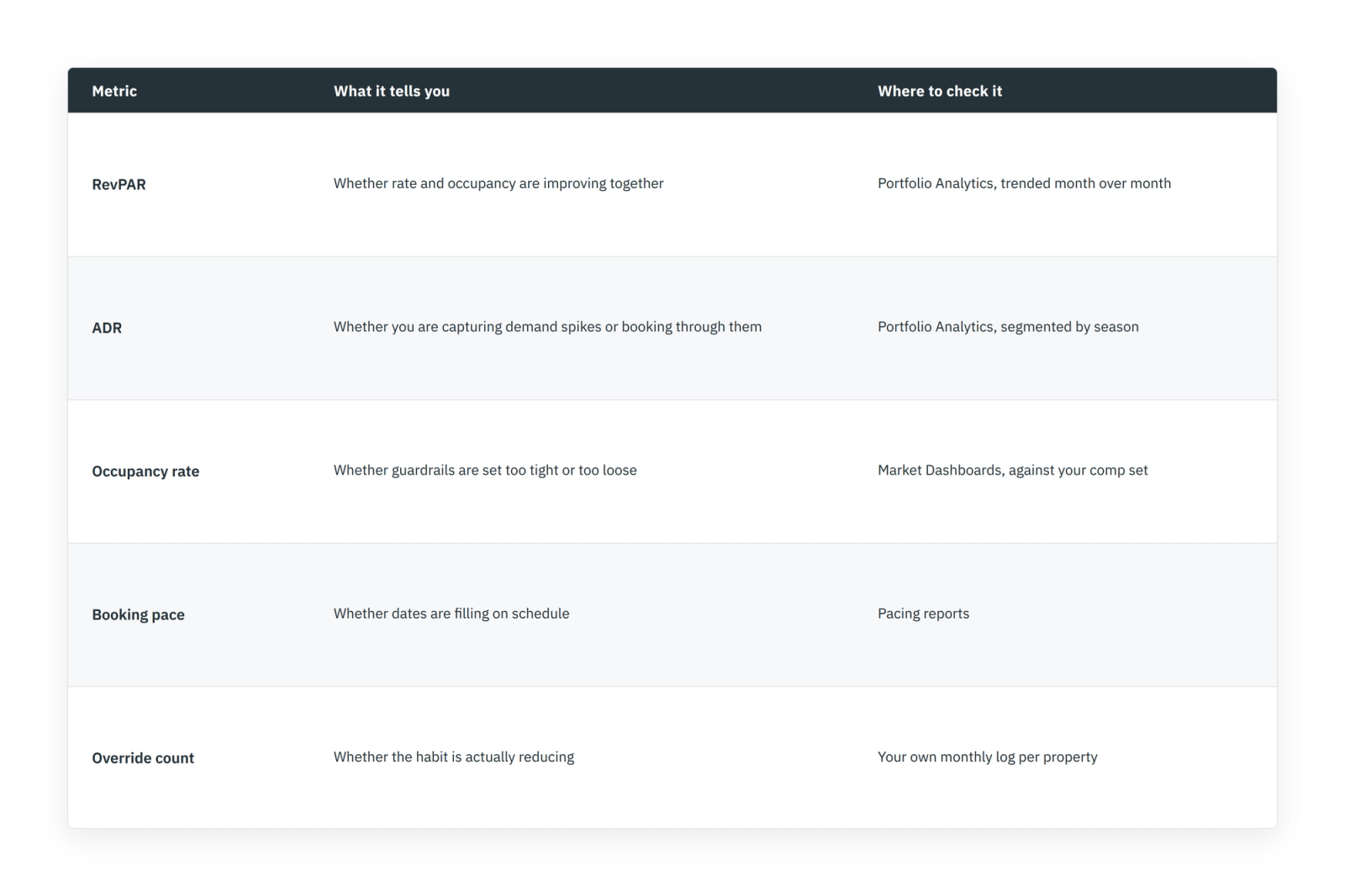
RevPAR is the one that catches what occupancy hides, because a listing can hold steady occupancy at a rate that is quietly too low. If you have not used it as a primary metric, RevPAR explained covers the calculation. Track it in Portfolio Analytics across a full twelve months so seasonality does not distort the comparison.
Add override count to that list as a tracked metric in its own right. Counting exceptions per property per month turns a vague intention into something visible, and it surfaces which properties or team members are driving the volume. The wider set of property management KPIs gives you the reporting frame to sit it in.
Resistance to automated pricing usually comes from habit rather than analysis, and the response that works is evidence rather than instruction. Pull the before and after numbers for a group of properties where overrides dropped, and let the comparison make the case. Building trust with owners through data works the same way, because a pacing report answers a rate question better than an assurance does.
Train the team to change rules rather than rates. When someone spots a pattern, the useful output is a configuration change that holds for every similar date, not a single edit. This is how property managers using PriceLabs day to day tend to describe the shift in their workflow.
Owner conversations get easier for the same reason. A rate you can trace to booking pace, competitor movement, and event data is defensible in a way that a manual adjustment is not. The market data behind the recommendations is what you point to when an owner asks why a rate moved. For the broader strategy this all sits within, see our complete guide to dynamic pricing for vacation rentals.
There is no universal threshold, so use the diagnostic rather than a number. If an override repeats across dates or properties, it is a rule you have not written yet. Anything you can predict belongs in your configuration, which is the core principle behind dynamic pricing best practices and the automation feature set.
No, because control lives in your guardrails rather than in daily edits. Minimum and maximum prices, seasonal profiles, and stay restrictions all constrain what the algorithm can do. Automated pricing through Dynamic Pricing adjusts inside those limits, not around them.
Set a Date Specific Override for that window and give it an expiry rather than leaving it open ended. Then check whether the event recurs annually, because if it does, it belongs in your seasonal configuration. The calendar guide covers how event dates fit alongside your other rules.
Give it a full booking cycle for your market, which usually means at least one season rather than a few weeks. Compare RevPAR and ADR against the same period last year rather than against the previous month. Your typical booking window determines how long the signal takes to appear.
The principle holds at any size, though the payoff scales with property count. With a handful of listings the time saved is modest, while the consistency gain is immediate. Managers scaling past a dozen units tend to feel it most, as the walkthrough of building a pricing strategy illustrates.
Pick one group of properties, log every override for a month, and sort the list into recurring and genuinely one off. The recurring ones become rules, and the rest stay as bounded exceptions with an expiry date. That single exercise is the practical form of dynamic pricing best practices, and the PriceLabs blog has deeper guides on each piece of the setup.
Want to learn what PriceLabs can do for you? See for yourself with a free trial. Get started now!