Introducing Revenue Accelerator : 30 new features to power your entire revenue strategy.

Learn more

Use AI to turn data charts into easy-to-understand sentences. Know More
Revenue Estimator Pro: Get Instant Revenue Estimates for Any Address.

Learn How

How Hosts in World Cup Cities Can Price Smarter and Profit from FIFA World Cup 2026

Share on

Spread the love

Updated : Apr 16, 2026

Guadalajara, Dallas, and Boston are showing major uplift in ADR, RevPAR, and early occupancy pacing. For STR hosts, this is the moment to set strong price anchors and secure visibility before demand spikes even harder.

The FIFA World Cup is divided into two main phases, and understanding them helps hosts predict how fans will travel and how demand will behave.

Bonus: How to Become an Airbnb Host: The Complete Guide

Visit the FIFA World Cup Landing page to get updated data on Host cities and their demand

1. The Group Stage (the first round of the tournament)

This is where all qualified teams begin their journey.

  • Teams are divided into groups.
  • Each team plays three matches.
  • Fans travel in larger numbers because every team is still alive in the tournament.
  • Matches are spread across multiple cities, creating a broader distribution of demand.

For hosts, this phase brings steady, early interest. Fans plan ahead, compare listings, and often travel in groups or families. Demand is healthy, but spread out.

2. The Knockout Stage (the elimination round)

This begins after the group stage, and every match becomes a win-or-go-home affair.

  • Only the top teams advance.
  • Each game eliminates one team.
  • Stakes are higher, emotions run hotter.
  • Fans book last-minute once they know their team has qualified.

This is the phase where demand compresses and spikes hard. Fans book quickly, stay longer, and are willing to pay more to be near stadiums hosting elimination matches.

The two phases create two totally different pricing strategies:

  • Group Stage → early planners, gradual pacing
  • Knockout Stage → urgent bookings, high willingness to pay

This is why hosts must treat them as two unique revenue windows, not one long event.

Dynamically Price Your Property and Get FREE Custom Reports Tailored To Your Property!

Use PriceLabs Dynamic Pricing to competitively and dynamically price your property according to demand shifts and analyze past performance to set a strong pricing strategy for your property.

Create your Account Now

Pricing Framework for Hosts (Simple, Fast, Data-Driven)

For a global event like FIFA 2026, pricing isn’t guesswork — it’s timing. Early pacing across key host cities already shows aggressive lifts in ADR and RevPAR, even where occupancy is still low. This is the clearest signal that hosts must price confidently and avoid reacting to slow pacing too early.

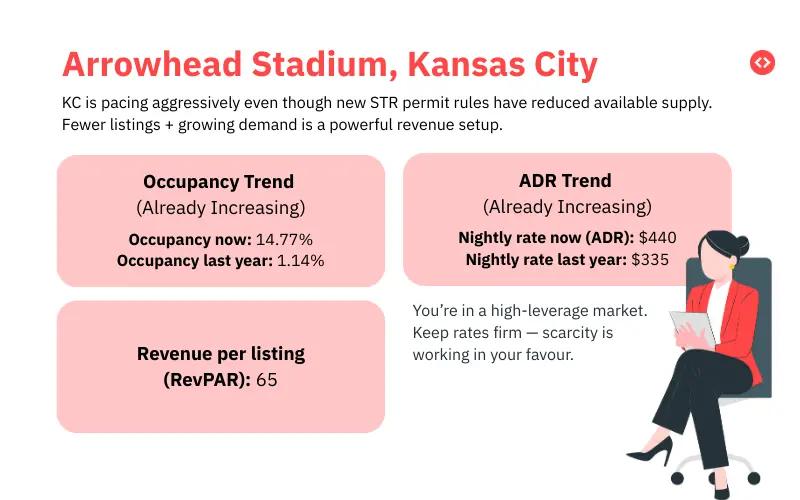
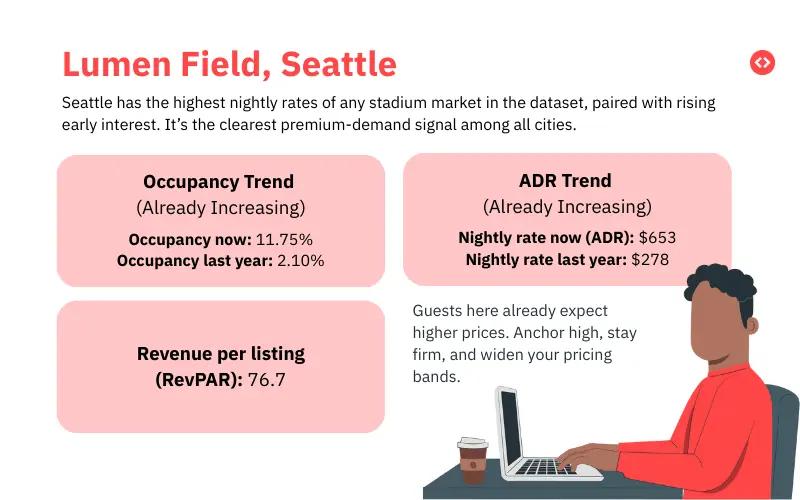
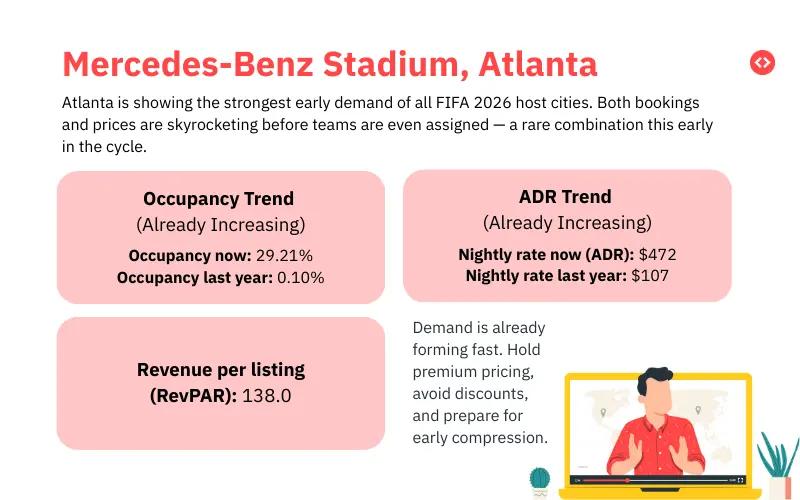
Across the 15 stadium markets analyzed, every single venue shows higher ADR in 2026 vs. the same time in 2025, with several posting triple-digit jumps. RevPAR performance is even stronger, with markets like Atlanta, Kansas City, Seattle, Philadelphia, and Guadalupe reporting extraordinary year-over-year surges driven by World Cup anticipation.

Here’s what those data signals mean for your pricing strategy:

1. Before Teams Are Announced: Anchor High

This is the phase we’re in today — and the numbers already show why hosts should lead with premium pricing.

  • Guadalajara (Akron Stadium) ADR: $106 vs $41 (+158%)
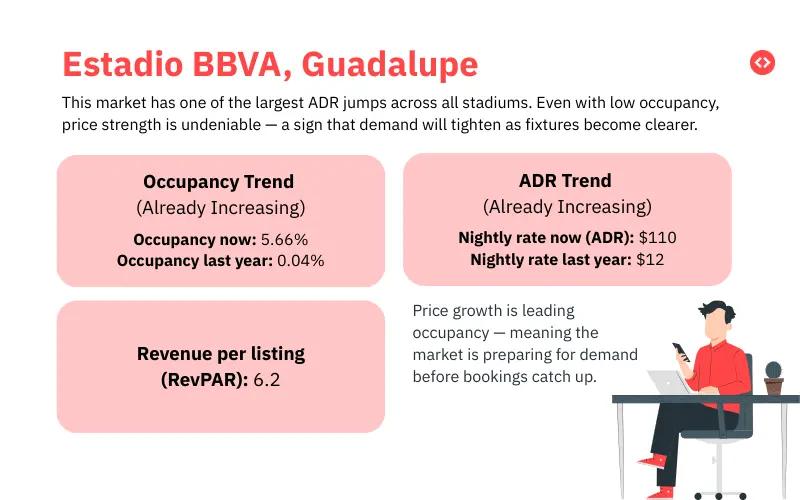
  • Guadalupe (Estadio BBVA) ADR: $125 vs $42 (+195%)
  • Dallas (AT&T Stadium) ADR: $276 vs $148 (+87%)
  • Mexico City (Banorte Stadium) ADR: $82 vs $35 (+134%)
  • Boston (Gillette Stadium) ADR: $330 vs $197 (+68%)

Even with low early occupancy (e.g., Guadalupe at 15.91%, Dallas at 18.24%), pricing signals are extremely strong across the board.

What this means: Don’t let low pacing trick you. These ADR jumps confirm that demand is forming and guests are willing to pay more. This is the window to set your highest anchor rates, avoid early discounts, and boost your listing’s visibility.

2. Group Stage Pacing: Hold Your Nerve

During the group stage, occupancy rarely fills early—but markets consistently outperform last year’s RevPAR.

Examples from the data:

  • Boston (Gillette Stadium) RevPAR: $103.13 vs $40.14 (+157%)
  • Kansas City (Arrowhead Stadium) RevPAR: $84.51 vs $23.85 (+254%)
  • Philadelphia (Lincoln Financial Field) RevPAR: $57.68 vs $19.36 (+198%)
  • Dallas (AT&T Stadium) RevPAR: $50.40 vs $9.42 (+435%)
  • Guadalajara (Akron Stadium) RevPAR: $25.86 vs $1.85 (+1,298%)

These numbers are wild — but more importantly, they show that revenue lift is happening without high early occupancy.

What this means: Group-stage demand is slow and steady. Resist the urge to cut prices if bookings don’t come immediately. The market is telling you the opposite: prices are rising despite low pacing.

Stay firm. Keep your minimum stays tighter. Trust the demand curve.

3. Knockout Stage Team Qualification: Push Hard

Once teams qualify for knockout rounds, the booking behavior flips:

  • Fans book within hours, not days.
  • Price elasticity increases sharply.
  • International travelers flood the market.
  • Proximity to stadiums becomes a premium factor.

Cities with stronger early indicators — especially Guadalajara (+19.85% occupancy delta), Guadalupe (+12.98%), Dallas (+11.87%) — are likely to see the sharpest knockout-stage compression.

What this means: When teams advance, raise rates 20–40% immediately and widen your last-minute price rules. This is your highest-earning window of the entire tournament.

The Framework in One Line:

1) Anchor high 2) Hold steady 3) Push aggressively when teams qualify.

Hosts who follow this rhythm will capture the full revenue potential of FIFA 2026 without chasing occupancy or underpricing during the biggest sports event of the decade.

We used STR Index and PriceLabs Market Dashboards to make these analyses for various markets in the FIFA 2026 schedule.

Create Data Analyses For Various Markets Using STR Index and Market Dashboards Like the Analysis In This Article.

Use STR Index and Market Dashboards with PriceLabs Dynamic Pricing to competitively and dynamically price your property according to demand shifts and analyze past performance to set a strong pricing strategy for your property based on real-market trends.

Create your Account Now

Top 5 Stadium Markets to Watch (Highest Occupancy Delta)

While every FIFA 2026 host city is showing stronger pricing signals than last year, five stadium markets stand out for one reason: they’re already pacing far ahead of 2025 in occupancy, even before teams are assigned and fixtures are finalized. This early demand is a strong indicator of future compression and typically aligns with the markets where hosts capture the highest ADR and RevPAR premiums.
1. Akron Stadium, Guadalajara — +19.85% Delta

Guadalajara is the clear front-runner in the updated data, posting the single largest occupancy surge of any host market.

  • Occupancy: 24.35% (vs 4.50% LY)
  • ADR: $106 (vs $41)
  • RevPAR: $25.86 (vs $1.85)

Guadalajara’s occupancy has jumped nearly 20 points year-over-year — the steepest climb in the entire dataset. ADR growth of +158% confirms that early bookers are already paying a significant premium. With Mexico as a co-host nation and passionate local fanbases, this market will intensify sharply once the Mexican national team’s group stage schedule is confirmed.

2. Estadio BBVA, Guadalupe — +12.98% Delta

Guadalupe (Monterrey) holds the second spot, with occupancy pacing surging from under 3% to nearly 16% year-over-year.

  • Occupancy: 15.91% (vs 2.93% LY)
  • ADR: $125 (vs $42)
  • RevPAR: $19.95 (vs $1.24)

ADR growth of +195% — the highest rate increase among all host markets — reflects intense early demand compression already underway. Hosts in the Monterrey area should anchor prices high and resist any urge to discount early. The RevPAR jump from $1.24 to $19.95 (+1,509%) signals that revenue lift is arriving well ahead of high occupancy.

3. AT&T Stadium, Dallas — +11.87% Delta

Dallas rounds out the top three, showing strong early interest before fixtures are even finalized.

  • Occupancy: 18.24% (vs 6.37% LY)
  • ADR: $276 (vs $148)
  • RevPAR: $50.40 (vs $9.42)

Dallas is one of the largest STR markets in the US, and this early signal suggests serious demand compression is coming. RevPAR has grown +435% year-over-year, from $9.42 to $50.40. Hosts near AT&T Stadium should establish premium rate floors now, particularly for knockout-stage dates.

4. Banorte Stadium, Mexico City — +10.93% Delta

Mexico City is showing healthy pacing alongside its Guadalajara counterpart, with occupancy climbing nearly 11 points year-over-year.

  • Occupancy: 18.91% (vs 7.98% LY)
  • ADR: $82 (vs $35)
  • RevPAR: $15.53 (vs $2.80)

ADR growth of +134% and a RevPAR jump from $2.80 to $15.53 (+455%) confirm that fans are already booking at significantly elevated rates. Mexico City’s combination of large local fanbase, international visitor draw, and strong match schedule gives it consistent demand across both the group stage and knockout rounds.

5. Gillette Stadium, Boston — +10.87% Delta

Boston rounds out the new top five, and stands out as the highest-occupancy market in the entire dataset at 31.28% — already well ahead of everywhere else in absolute terms.

  • Occupancy: 31.28% (vs 20.40% LY)
  • ADR: $330 (vs $197)
  • RevPAR: $103.13 (vs $40.14)

Gillette Stadium leads all host markets in RevPAR at $103.13, up +157% from last year. The high occupancy baseline combined with strong ADR growth tells a different story from the Mexican markets — Boston demand is broad and early, not just compressed around a few key matches. Hosts here should focus on tightening minimum stays and pushing knockout-stage pricing aggressively once team qualifications are confirmed.

Use PriceLabs Market Dashboard to understand your market

Why These Markets Matter

These top five cities provide hosts with a preview of where the strongest opportunities lie. A notable pattern in this year’s data is the dominance of Mexican host cities — Guadalajara, Guadalupe, and Mexico City all rank in the top four by occupancy delta. This reflects the elevated excitement around Mexico as a co-host nation and the strength of local demand ahead of the Group Stage. US markets like Dallas and Boston are not far behind, and are poised to accelerate sharply once knockout fixtures are assigned.

When a city shows high occupancy delta + high ADR delta before fixtures, it almost always becomes one of the strongest tournament performers. Hosts in these markets should plan tighter minimum stays, premium pricing, and more aggressive knockout-stage strategies.

Closing: The Smart Host Advantage for FIFA 2026

FIFA 2026 will bring millions of fans, thousands of matches across three countries, and unprecedented pressure on accommodation supply. The hosts who win will be the ones who trust the data, maintain premium anchors, and use pricing automation to stay responsive when demand accelerates. The groundwork is already laid — now it’s time to turn insight into action.

Dynamic pricing in Airbnb refers to the practice of adjusting rental rates in real time based on various factors such as demand, seasonality, local events, and market conditions. This approach allows hosts to optimize their earnings by automatically increasing or decreasing prices to match supply and demand fluctuations. By utilizing data and algorithms, dynamic pricing aims to find the optimal balance between attracting guests and maximizing revenue, ensuring that prices reflect the current market dynamics.
To implement dynamic pricing for vacation rentals, collect relevant data, identify key factors, set pricing rules, use dynamic pricing software, monitor performance, and adjust as needed to optimize revenue.
The aim of dynamic pricing is to optimize revenue and occupancy rates. It is done by adjusting prices in real time based on factors such as demand, market conditions, competition, and other variables. Dynamic pricing softwares seeks to find the optimal balance between attracting guests and maximizing profitability by dynamically setting prices that reflect current market dynamics. The goal is to capture the highest possible value for each booking while ensuring competitiveness in the market.
0%

About PriceLabs

PriceLabs is a revenue management solution for the short-term rental and hospitality industry, founded in 2014 and headquartered in Chicago, IL. Our platform helps individual hosts and hospitality professionals optimize pricing and manage revenue by adapting to changing market trends and occupancy levels.

Every day, we price over 600,000+ listings globally across 150+ countries, offering world-class tools like the Base Price Help and Minimum Stay Recommendation Engine.

With dynamic pricing, automation rules, and customizations, we manage pricing and minimum-stay restrictions for any portfolio size, with prices automatically uploaded to preferred channels such as AirbnbVrbo, and 150+ property management and channel integrations.

Sign up for a free 30-day trial for optimized revenue.

Get started with PriceLabs

Want to learn what PriceLabs can do for you? See for yourself with a free trial

This site is registered on wpml.org as a development site. Switch to a production site key to remove this banner.