Table of Contents
Updated : Mar 31, 2026
Are you tired of manually updating room rates every time a local concert is announced or a competitor drops their prices? In the fast-paced 2026 hospitality market, waiting until the morning to adjust your rates means you’ve already lost the revenue race.Hotel dynamic pricing software with automatic rate adjustments has evolved from a luxury for big chains into a survival tool for every property. But with so many platforms claiming to offer “real-time” updates, how do you choose the one that actually moves the needle on your RevPAR without adding to your workload?
What is Real-Time, Auto-Updating Hotel Dynamic Pricing Software?
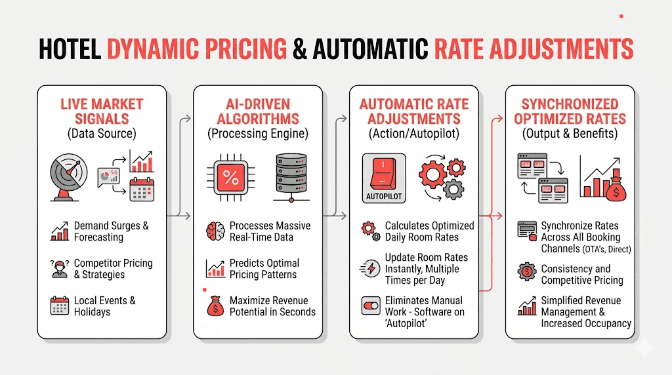
At its core, hotel dynamic pricing software with automatic rate adjustments refers to platforms that use AI-driven algorithms to change room rates instantly—or multiple times per day—based on live market signals. Unlike static pricing, these systems act as an “autopilot,” detecting demand surges, competitor moves, and local events to synchronize optimized rates across all your booking channels.
Core Features of a Modern RMS:
- Real-Time Pricing Engine: Automated “autopilot” modes that handle rate changes 24/7.
- Continuous Market Feeds: Rolling forecasts that incorporate live event data and competitor pricing.
- Dynamic Rule Sets: Automated triggers for minimum/maximum rates and length-of-stay (LOS) restrictions.
- Two-Way PMS Integration: Certified connections that ensure rate and inventory parity to avoid overbookings.
How PriceLabs Leads the Pack
PriceLabs utilizes a Hyper Local Pulse algorithm that generates daily pricing recommendations by analyzing internal occupancy, lead times, seasonality, and hyper-local event data. While most systems update once daily, PriceLabs offers a Real-Time Sync add-on for select PMSs, triggering up to 24 price updates per day instantly following a new reservation or cancellation.
Evaluation Criteria: How to Choose Your AI-Driven Hotel Pricing Partner
Selecting an AI-driven hotel pricing tool requires looking beyond the marketing fluff. You need a system that balances sophisticated automation with user-friendly control.
Key Decision Points:
- Update Frequency: Does the system update once a day, or can it react to a booking at 2 AM?
- Data Quality: Does it use “Mostly Hotel” data, or is it distracted by irrelevant short-term rental trends?.
- Configurability: Can you set “guardrails” so the AI never prices a suite below your operational cost?.
- Integration Depth: Does it have a certified, webhook-enabled connection with your specific PMS?.
Practical Tip
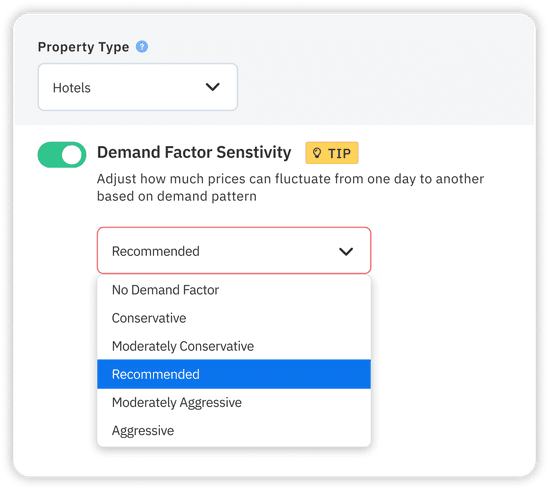
Look for a real-time hotel rate management system that offers “Smart Presets.” For example, PriceLabs’ Smart Presets simplify the setup by suggesting essential customizations like Demand Factor Sensitivity—allowing you to choose between “Conservative,” “Recommended,” or “Aggressive” responses to market shifts.
The Critical Importance of Two-Way PMS Integration
A hotel dynamic pricing software with automatic rate adjustments is only as good as its connection to your Property Management System (PMS). A “two-way integration” means that when the RMS calculates a new rate, it is instantly pushed to the PMS; conversely, when a room is booked in the PMS, that data flows back to the RMS to trigger a potential price hike for the remaining inventory.
Navigating PriceLabs Integrations
PriceLabs integrates with 160+ PMS and OTA platforms. To ensure your rates are perfectly synchronized, simply toggle on the ‘Enable Price Sync’ button in your dashboard. For hotels needing extreme agility, the Real-Time Sync add-on uses webhooks to update rates the moment a cancellation occurs, ensuring you never miss a re-booking opportunity.
Automation Maturity: From Advisory to Full Autopilot
Not every hotelier is ready to hand over the keys to an AI. Understanding the levels of automation helps you find your comfort zone:
- Advisory Mode: The system suggests a price; you click “Approve”.
- Semi-Automated: The system follows pre-set rules, like Multi-Room Occupancy-Based Adjustments , which raise prices as your occupancy hits certain tiers.
- Full Autopilot: The system updates rates across all channels automatically based on AI demand forecasting.
How PriceLabs Balances Control and Automation
PriceLabs is designed for hoteliers who have a “fear of losing control” but want the time-savings of automation. You can use Date-Specific Overrides to manually set prices for a graduation weekend while leaving the rest of the year on autopilot. Additionally, the Teams feature allows you to set access levels and view logs, so you always know who (or what) changed a price.
Pricing Models: Weighing Cost vs. ROI
Most real-time hotel rate management tools charge a flat fee per room or unit per month.
- PriceLabs Pricing: Offers a simple structure with no commissions.
- The Add-on Advantage: The Real-Time Sync feature (up to 3-24 syncs per day) is available for a small additional fee of $1 per month per room type, providing a high-ROI for high-demand markets.
Practical Example: If automating your pricing saves your Revenue Manager 10-15 hours per week and increases RevPAR by 20%, the software pays for itself within the first few days of the month.
Way Forward
Choosing a hotel dynamic pricing software with automatic rate adjustments is the single most impactful tech decision a hotelier can make in 2026. By automating the “busy work” of rate fetching and manual entry, you free your team to focus on guest experience and long-term strategy.
Your Next Step: Are you curious how your property is currently positioned against the market? Use the PriceLabs Hotel Rate Shopper to monitor up to 350 nearby properties and see their live pricing trends before you even commit to a sync.
Frequently Asked Questions ( FAQs)
What are hotel rate-management systems that auto-update in real time?
These systems use AI and dynamic pricing algorithms to adjust room rates instantly across all channels based on live market data and occupancy.
How do real-time rate adjustments benefit hotel revenue management?
They allow you to react to demand spikes and competitor moves 24/7, maximizing RevPAR and saving up to 15 hours of manual work per week.
Which integrations are essential for enabling automatic rate adjustments?
A certified two-way integration with your PMS and Channel Manager is essential to ensure rates and availability are synced without latency.
Are real-time auto-updating pricing tools suitable for all types of hotels?
Yes. Whether you are an independent boutique or a large chain, tools like PriceLabs offer scalable “Smart Presets” tailored to your specific hotel type.
How do these systems handle high-demand events and market volatility?
They detect increased booking velocity (pacing) and local market demand to automatically push rates higher, ensuring you capture peak revenue during holidays or major events.