
Get started with PriceLabs now!
Want to learn what PriceLabs can do for you? See for yourself with a free trial. Get started now!

Guests decide whether to click a listing in about eight seconds. If the cover photo is dark or the title reads like a disclaimer, price stops mattering. That's the pattern behind most requests to improve vacation rental reviews: the reviews aren't the real problem. The listing behind them usually is. Below is exactly what to check on your listing, how to reply to reviews in a way that changes outcomes, and where Listing Optimizer fits ahead of both.
To improve vacation rental reviews, audit five things before touching your price: the title, the cover photo, the first three lines of the description, the amenity list, and whether all of it agrees with itself. Guests judge accuracy fastest, and mismatches are the single biggest driver of low ratings.
Airbnb's ranking logic leans on two signals above almost everything else: the odds a guest books after seeing your listing, and the odds that guest leaves a strong review afterward. A listing that looks great but underdelivers collects weak reviews over time and slips in search.
PriceLabs' own analysis of more than 10,000 Airbnb listings found that 88 percent had some form of content issue, 70 percent had weak images, and 54 percent had inconsistent details between photos, description, and amenities. Listings with strong, consistent content were 35 percent more likely to outperform their local market. None of that is about price. It's about whether the listing tells guests the truth clearly enough to trust it.
A listing rated below 4.50 stars earns roughly 36 percent less than a near perfect one in the same market, and the gap compounds because Airbnb's algorithm now reads review text, not just star counts.
Two signals carry the most weight in search: click through rate, driven by your cover photo and title, and conversion rate, driven by price, completeness, and reviews together. Great reviews can't fix a listing guests never click on.
Airbnb applies natural language processing to guest reviews, so recurring phrases about noise or space get tracked as patterns even when stars stay high. A 4.7 star listing with clean, consistent language can outrank a 4.9 star listing with buried complaints. Cutting price rarely fixes this. Search placement depends on content first, rate second.
Run this before you touch a single rate. It takes about twenty minutes and surfaces most of what's actually suppressing your reviews and your bookings.
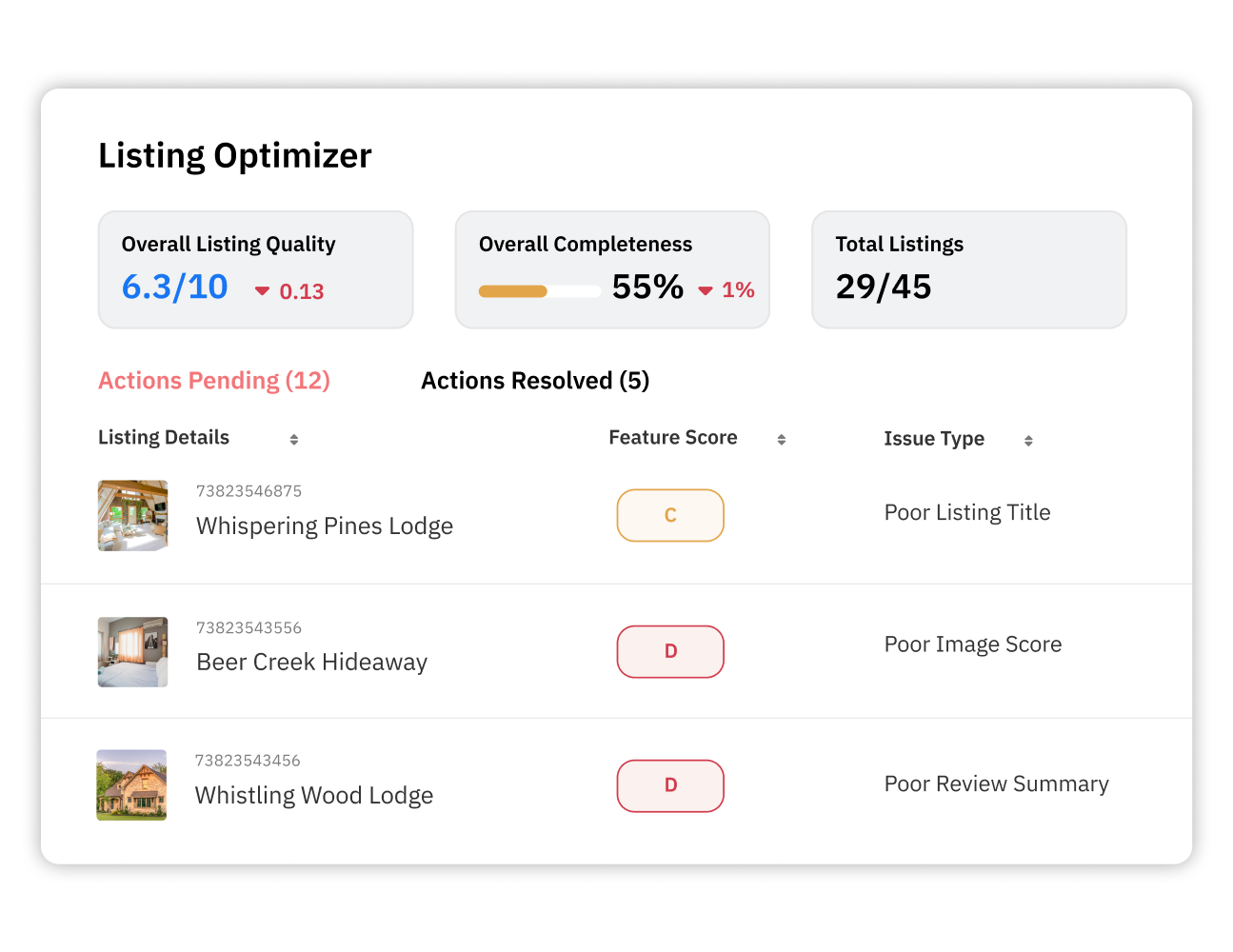
Title. Lead with the one feature a guest can't get nearby: the view, the hot tub, the walk to the beach. Drop filler words like "cozy" or "beautiful." They tell a search algorithm and a scanning guest nothing. Keep it under ten words.
Cover photo. It should show the single best room or view, shot in daylight, straight on rather than from a corner. If your current cover photo is a bedroom, check whether the living space or the view converts better. This one image drives most of your click through rate.
Description, first three lines. Guests read the opening lines before deciding whether to scroll further. Lead with layout, then the standout feature, then one practical detail such as parking or check in type. Save the full amenity list for further down.
Amenities against photos. Walk through your photos and your listed amenities side by side. Every amenity you list should appear in a photo, and every notable feature in a photo should be a listed amenity. Gaps here are the most common source of "smaller than photos" and "not what I expected" complaints.
Consistency check. Read the title, description, and amenities as a guest who has never seen the property would. If any one of the three implies something the others don't confirm, guests notice mid stay, not before booking, and it shows up in the review.
A generic thank you reply does nothing for your ranking. Airbnb's systems parse the substance of a reply, so it only helps if it demonstrates you actually fixed something.
Reply within 48 hours. Response speed is a tracked signal on its own, separate from what the reply says.
Name the specific issue. If a guest mentions noise, thin walls, or a confusing check in, restate it rather than posting a generic apology. This tells future guests exactly what changed and signals that the issue was acknowledged, not ignored.
State the fix, not just the apology. "We've added blackout curtains and posted quiet hours since your stay" carries more weight than "sorry to hear that." A stated fix becomes part of the listing's trust signal the next time a similar concern comes up.
Skip the public reply only when a review is factually wrong. Contest it through Airbnb's review process instead of arguing publicly. A defensive public reply reads worse to future guests than no reply at all.
Once listing content and review replies are solid, pricing is where gains compound. A property with strong, consistent reviews can support a higher ADR without losing conversion, because guests trust what they see before booking.
This is where dynamic pricing earns its keep. Rather than guessing a flat rate, a tool that adjusts to real time demand and your local comp set lets you capture the extra ADR your improved listing has already earned. Reviews and pricing aren't separate levers. Better feedback raises the ceiling, and dynamic pricing is how you reach it.
One time fixes fade. Photos age and competitors change. Rerun the five-point audit quarterly, check review sentiment for recurring themes, and confirm photos still match the property. For hosts managing several units, a management routine built around recurring checks scales better than reactive fixes after a bad month.
New listings need a different approach. Strong photos and an honest description carry the weight until first reviews arrive. Consistency, not a single overhaul, is what keeps a listing performing over time.
Run the five-point audit on your title, cover photo, description, and amenities before anything else. Weak or inconsistent listing content shapes guest expectations more than almost anything you can do during the stay. Then reply to existing reviews with specifics, not generic thanks.
Yes. Airbnb reads the full review text, not just stars, and tracks recurring themes. Consistently positive language around cleanliness and communication can outrank a slightly higher star rating with buried complaints.
It analyzes your title, description, photos, and amenities, grades the listing A through D, and returns recommendations ranked by likely impact, benchmarked against strong performers in your market.
Not automatically. Run the audit and check recent review sentiment first. A price cut on a listing with inconsistent content usually just trades revenue for the same visibility problem.
Improving vacation rental reviews rarely starts with the stay itself. It starts with what the listing promises before a guest checks in. Run the five-point audit, fix what's inconsistent, and reply to reviews with specifics instead of apologies. Then let strong reviews support a pricing strategy built to capture what your improved listing has already earned. Run yours through Listing Optimizer to see where it stands today.
For real, high-converting review examples, see our full guide to Airbnb guest review examples.
Improving reviews is one part of a broader listing strategy — see our complete guide to Airbnb listing optimization.
Want to learn what PriceLabs can do for you? See for yourself with a free trial. Get started now!