Table of Contents
Updated : Feb 16, 2026
Choosing between hotel dynamic pricing tools vs vacation rental tools is a lot like buying a bespoke tailored suit versus an off-the-rack jacket—both keep you warm, but only one is cut perfectly to your unique dimensions and operational needs. At its core, dynamic pricing is the automated process of adjusting rates in real time using demand, seasonality, competition, and local events to ensure your nightly rates are constantly optimized to maximize occupancy and revenue. However, because hotels manage interchangeable room blocks and face distinct market pressures, their revenue management software must prioritize different data, integrations, and automation rules compared to tools built for unique, standalone vacation rentals. Let’s break down the seven critical differences so you can select the right engine for your property.
1. Data Sources and Market Granularity
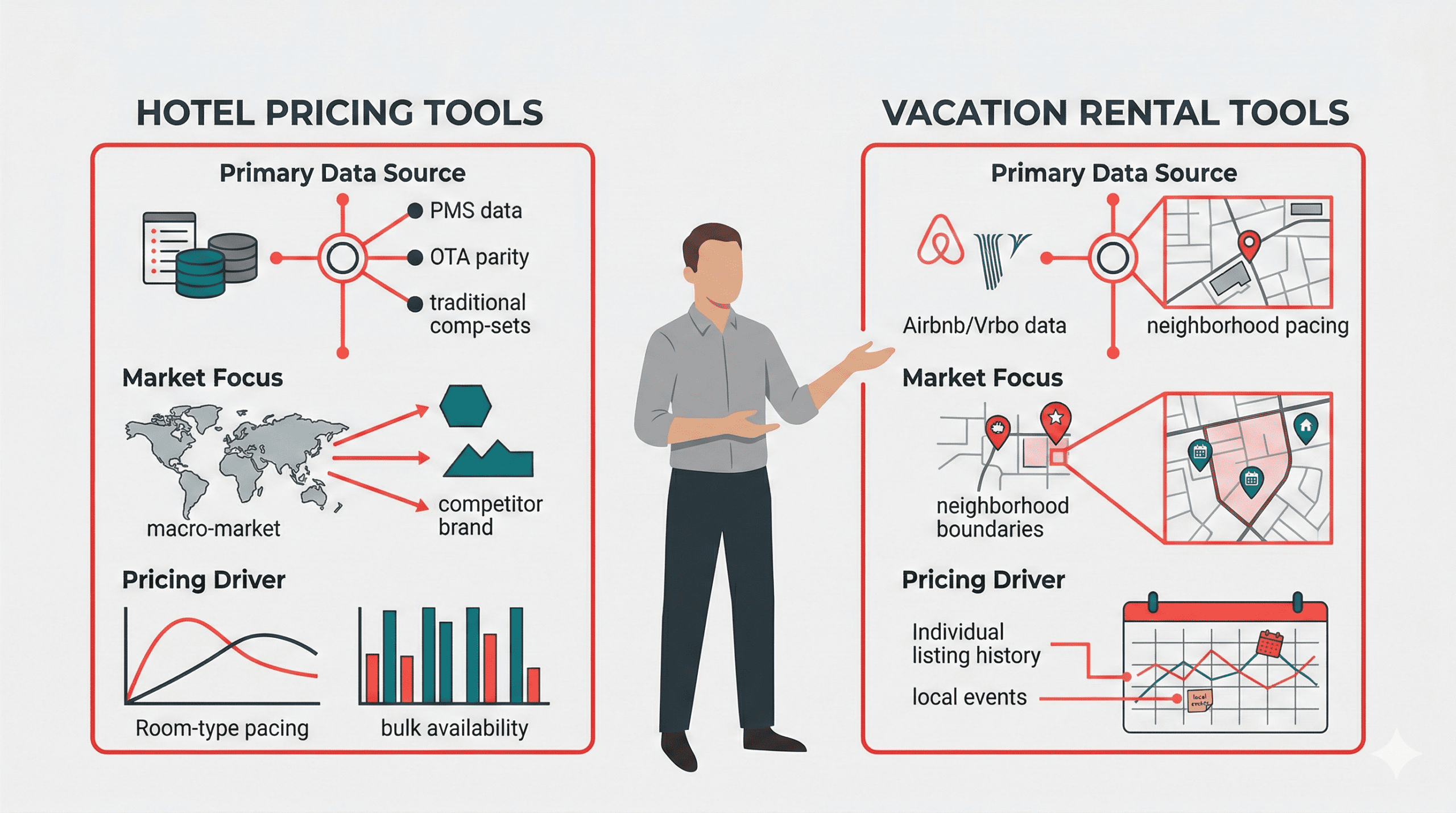
The foundation of any pricing engine is the data it consumes. Hotel and vacation rental systems look at entirely different sets of market signals to determine the “right” price.
For Hotels: Hotel systems heavily rely on OTA (Online Travel Agency) and PMS (Property Management System) occupancy data, strict rate-parity signals, and structured competitive set (comp-set) monitoring. They look at macro market trends and direct competitor pricing.
For Vacation Rentals: These tools emphasize hyper-local comps, listing-level booking history, neighborhood demand signals, and local event calendars because each property is distinct.
| Feature | Hotel Pricing Tools | Vacation Rental Tools |
| Primary Data Source | PMS data, OTA parity, traditional comp-sets | Airbnb/Vrbo data, neighborhood pacing |
| Market Focus | Macro-market and direct brand competitors | Hyper-local neighborhood trends |
| Pricing Driver | Room-type pacing and bulk availability | Individual listing history and local events |
How PriceLabs Helps Hotels: If you are struggling with no clear competitive benchmarking, PriceLabs bridges this gap perfectly. The Dynamic Pricing (Hyper Local Pulse) generates daily pricing recommendations using internal occupancy, lead time, seasonality, and publicly available hotel market data. Plus, the Hotel Data Tab (Rate Shopper) lets you monitor pricing trends across up to 350 nearby hotel-like properties, while Hotel Weights gives you control over the influence of hotel data versus short-term rental data on your pricing recommendations.
2. Inventory Model and Property Uniqueness
How you sell your space dictates how you must price it. The inventory models between these two sectors are fundamentally different.
Hotels manage pools of interchangeable rooms grouped by type (e.g., 50 Standard Kings). This enables bulk rate-setting at the portfolio or room-type level. Vacation rentals, on the other hand, boast high property uniqueness; each home requires individual price optimization factoring in specific amenities, location, and owner rules. Rental tools also focus heavily on “orphan day optimization”—automatically discounting 1- or 2-night gaps between longer bookings.
Practical Tip: If you run a boutique hotel, you need a tool that understands room categories, not just single listings, to prevent unbalanced sell-throughs where your cheap rooms sell out months in advance while suites sit empty.
How PriceLabs Helps Hotels: To solve the pain of managing complex pricing strategies across different inventory, PriceLabs offers Multi-Room Occupancy-Based Adjustments. This feature automatically adjusts pricing recommendations based on occupancy trends within specific room types, supporting balanced sell-through across your entire inventory. You can also utilize Room-Type Specific Pricing to apply custom rules to individual room categories without breaking your broader property settings.
3. Automation and Manual Override Controls
Automation in dynamic pricing refers to the system’s ability to update rates, restrictions, and minimum stays without manual intervention, while manual override allows human input for exceptions.
Hotels require centralized control, portfolio rules, and bulk rate adjustments to manage scale. If a hotel manager is facing unexpected group cancellations, they need to push a bulk update instantly. Vacation rentals require granular customizations, such as per-listing rule sets and owner-specific minimum/maximum nightly price limits.
How to Balance Automation and Control:
- Let the system handle daily demand-based pricing fluctuations.
- Use manual overrides only for unique situations, like a sudden corporate buyout or VIP event.
How PriceLabs Helps Hotels: Many revenue managers have a fear of losing control and prefer manual adjustments. PriceLabs gives you full user control while eliminating manual busywork. You can use Date-Specific Overrides to lock in pricing and stay restrictions for high-demand dates, or rely on automated Last-Minute Pricing Adjustments to adapt close-in dates based on pickup and market demand. You get the automation you need without sacrificing the exact control you want.
4. Length-of-Stay and Minimum Stay Logic
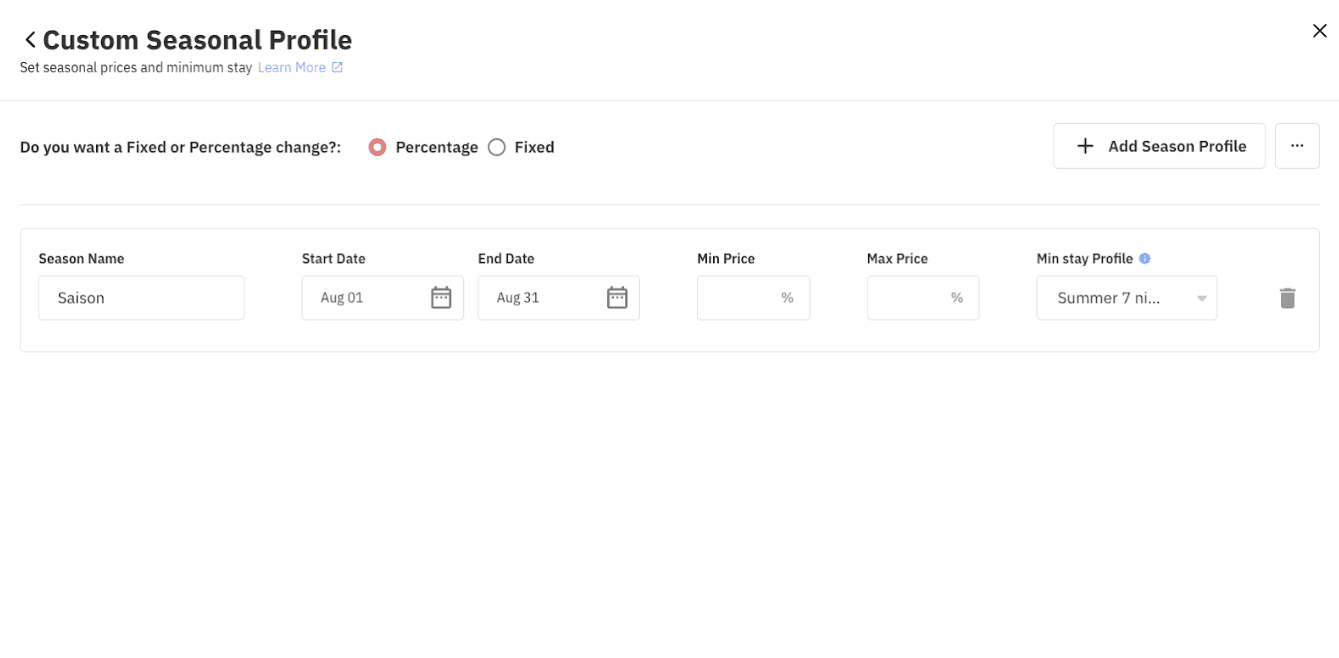
Length-of-stay (LOS) logic refers to policies that vary pricing or booking acceptance based on the number of nights booked.
Hotels traditionally set LOS requirements across room types and rate plans, often tying them to specific packages, corporate groups, or negotiated rates. Vacation rental software leans heavily into advanced minimum-stay intelligence and cascading discounts—for example, requiring a 3-night stay on weekends but dropping it to 1 night to fill an “orphan day” gap last minute.
| Lodging Type | Typical LOS Strategy | Primary Goal |
| Hotels | Yield management by room type, seasonal base rules | Maximize total revenue per available room (RevPAR) |
| Vacation Rentals | Cascading minimums, orphan day filling | Reduce operational turnover costs and fill calendar gaps |
How PriceLabs Helps Hotels: To help you capture peak demand opportunities without leaving gaps in your calendar, PriceLabs features robust Minimum Stay Rules. This adapts length-of-stay suggestions dynamically based on seasonality, booking patterns, and demand periods, ensuring your hotel maximizes revenue during busy weekends without turning away mid-week travelers.
5. Integration Depth and Sync Frequency
A pricing tool is only as good as its ability to talk to your other systems. The term ‘integration depth’ refers to how well a pricing tool connects to your PMS, OTAs, or channel managers to push prices and restrictions.
Hotel systems require deep PMS integrations to handle complex rate parity across OTAs, corporate contracts, and group room allocations, often requiring high-frequency or real-time updates. Vacation rental tools typically sync nightly (often between 6 PM and 6 AM) and focus on connecting with platforms like Airbnb and Vrbo alongside property management software.
How PriceLabs Helps Hotels: Disconnected systems are a major headache for hoteliers. PriceLabs boasts 160+ PMS & OTA Integrations, ensuring automated rate syncing across all your booking channels. More importantly, for select PMSs, PriceLabs offers Real-Time Sync—a high-frequency add-on using webhooks to trigger up to 24 price updates per day instantly following new reservations or cancellations.
6. Reporting Focus and Key Performance Indicators
If you are a hotel operator, you speak a very specific language: RevPAR (Revenue per Available Room) and ADR (Average Daily Rate). Hotel dashboards must focus on occupancy pacing, RevPAR growth, ADR trends, and bulk portfolio analytics to justify pricing changes to owners.
Vacation rental reporting tends to focus on revenue per individual property, owner payout statements, and gap-filling success rates.
How PriceLabs Helps Hotels: Revenue managers often face data overload but still need solid data to manage owner pushback. PriceLabs cuts through the noise with its Report Builder and Portfolio Analytics. You can create custom, easy-to-understand reports using key hotel KPIs like ADR, Occupancy, RevPAR, and pacing. This makes it incredibly easy to forecast revenue, track room-level performance, and confidently justify your pricing strategy to stakeholders.
7. Pricing Models and Commercial Structures
Finally, how you pay for the software differs wildly.
Large hotel portfolios typically benefit from flat-fee models (a predictable recurring charge per room or property per month) because their scale makes commission-based pricing too expensive. Vacation rental tools often offer commission models (a percentage of revenue generated) which can lower the barrier to entry for seasonal operators.
How PriceLabs Helps Hotels: Many independent hotels hesitate to invest in expensive enterprise revenue management solutions due to budget constraints. PriceLabs offers an accessible, transparent pricing model without the complexity or massive price tag of legacy enterprise RMS platforms. With automated reports, instant insights, and a seamless interface, you get big-brand sophistication at an independent hotel budget.
Way Forward
Understanding the nuances between hotel dynamic pricing tools vs vacation rental tools is essential for optimizing your revenue strategy. While vacation rental tools prioritize individual listing quirks and neighborhood pacing, hotel tools must handle interchangeable inventory, complex rate parity, and macro-market competitive benchmarking. By utilizing a highly adaptable, data-driven system, independent hotels can finally ditch manual spreadsheets, reduce their reliance on OTA commissions, and confidently capture peak demand.
Frequently Asked Questions
What distinguishes hotel dynamic pricing tools from vacation rental tools?
Hotel dynamic pricing tools prioritize centralized control, interchangeable room-type inventory, and portfolio-wide automation, while vacation rental tools are designed for per-property customization, unique amenities, and local market responsiveness.
How do integration requirements differ between hotel and vacation rental pricing systems?
Hotels generally require deeper PMS integrations for high-frequency rate updates, rate parity management, and group inventory handling, while vacation rental tools focus heavily on seamless nightly syncing with major OTAs like Airbnb and Vrbo.
What impact do length-of-stay rules have on pricing strategies?
Length-of-stay rules help optimize occupancy by enabling flexible restrictions for longer or shorter stays. They tailor pricing to demand patterns, ensuring hotels can protect weekend availability while vacation rentals can automatically fill awkward mid-week calendar gaps.
How should portfolio size influence the choice of pricing tool?
Larger hotel portfolios typically benefit from bulk automation, room-type categorization, and flat-fee pricing models. Smaller or highly unique vacation rental operators often prefer granular, property-level controls and flexible, sometimes commission-based, models.
What are common challenges when implementing dynamic pricing for different lodging types?
Key challenges include ensuring rate parity and managing group displacement for hotels, customizing pricing for unique property amenities in rentals, and ensuring seamless data syncs between diverse PMS and channel management systems.