
Get started with PriceLabs now!
Want to learn what PriceLabs can do for you? See for yourself with a free trial. Get started now!

When investing in real estate, one of the most important questions that investors ask is: What kind of return on rental property can I expect? Understanding your vacation rental return is crucial for making smart, data-driven decisions that boost your profit, build your wealth, and minimize risk.
In this ultimate guide, we’ll go over how to calculate ROI on rental properties, how it compares to other metrics, what is considered a good ROI on rental property, and how to enhance the performance of your investment property. We’ll also show you how tools like PriceLabs can help you optimize pricing and occupancy to maximize your bottom line.
Bonus: How to Calculate Airbnb Income: The Ultimate Guide to STR Profitability
Return on investment (ROI) is a metric commonly used to evaluate the profitability of an investment in relation to its total cost. For rental properties, ROI refers to the profit you’re making from the property relative to how much money you’ve spent on it. It is one of the main vacation rental KPIs.
ROI Formula
ROI = Net Annual Profit/Total Investment x 100%
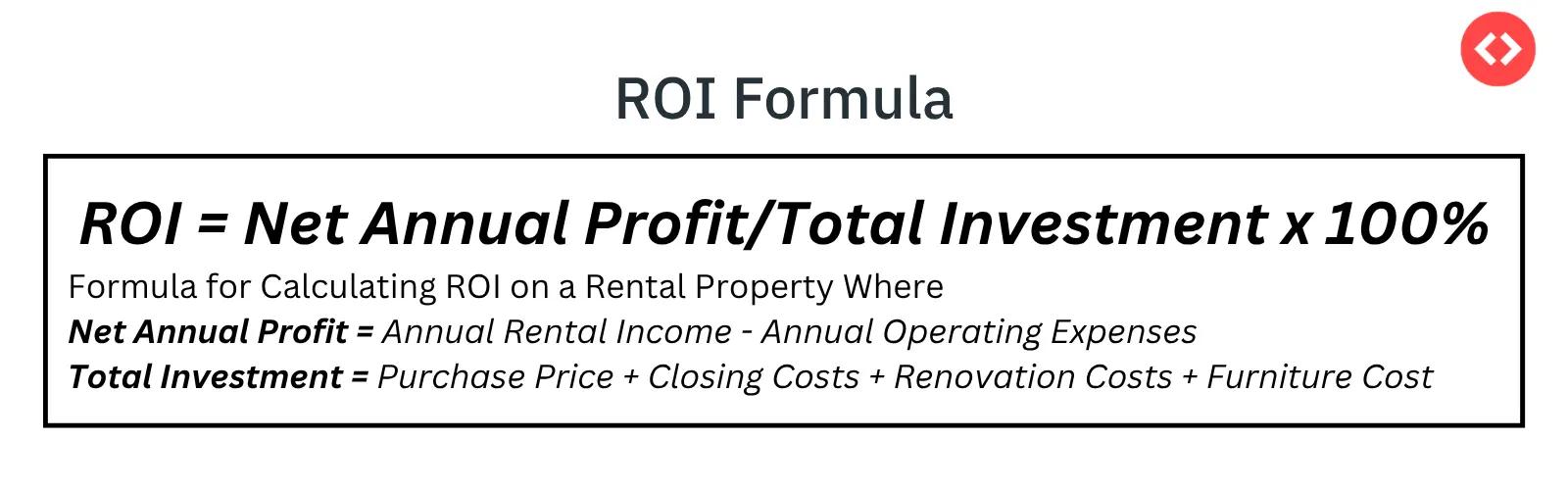
To calculate the rental income of your Airbnb property, use the following formula:
Gross Rental Income = Average Daily Rate (ADR) x Occupancy Rate
To make things clearer for first-time investors, let’s take a look at a concrete example.
ROI Example
Consider the following scenario. An investor buys an Airbnb property and yields these financial results:
ROI = ($55,000 – $20,000)/($350,000 + $8,700 + $15,000 + $20,000) x 100%
ROI = 8.89%
So, the return on this rental property is 8.89% per year.
The capitalization rate (cap rate) is another measure of profitability in real estate investing. Although it is often confused with ROI, these are two distinct metrics that serve different purposes and are calculated differently.
The cap rate evaluates a rental property’s income potential relative to its current market value (CMV). It doesn’t consider the method of financing. Meanwhile, the ROI takes into account the total investment, including mortgage payments. This makes return on rental properties a more comprehensive measure of long-term profit.
Both the cash on cash return (CoC return) and ROI assess rental property performance, but they focus on different aspects.
The cash-on-cash return measures the annual pre-tax cash flow relative to the actual cash invested. This makes it a particularly good metric for financed properties. The return on investment, on the other hand, evaluates total profitability over time. Thus, the average ROI on a real estate property provides a broader picture of the overall investment performance.
There is no single best ROI for a rental property as it depends on a number of factors. Still, most real estate experts agree that a good ROI for a rental property is in the range of 5-10%.
A higher return on a rental property – 15%+ – is sometimes possible in high-demand or emerging markets, but it comes along with greater risk.
Lower ROI – 5-7% – might be good if you invest in a property in stable, sub-urban markets where appreciation is the main driver of profit. This lower return brings lower risk too.
It is hard to say what a good return on a rental property is because it depends on many factors.
The main drivers of ROI include:
The following proven tips will help you maximize the ROI of your short-term rental:
Maximizing your return on rental property boils down to choosing the right market, boosting occupancy, enhancing daily rates, keeping expenses at bay, and making smart, data-based decisions. In other words, your long-term success depends on optimizing both rental income and operating costs.
Technology plays a vital role in this process. You can dynamically adjust nightly prices based on demand and comps with tools like PriceLabs’ Dynamic Pricing. You can benchmark your property’s performance against local trends to increase ROI with Market Dashboards. You can track performance to ensure upward trends with Portfolio Analytics.
By leveraging the power of smart technology, such as PriceLabs, you can increase bookings, reduce vacancy, optimize daily rates, and – ultimately – boost the return on your vacation rentals without extra manual work.
According to the 2% rule, a rental property is a good deal if the monthly rent is equivalent to at least 2% of the purchase price. For example, a property that costs $200,000 should rent out for at least $4,000 per month.
The 50% rule suggests that about 50% of the rental income goes towards operating expenses excluding mortgage. So, if you earn $3,000 in monthly rent, you can expect $1,500 in operating costs.
Simply put, the ROI measures how much profit you make from a rental compared to what you spend on the property. It tells you how much money your investment is making.
For the broader set of calculator tools beyond ROI specifically, see our roundup of income calculators.
Want to learn what PriceLabs can do for you? See for yourself with a free trial. Get started now!