
Table of Contents
Updated : Mar 26, 2026
If you are a vacation rental property manager, you already know that the short-term rental (STR) industry is not just about handing over keys and cleaning up after guests leave. It is a fast-paced, highly competitive ecosystem that requires you to be a hospitality expert, a marketing guru, a logistics master, and a data-driven revenue manager all at once.
Whether you are managing a portfolio of five boutique cabins or tackling complex multi-unit vacation rental management with hundreds of urban apartments, the core goal remains the same: maximizing revenue for your owners while delivering unforgettable experiences for your guests.
But how do you scale your operations without burning out? Navigating everyday property management challenges—like double bookings, seasonality shifts, and maintenance emergencies—requires a proactive approach. How do you ensure your listings stay at the top of search results on Airbnb, Vrbo, and Google? And most importantly, how do you avoid leaving money on the table in an ever-changing market?
Welcome to your ultimate guide to short-term rental property management. In this comprehensive pillar guide, we will break down everything you need to know to build, manage, and scale a highly profitable vacation rental property management company.
Who Is This Guide For?
Wondering if this comprehensive guide is the right fit for you? We designed this resource with both aspiring and experienced property managers in mind.
If you are just considering—or actively in the process of becoming—a vacation rental property manager, this guide will equip you with the foundational knowledge you need to hit the ground running.
However, if you are already an established professional in the short-term rental industry, this guide is just as valuable. In the following chapters, you will discover advanced strategies to scale your vacation rental property management business. We cover how to expand your services, optimize your nightly rates using data-driven tools like PriceLabs, and build a tech stack that runs your operations on autopilot.
Whether you are managing your first property or looking to double your existing portfolio, there is a strategy in here to help you grow.
What Exactly is Short-Term Rental Property Management?
Short-term rental (STR) property management is the complete, end-to-end oversight of a furnished living space that is rented out for short periods—typically ranging from a single night to a few weeks.
Unlike traditional long-term rental management, where your primary job is finding a reliable tenant for a 12-month lease and handling the occasional leaky faucet, STR management is an intensive, fast-paced hospitality operation. You aren’t just managing a building; you are managing a revolving door of guest experiences.
Maximize Your Earnings with PriceLabs
Automated dynamic pricing and market dashboards designed for serious vacation rental operators.
Start Your Free Trial NowThe Origins: How the Vacation Rental Industry Evolved
To understand where property management is today, it helps to look at how it started. Vacation rentals themselves are not a new concept. For decades, families rented out beach houses and ski cabins using newspaper classifieds, local bulletin boards, or traditional real estate agents.
In 1995, VRBO (Vacation Rentals by Owner) moved the industry online, allowing owners to list their properties on the internet. However, it remained a relatively niche market primarily focused on traditional vacation destinations.
Then came 2008. The launch of Airbnb changed the landscape forever, turning spare bedrooms, urban apartments, and second homes into a massive, global hospitality movement. What started as a quirky “couch-surfing” alternative rapidly matured. Travelers realized they loved the privacy, kitchens, and unique local feel of short-term rentals, while property owners realized the massive revenue potential.
Today, the STR sector is a multi-billion dollar industry. It has shifted from a casual side-hustle for amateur hosts to a highly professionalized asset class requiring sophisticated technology, specialized staff, and data-driven revenue management.
The Day-to-Day Responsibilities of an STR Property Manager
Because the industry has professionalized, the workload has grown exponentially. If you or your clients are wondering exactly what a property manager does on a daily basis, the reality is that you must wear a dozen different hats.
A standard day in the life of a professional STR manager involves orchestrating the following core responsibilities:
- Listing Creation and Channel Distribution: Your digital storefront never closes. You must write compelling, SEO-optimized titles and descriptions, and manage high-quality photography across multiple Online Travel Agencies (OTAs). Furthermore, dedicated Airbnb property management requires a deep understanding of platform-specific algorithms—such as knowing how often to update your calendar, how to maintain Superhost status, and how to utilize Instant Book to stay at the top of search results.
- Pricing and Revenue Management: You cannot set a flat rate and walk away. Every single day, you must adjust nightly rates based on shifting market demand, local events, pacing, and competitor data. (This is where utilizing PriceLabs’ automated dynamic pricing saves managers countless hours every week).
- 24/7 Guest Communication: The modern traveler expects immediate responses. Your day involves handling pre-booking inquiries, sending automated check-in codes, troubleshooting Wi-Fi issues at 10:00 PM, and leaving thoughtful reviews after check-out.
- Housekeeping and Turnover Logistics: You must coordinate a military-tight schedule of turnover cleans between a 10:00 AM check-out and a 4:00 PM check-in. This involves scheduling cleaning crews, monitoring inventory (like coffee, toilet paper, and linens), and managing sudden maintenance emergencies.
- Owner Reporting and Trust Accounting: You work for the property owners. At the end of every month, you must distribute accurate financial payouts, track maintenance expenses, and provide transparent performance reports that prove your value.
- Legal, Tax, and Local Compliance: You are responsible for ensuring that every property meets local zoning laws, has the correct operating permits, and that all transient occupancy taxes are collected and remitted properly.
In short, short-term rental property management is a complex balancing act. Because the day-to-day responsibilities are so demanding, the most successful managers rely heavily on automated tech stacks to handle the routine tasks, freeing them up to focus on scaling their business and maximizing revenue.
Bonus Read: How to Manage Your Vacation Rental Home Remotely
The Mechanics of Dynamic Pricing & Revenue Management
As a property manager, your inventory is highly perishable. If a night goes unbooked, you can never sell it again. This is why revenue management—specifically dynamic pricing—is the beating heart of a successful short-term rental business.
Many amateur hosts still rely on static pricing. They might have a “summer rate” and a “winter rate,” or perhaps they charge slightly more on weekends. This “set-it-and-forget-it” mentality leaves massive amounts of money on the table.
The Key Factors Influencing Your Nightly Rate
To maximize both occupancy and Average Daily Rate (ADR), your pricing strategy must account for several overlapping variables every single day:
- Seasonality: Every market has peak, shoulder, and low seasons. Your pricing needs to curve smoothly with these macro-trends rather than jumping abruptly from one static tier to another.
- Day-of-Week Trends: In urban markets, Tuesdays and Wednesdays might be dead, while weekends are fully booked. Conversely, some destination markets see week-long bookings where the day of the week matters less than the check-in day.
- Local Events and Holidays: A major tech conference or a regional sports tournament can cause demand to spike 500% overnight. If you aren’t tracking local event data, you will sell out too early and too cheaply.
- Lead Time: How far in advance are people booking? If a guest wants to book a home for Christmas six months in advance, they should pay a premium. If a property is sitting empty for this coming weekend, you need a last-minute discount strategy to secure a booking.
Maximize Your Earnings with PriceLabs
Automated dynamic pricing and market dashboards designed for serious vacation rental operators.
Start Your Free Trial NowHow PriceLabs Automates the Heavy Lifting
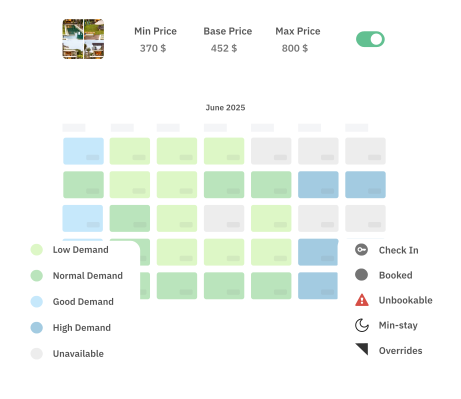
You cannot manually monitor pacing, events, and lead times for dozens of properties. PriceLabs turns this complex mathematical challenge into an automated, easy-to-manage workflow.
- Automated Dynamic Pricing: PriceLabs scans billions of data points to adjust your nightly rates automatically based on seasonality, day-of-week trends, and local events.
- Length of Stay (LOS) Customization: You can set rules that automatically reduce minimum stay requirements if a property has a gap between two bookings, ensuring you never miss an “orphan day” booking.
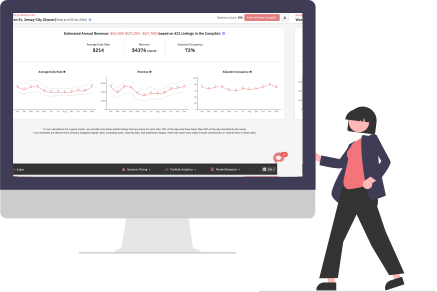
- Revenue Estimator Pro: If you are trying to pitch a new owner to sign with your management company, use the PriceLabs Revenue Estimator Pro to generate instant, highly accurate revenue projections for their specific address.
Building a Future-Proof Tech Stack
Managing five properties using a spreadsheet and an alarm clock might work temporarily, but managing 50 or 500 properties requires a serious software ecosystem. Here is the blueprint for a modern, highly efficient short-term rental tech stack.
1. The Command Center: Property Management Systems (PMS)
Your PMS is the central nervous system of your entire operation. A robust PMS replaces the need to log into individual OTAs every day, providing a unified inbox, a channel manager to prevent double bookings, and secure payment processing.
2. The Brain: Revenue Management Software (RMS)
Your PMS tells the internet when your properties are available, but your RMS tells the internet how much they cost.
- Seamless Integration: PriceLabs connects directly with over 150+ PMS platforms and Channel Managers. You set your strategy in PriceLabs, and it automatically pushes daily rate updates everywhere.
- Portfolio Analytics: Track your entire company’s performance at a glance. Identify which properties are underperforming and adjust their specific pricing strategies on the fly.
3. The Muscle: Operations and Housekeeping Tech
Use task automation software (like Turno or Breezeway) to automatically read your PMS calendar. The second a guest books a stay, a cleaning task is automatically generated. Require visual, timestamped checklists from your cleaners before they clock out.
4. The Eyes and Ears: Smart Home Automation
- Smart Locks: Integrate locks with your PMS so every guest automatically receives a unique, time-sensitive code.
- Noise Monitors: Prevent unauthorized parties using decibel-monitoring devices that alert you before the neighbors call the police.
- Energy Management: Use smart thermostats to automatically reset temperatures after check-out, saving thousands on utility bills.
- Advanced Marketing and Multi-Channel Distribution
Having a beautiful property and the perfect dynamic pricing strategy means nothing if no one sees your listing. To truly succeed, you need comprehensive marketing strategies for vacation rentals that go beyond simply publishing an OTA listing.
Bonus Read: How to Get Property Management Leads: 8 Effective Ways to Grow Your Business
1. Mastering the Big OTAs (The Billboard Effect)
Think of Airbnb, Vrbo, and Booking.com as massive digital billboards. You need to be on them, but you need to know how to play their specific algorithm games. Ensure your listings are visually stunning, packed with optimized keywords, and feature comprehensive amenity lists.
2. The Direct Booking Revolution
Building your own direct booking website is how you reclaim the 15% to 20% commission fees charged by OTAs.
- It protects you from algorithmic changes, allows you to build a recognizable brand, and gives you direct ownership of your guest data.
- Using PriceLabs, you can set channel-specific markups, ensuring your direct site is always the most cost-effective option for guests to book.
Bonus Read: Social Media Tips for Hosts: Boost Your Airbnb Marketing
Mastering Legal, Compliance, and Accounting
Growth is exciting, but compliance is what keeps the doors open.
1. Navigating STR Regulations and Zoning
Never operate an illegal short-term rental. Ensure every property in your portfolio has the correct municipal permits, fire safety inspections, and business licenses.
2. Trust Accounting and Financial Transparency
When handling other people’s money, your accounting must be flawless. Use dedicated trust accounts to separate guest deposits, owner payouts, and your management commissions. When sending out monthly statements, use data from PriceLabs Portfolio Analytics to show your owners exactly how your dynamic pricing strategy increased their revenue compared to the market average.
3. Bulletproof Insurance and Risk Management
Standard homeowner’s insurance almost never covers short-term rental activity. Require every owner to carry specialized commercial vacation rental insurance. Furthermore, integrate a guest screening tool into your booking flow to run instant background checks and verify IDs, keeping your properties safe from professional party-throwers.
Maximize Your Earnings with PriceLabs
Automated dynamic pricing and market dashboards designed for serious vacation rental operators.
Start Your Free Trial NowScaling Your Property Management Business
Once your operations are humming, the next step is growth. Scaling your property management business requires a shift from day-to-day operations to high-level strategy and owner acquisition.
Leverage Data for Owner Acquisition
When you pitch a prospective property owner, don’t just promise them you will “do a good job.” Show them the numbers.
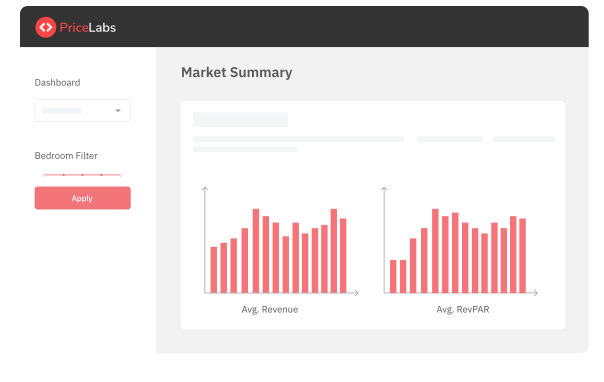
Using PriceLabs Market Dashboards, you can pull real-time data on their exact neighborhood. You can walk into a meeting and say: “Properties of your size in this zip code are operating at 65% occupancy and making $85,000 a year. Based on my revenue pacing analysis, I can increase your off-season occupancy by 15% using intelligent dynamic pricing, bringing your potential revenue to $105,000.” Data wins contracts.
Build a Recognizable Brand
Don’t just be a generic management company. Build a brand that stands for quality, consistency, and trust. Standardize your amenities across all units, invest in a professional web presence, and actively gather positive reviews on Google My Business.
Conclusion: The Future Belongs to the Data-Driven Manager
Short-term rental property management is no longer a side hustle; it is a sophisticated, technology-driven hospitality business. The managers who will dominate the market in 2026 and beyond are the ones who adapt to changing trends, automate their repetitive tasks, and obsess over data-driven revenue management.
You don’t have to guess what your nightly rate should be. You don’t have to wonder if your market is pacing ahead or behind last year.
By integrating a powerful tech stack, prioritizing guest experience, and leveraging world-class tools like PriceLabs, you can unlock the full revenue potential of your properties, thrill your property owners, and build a highly profitable management empire.