Table of Contents
Updated : Mar 3, 2026
Managing your hotel’s daily rates with a manual spreadsheet is like trying to navigate a cross-country road trip using a crumpled, decade-old paper map while your competitors are using a live, traffic-updating satellite GPS. You might eventually reach your destination, but you will hit every traffic jam, miss the fastest shortcuts, and burn a lot of unnecessary fuel along the way. In today’s hyper-competitive hospitality landscape, relying on static data means leaving money on the table every single night. That is exactly why independent hoteliers are moving beyond the spreadsheet. To thrive, you need a system that adapts to the market in real-time. Let’s dive deep into why implementing modern pricing tools for hotels is the ultimate game-changer for your revenue strategy.
The Spreadsheet Trap: Why Manual Pricing is Costing You Money
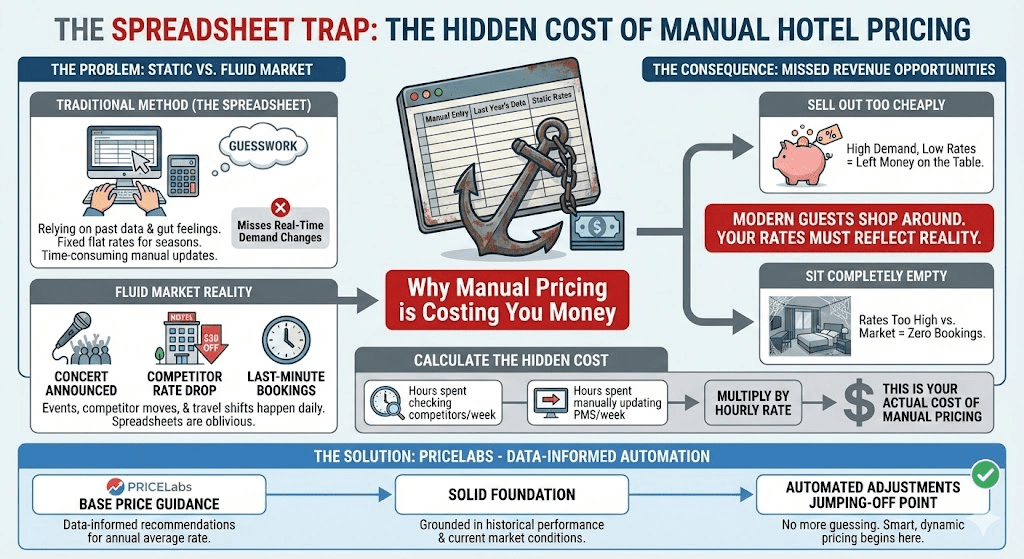
For years, the standard operating procedure for independent hotels was the trusty spreadsheet. You would look at last year’s numbers, guess the upcoming demand, and manually type in a flat rate for the season.
But here is the candid truth: spreadsheets are static, and the travel market is incredibly fluid. If a major concert is announced in your city on a random Tuesday, your spreadsheet won’t tell you. If your competitor down the street drops their rates by $30 to capture last-minute bookings, your spreadsheet remains blissfully unaware. Relying on manual updates is not just time-consuming; it is a recipe for missed revenue. The modern guest shops around, and if your rates don’t reflect current market realities, you either sell out too cheaply or sit completely empty. This is the primary reason why sophisticated pricing tools for hotels have become essential.
Practical Tip: Calculate how many hours you or your revenue manager spend each week just checking competitor websites and manually adjusting rates in your Property Management System (PMS). Multiply those hours by your hourly rate. That is the hidden cost of the spreadsheet.
How PriceLabs Helps Here: Breaking away from the spreadsheet starts with establishing a solid foundation. PriceLabs offers Base Price Guidance, which provides data-informed recommendations for setting an annual average rate. Instead of guessing your baseline, this tool grounds your starting price in your hotel’s historical performance and current market conditions. It gives you the perfect jumping-off point for automated adjustments.
What Exactly Are Pricing Tools for Hotels?
When we talk about pricing tools for hotels, we are talking about intelligent software that automates the revenue management process. Often called hotel revenue management software, these platforms analyze millions of data points to recommend and apply the most profitable room rate for any given night.
Unlike traditional, clunky enterprise systems designed for massive 500-room corporate chains, modern pricing tools for hotels are built to be agile, user-friendly, and accessible for independent operators. They look at your internal data (how many rooms you have left to sell) and external data (what the market is doing) to find the perfect mathematical sweet spot for your daily rate.
An Example of Automation:
Imagine it is a slow month. A sudden weather front delays dozens of flights at your local airport. Demand for hotel rooms spikes at 4:00 PM. A human using a spreadsheet would likely miss this micro-surge. Modern software detects the surge in market demand and incrementally raises your rates to capture maximum value from stranded travelers.
How PriceLabs Helps Here:
This is where PriceLabs’ Dynamic Pricing (Hyper Local Pulse) shines. It generates daily pricing recommendations using your internal occupancy, lead time, seasonality, local events, and publicly available hotel market data. It does the heavy lifting, ensuring you are always offering the right price to the right guest at the right time.
The Need for Speed: Embracing Real-Time Syncing
The hospitality market moves fast. A sudden cancellation from a large wedding block can suddenly leave you with 10 empty rooms for the upcoming weekend. If you are updating rates manually, it might take you a day or two to realize the cancellation happened, lower your rates, and push those updates to all your Online Travel Agencies (OTAs).
By the time you make the manual update, the booking window for that weekend might have already closed. Modern pricing tools for hotels eliminate this lag time.
How to Step: Stop the Manual Push
- Connect your property management system to a dynamic pricing tool.
- Set your minimum and maximum rate boundaries.
- Allow the software to automatically push rate updates to your direct website and all OTAs simultaneously.
How PriceLabs Helps Here:
PriceLabs offers a high-frequency add-on called Real-Time Sync (for select PMSs). This feature uses webhooks to trigger up to 24 price updates per day instantly following new reservations or cancellations. If that wedding block cancels, PriceLabs instantly reacts, adjusting your rates to stimulate demand and syncing those new prices across your channels without you having to lift a finger. Furthermore, with Rate Plan Support, it syncs these recommendations across multiple rate plans, including your refundable and non-refundable options.
Competitive Benchmarking: Spying on the Neighbors Digitally
You cannot price your hotel in a vacuum. Your potential guests certainly aren’t shopping in one. When a traveler is looking for a room, they open Expedia, Booking.com, or Google Travel and compare your property directly against your neighbors.
If your nightly rate is significantly higher than a comparable hotel next door, the guest needs a very obvious reason (better reviews, better amenities) to choose you. If your rate is drastically lower, you are simply giving away profit. The best pricing tools for hotels act as an automated digital magnifying glass on your local market.
| Method | Tracking Competitors | Speed of Adjustment | Accuracy |
| Spreadsheet | Manual website checking | Slow (Weekly/Monthly) | Prone to human error |
| Pricing Tools | Automated data scraping | Fast (Daily/Hourly) | Highly accurate market data |
How PriceLabs Helps Here
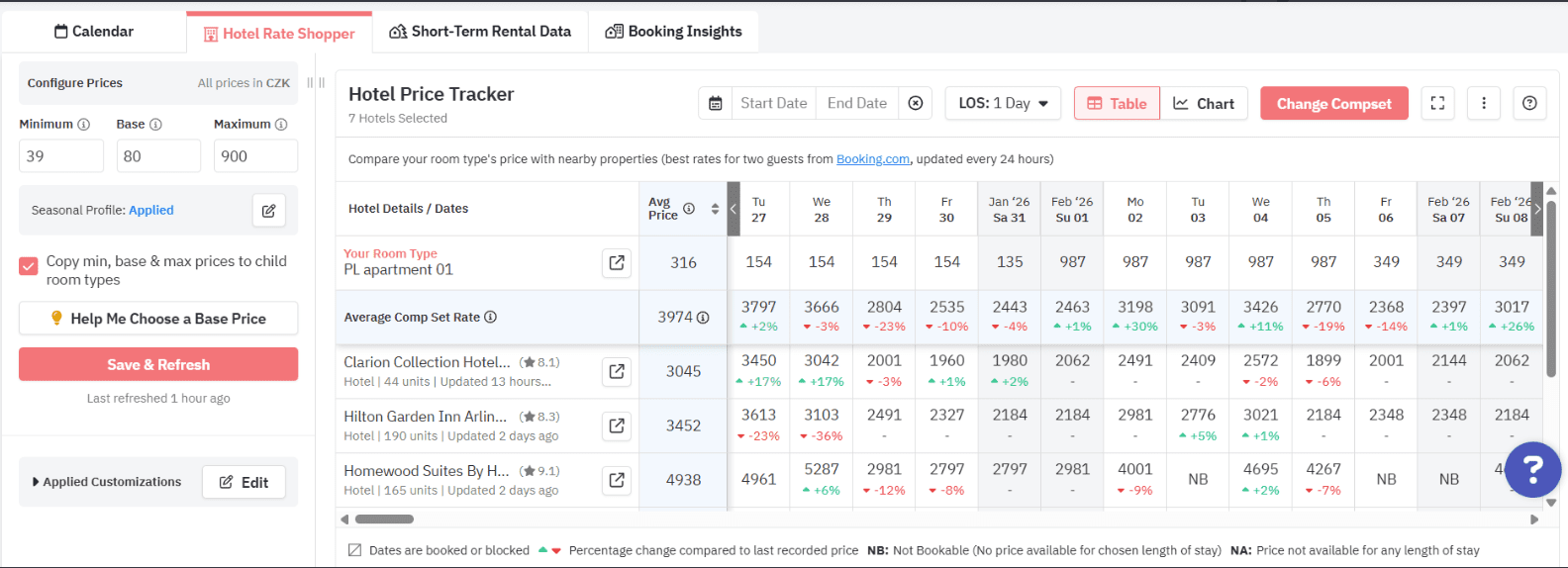
PriceLabs eliminates the need for manual rate shopping. The Hotel Data Tab / Rate Shopper allows you to monitor pricing trends across up to 350 nearby hotel-like properties. You can track their recent rate changes and identify high-demand periods using publicly available data that is refreshed regularly. Even better, the Custom Comp Sets feature lets you manually select specific rival hotels to benchmark against. This ensures your rates are influenced only by the properties your guests actually consider alongside yours.
The Blurry Lines: Competing with the Short-Term Rental Market
Ten years ago, independent hotels only had to worry about other hotels. Today, the landscape is entirely different. Short-term rentals, Airbnbs, and serviced apartments are directly competing for your guests.
If you are only looking at hotel data, you are only seeing half the picture. If a family of four is visiting your town, they are comparing your two interconnected rooms against a 3-bedroom Airbnb house. Your pricing tools for hotels must account for this alternative accommodation data.
Practical Tip: Identify if your hotel caters more to corporate travelers (who prefer traditional hotels) or leisure groups (who often cross-shop with short-term rentals). Adjust your pricing strategy based on who you are actually competing against.
How PriceLabs Helps Here
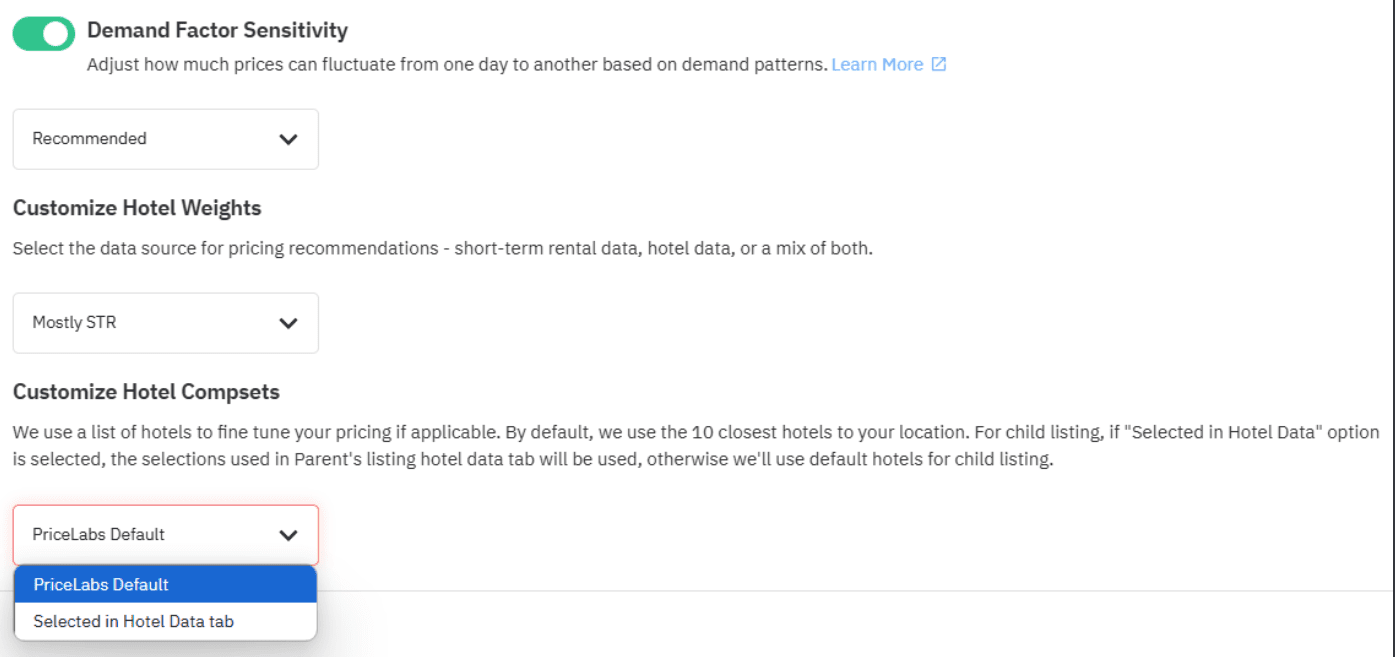
PriceLabs offers a highly unique feature called Hotel Weights. This allows you to control the influence of hotel data versus short-term rental data on your pricing recommendations. This is absolutely ideal for independent hotels located in markets heavily dominated by short-term rentals. Additionally, the Neighborhood Data Tab lets you deeply analyze short-term rental pricing trends and your competitive positioning within your specific local market.
Granular Control: Room-Type Level Customization
A common mistake hoteliers make when ditching the spreadsheet is applying a “blanket” percentage increase or decrease across the entire property. But your standard queen room behaves very differently from your luxury penthouse suite.
Effective dynamic pricing for independent hotels requires granular control. If your standard rooms are selling out rapidly for a specific week, but your suites remain empty, raising the price on the entire hotel will just make the suites even harder to sell.
Example of Granular Pricing:
- Standard Rooms: High demand from a local corporate conference. Action: Increase rates by 20%.
- Suites: Low demand as corporate travelers rarely book suites. Action: Hold rates steady or offer a slight discount to encourage upgrades.
How PriceLabs Helps Here
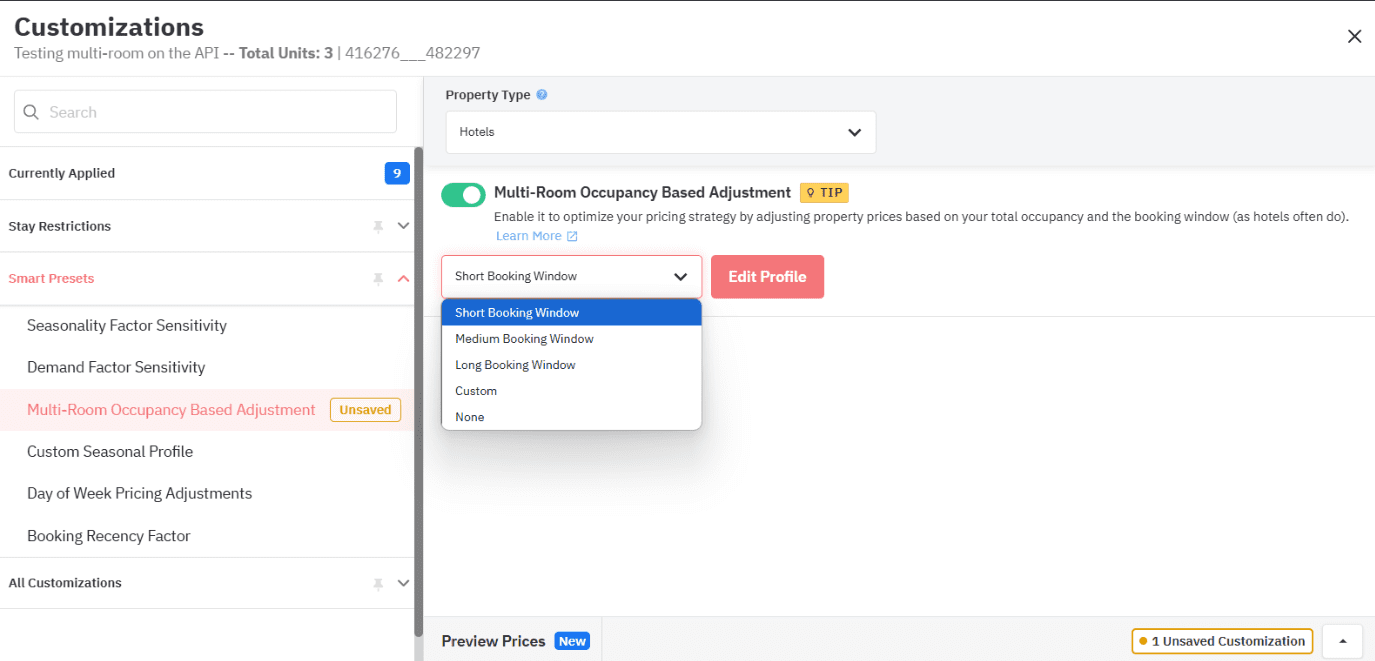
PriceLabs gives you ultimate control with Room-Type Specific Pricing. You can customize pricing strategies based on room categories, demand patterns, and booking windows. You apply custom rules to individual rooms without affecting the broader property settings.
To take it a step further, PriceLabs features Multi-Room Occupancy-Based Adjustments. This automatically adjusts pricing recommendations based on the occupancy trends within specific room types, supporting a perfectly balanced sell-through across all your inventory.
Mastering the Booking Window: Patience vs. Panic
One of the hardest parts of hotel revenue management is holding your nerve. When you look at your spreadsheet and see that next month is completely empty, the natural human reaction is to panic and slash prices.
However, every hotel has a typical booking curve. Perhaps your guests usually book only 14 days in advance. Slashing prices 30 days out just means you are giving early bookers a massive, unnecessary discount. The right pricing tools for hotels understand your historical lead times and adjust accordingly.
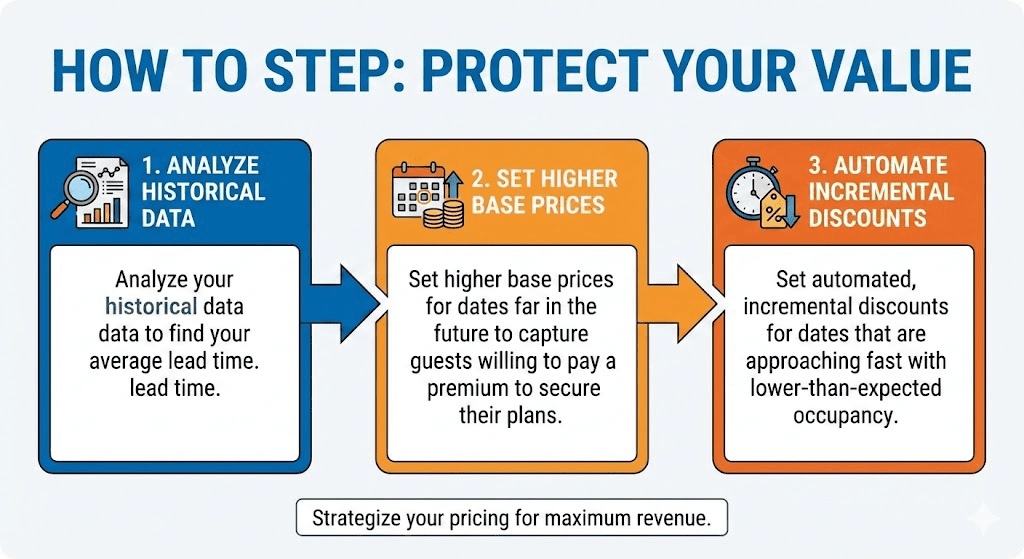
How to Step: Protect Your Value
- Analyze your historical data to find your average lead time.
- Set higher base prices for dates far in the future to capture guests willing to pay a premium to secure their plans.
- Set automated, incremental discounts for dates that are approaching fast with lower-than-expected occupancy.
How PriceLabs Helps Here
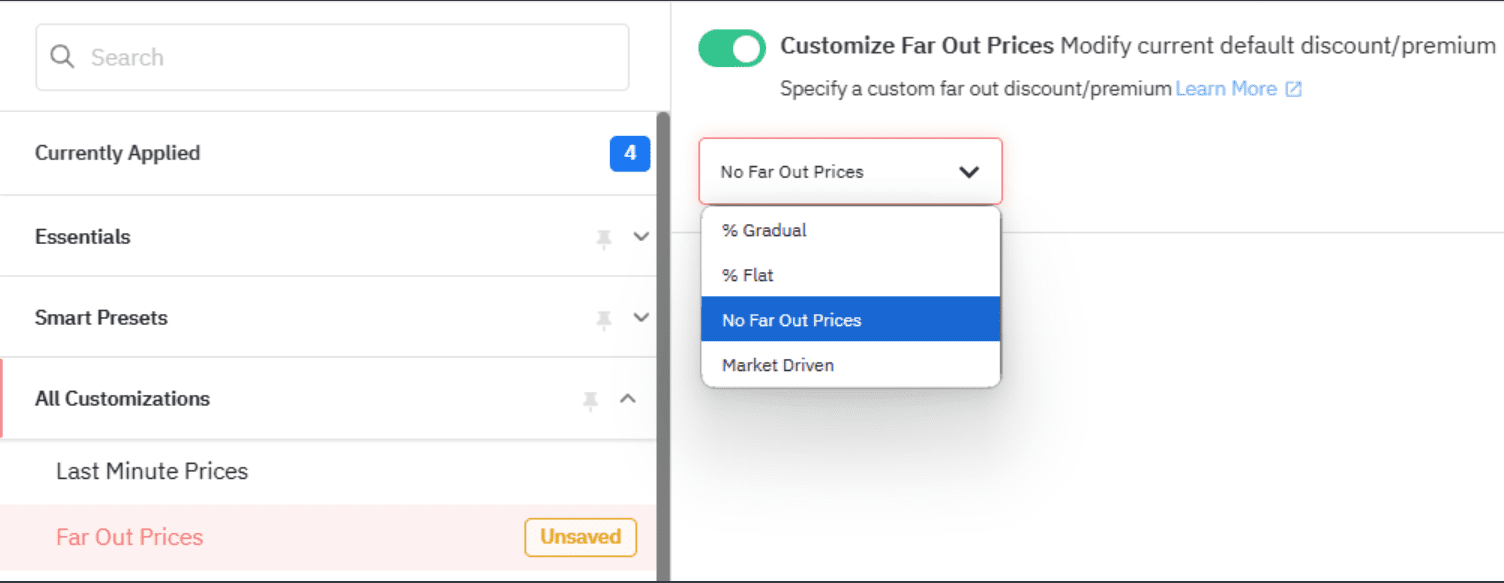
PriceLabs handles the psychology of the booking window automatically.
- Far-Out Pricing Adjustments: Shapes recommendations for dates far in advance to reflect long lead times and early demand signals, helping protect your value from premature discounting.
- Last-Minute Pricing Adjustments: Automatically drops recommendations for close-in dates based on your current occupancy and pickup to support optimal occupancy and prevent rooms from sitting empty.
Guardrails and Restrictions: The Power of the Minimum Stay
Pricing isn’t just about the dollar amount; it is about inventory control. Imagine a massive, three-day music festival is coming to town (Friday, Saturday, Sunday). If you allow guests to book only Saturday night at a premium rate, you will likely be left with empty rooms on Friday and Sunday because festival-goers want the whole weekend. This creates a “Swiss cheese” calendar full of un-bookable holes.
Top-tier pricing tools for hotels don’t just recommend rates; they recommend stay restrictions.
Practical Tip: Always apply minimum stay restrictions during peak events to force guests to book the shoulder nights, enhancing your total revenue per available room.
How PriceLabs Helps Here:
You don’t have to manually block out dates or build complex rules in your PMS. PriceLabs’ Minimum Stay Rules automatically adapt length-of-stay suggestions based on seasonality, your booking patterns, and known demand periods.
You can also use Seasonal Profiles to define distinct stay-rule strategies for peak, shoulder, and off-peak seasons. If a unique situation arises, you can always use Date-Specific Overrides to manually adjust stay restrictions and availability for high-demand dates or private events.
The Power of Data: Real Performance Analytics
You cannot manage what you do not measure. A spreadsheet might tell you how much money you made last month, but it struggles to tell you why.
To truly optimize your hotel, you need actionable analytics. You need to instantly see your Average Daily Rate (ADR), your Occupancy percentage, and your Revenue Per Available Room (RevPAR). You also need pacing reports to see if you are booking up faster or slower than you did at this exact time last year. Comprehensive pricing tools for hotels turn raw data into visual, easy-to-understand insights.
How PriceLabs Helps Here
PriceLabs replaces manual reporting with its powerful Report Builder. You can create custom reports using key hotel KPIs such as ADR, Occupancy, RevPAR, and pacing, and even forecast your revenue for the coming year.
With Portfolio Analytics, you can track these vital metrics at the property level, the room-type level, and even the individual room level, empowering you to make incredibly precise business decisions. Plus, with Multi-User Access & Logs, you can set role-based permissions so owners, revenue managers, and front desk staff all have the exact level of access they need.
Tying It All Together: Seamless Integration
The biggest fear independent hoteliers have when adopting new software is that it will break their current systems. The idea of learning a new tool while trying to force it to talk to an old PMS is daunting.
However, the modern ecosystem of pricing tools for hotels is built on the concept of open APIs and seamless connectivity. Your pricing software should sit quietly in the background, crunching numbers, and silently pushing the results to your existing tech stack.
How PriceLabs Helps Here:
PriceLabs is designed for frictionless adoption. It features 160+ PMS & OTA Integrations, meaning it almost certainly connects effortlessly to the Property Management System, Channel Manager, and direct booking platforms you are already using. Through Automated Rate Syncing, PriceLabs ensures real-time updates across all your booking channels. You retain full control and zero hassle; rates update automatically based on logic you approve, with no more manual entry required.
Way Forward
The transition from a manual spreadsheet to intelligent software is no longer a luxury for independent properties; it is a vital necessity for survival. Relying on gut feelings and outdated flat rates will only result in stagnant growth and lost opportunities. By embracing modern pricing tools for hotels, you unlock the ability to react instantly to market shifts, monitor your competitors flawlessly, and apply granular, room-type specific strategies that maximize every dollar. The way forward is clear: automate the math so you can get back to focusing on what actually matters—delivering an exceptional experience for your guests.
Frequently Asked Questions (FAQs)
Q: What exactly are pricing tools for hotels?
A: Pricing tools for hotels are automated software platforms that analyze market demand, competitor rates, seasonality, and your hotel’s internal occupancy to recommend and automatically apply the most profitable room rate for every single night.
Q: Why is a spreadsheet no longer enough for hotel revenue management?
A: Spreadsheets are static and require manual updates. The modern travel market fluctuates by the hour. A spreadsheet cannot instantly react to a competitor dropping their rate, a sudden local event, or a surge in last-minute bookings, leading to lost revenue.
Q: Can pricing tools for hotels help me compete with Airbnbs and short-term rentals?
A: Yes. Advanced platforms like PriceLabs feature tools like Hotel Weights and Neighborhood Data Tabs, allowing you to blend traditional hotel competitor data with short-term rental data, ensuring your rates are competitive across the entire accommodation landscape.
Q: Will using automated software mean I lose control of my hotel’s pricing?
A: Not at all. The best pricing tools for hotels offer full user control. You set minimum and maximum rate boundaries, define seasonal profiles, and can apply date-specific overrides whenever you want. The software simply automates the heavy lifting within the strategic guardrails you set.
Q: How hard is it to connect pricing tools for hotels to my current PMS?
A: It is usually incredibly simple. Industry leaders like PriceLabs integrate seamlessly with over 160 different Property Management Systems and Channel Managers, allowing for quick setup and automated rate syncing across all your booking channels without disrupting your workflow.