Table of Contents
Updated : Feb 5, 2026
Small, independent hotels often price rooms based on gut feel and spreadsheets—then watch bigger brands outmaneuver them with faster, data-driven moves. Cloud revenue tools change that.
By automating rate updates, forecasting demand, and unifying data, they help small teams react to market shifts in minutes, not days. The best platform depends on your size, tech stack, and goals, but the playbook is consistent: set clear KPIs, choose a cloud-based revenue management system (RMS) with strong forecasting and integrations, validate data, enable automation with guardrails, train your team, and iterate based on results. This guide shows how to do it and where solutions like PriceLabs fit, enabling you to capture more revenue with less manual work.
Understanding Pricing Challenges for Small Hotels
Small, independent hotels face four recurring pricing challenges: limited time and staff to monitor market shifts, fragmented data across PMS/OTAs, difficulty forecasting short-term demand, and the pressure of competing with chain pricing and OTAs (as outlined in innRoad’s guidance on independent hotel revenue) innRoad’s overview of independent hotel revenue issues. In practice, these challenges look like:
- Limited time and staff for market monitoring: Too few hours to scan competitors, events, and pickup patterns daily.
- Fragmented data streams: Rates, occupancy, and channel performance live in separate systems and spreadsheets.
- Forecasting difficulties: Unpredictable short-lead demand and seasonality undermine manual forecasts.
- Chain/OTA pressure: Brands use sophisticated tools and promotions; OTAs shift visibility and price expectations.
Manual pricing can’t keep up with intraday demand changes, and static spreadsheets’ slow response to market moves; modern RMS platforms update rates multiple times per day and consolidate data to improve speed and accuracy.
Revenue management is the process of using data, technology, and dynamic strategies to enhance income from room sales by anticipating demand and setting optimal prices. Tackling revenue management challenges for small hotels starts with acknowledging these constraints—and replacing manual guesswork with cloud automation.
Setting Baseline Goals and Key Performance Indicators
Clear goals and KPIs focus your efforts and reveal ROI. Track the metrics that show both pricing power and efficiency:
- RevPAR (Revenue per Available Room): Calculated by multiplying a property’s average daily rate by its occupancy rate; this reflects overall revenue performance.
- ADR (Average Daily Rate): Total room revenue divided by rooms sold; indicates rate strength.
- Channel mix: The balance between direct and OTA bookings; impacts costs and control.
- Occupancy, pickup, and lead time: Reveal pace and booking patterns.
Before adopting a cloud RMS, record baseline values and set targets. Example baselines to capture:
- Baseline ADR
- Target RevPAR increase (e.g., percentage uplift goal)
- Desired percentage of direct bookings
Set formal revenue goals and track progress using goal-setting and forecasting tools. Doing this upfront makes it easier to judge impact and adjust your strategy quickly.
Choosing the Right Cloud Revenue Management System
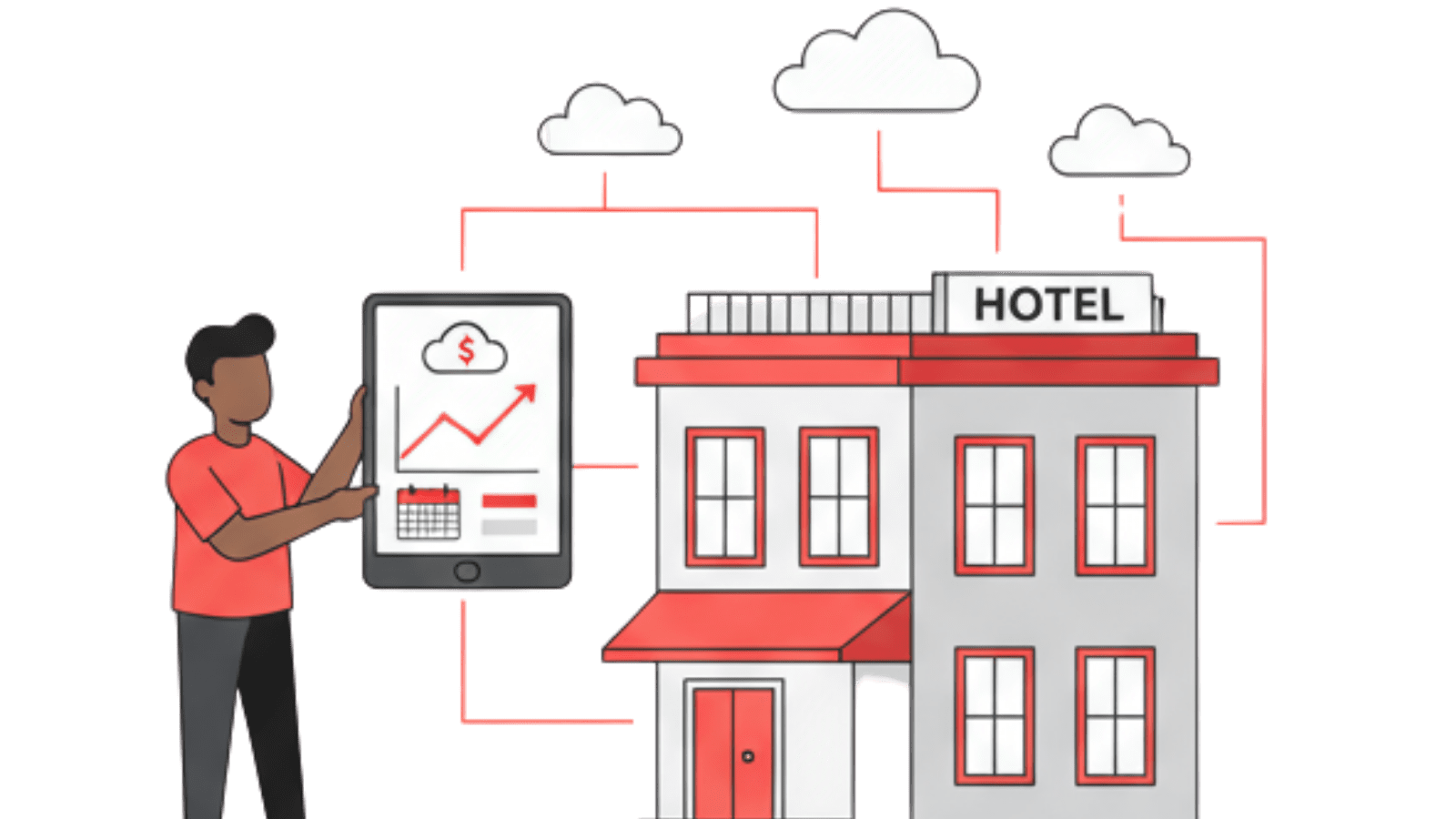
A cloud-based revenue management system is software you access over the internet that uses advanced analytics and automation to set room prices, forecast demand, and report on performance—no on-premise servers required. Your selection should depend on your needs, team size, and current tech stack.
PriceLabs recommends prioritizing forecasting accuracy when choosing a cloud RMS and pairing it with a dynamic pricing engine that updates rates frequently throughout the day Cloud-based RMS guide from PriceLabs. Key criteria to compare:
- Forecasting accuracy and explainability
- Automation cadence (multiple updates per day or real-time)
- Robust PMS and channel manager integrations
- Custom rule-setting and open pricing flexibility
- Transparent reporting with audit trails and user permissions
- Security, uptime, and support responsiveness
Leading options for small hotels include PriceLabs (extensive integrations, generative AI insights, audit trails), RoomPriceGenie (multiple daily dynamic pricing), Atomize (real-time optimization), and Cloudbeds PIE (part of an end-to-end stack). As per Oaky’s overview of revenue tools.
Example comparison snapshot
| Platform | Notable Strengths | Integrations (PMS/CM) | Automation Cadence | Transparency/Audit | Entry Pricing (Indicative) |
| PriceLabs | Forecasting-first, dynamic pricing, generative AI, role-based controls | Broad, deep integrations | Intra-day updates | Detailed audit trails | Varies by portfolio size |
| RoomPriceGenie | Easy setup, multiple daily updates, SMB-friendly | Wide coverage | Multiple times per day | Clear, simple dashboards | ~$300–$500/mo (small hotels) |
| Atomize | Real-time optimization, strong automation | Growing marketplace | Real-time | User overrides and logs | Varies |
| Cloudbeds PIE | Integrated with PMS/stack, centralized reporting | Native to Cloudbeds | Frequent automated updates | Centralized reporting | Bundled/varies |
Note: Features and pricing are subject to change; confirm with vendors.
Integrating Data and Validating Forecasts
To trust automation, start with clean data and a short validation period.
Step-by-step:
- Connect your PMS and/or channel manager to the RMS.
- Import at least 12–24 months of historical rates, occupancy, and pick-up.
- Run an initial forecast and publish rate recommendations in a test or limited mode.
- Validate for 2–4 weeks by comparing forecasted occupancy and ADR vs. actual results, and adjust settings.
Integrate and validate data: connect PMS/channel manager, import historical occupancy and rate data, and run a short validation period to check forecast alignment PriceLabs RMS guide. A property management system (PMS) manages front desk operations, room inventory, reservations, and often payments in one platform. Data integration glitches are common but fixable with vendor support and clear ownership between your PMS, channel manager, and RMS Cloud computing in hotel management.
Configuring Automation and Custom Pricing Rules
Dynamic pricing automatically adjusts room rates in real time based on demand signals, market trends, and your rules. Set guardrails that reflect your brand and costs while allowing the system to respond quickly.
High-impact configurations:
- Minimum/maximum pricing bands to protect rate floors and ceilings.
- Segmentation by room type, channel, and length of stay to align with traveler behavior and costs.
- Surge alerts: automated notifications when booking activity unexpectedly increases so you can respond to spikes.
- Automated rate changes that trigger immediate price updates when thresholds are met (both recommended in innRoad’s playbook).
Open pricing allows you to set unique prices by room type, channel, or segment instead of one fixed BAR, unlocking granular control and better margins.
Example surge alert workflow:
| Signal Detected | Rule/Threshold | Automated Action | Human Check |
| 15 unexpected pickups in 2 hours for Fri | Surge alert + occupancy > 80% | Increase Fri rates +12% on OTAs; +8% direct | Verify special events; adjust cap if needed |
Hybrid approaches—automation with human guardrails—deliver the best results for small teams: let the engine update continuously while you refine rules weekly.
Training Staff and Operationalizing Revenue Tools
Cloud-based RMS adoption requires staff training and change management to succeed. Focus on:
- Onboarding sessions tailored by role (owner, revenue lead, front desk).
- Role-based access so team members see the right dashboards and controls.
- How to read key metrics, approve overrides, and adjust rules.
- Clear escalation paths for price exceptions (e.g., groups, events).
- Reporting cadence: daily glance, weekly performance review, monthly strategy sync.
Plan short weekly check-ins after launch to fine-tune rules, caps, and automation levels as confidence grows.
Measuring Performance and Iterating Pricing Strategies
After go-live, build a feedback loop that turns data into decisions. Track:
- ADR: average price paid for sold rooms.
- RevPAR: average daily rate multiplied by occupancy, reflecting total revenue per available room.
- Direct vs. OTA bookings: quantify cost of acquisition and control.
- Competitor rate positioning: compare your rates to a comp set by date and segment.
Monitor ADR/RevPAR, OTA vs. direct performance, and competitor positioning; refine rules and consider BI reports for cross-department decisions PriceLabs RMS guide. Business intelligence platforms provide live insights that elevate revenue managers into strategists and reduce reporting workload. Review weekly in the first month, then monthly, and share exports with sales, marketing, and finance to align promotions, packaging, and pace.
Practical Tips for Enhancing Cloud RMS Benefits
- Use surge alerts and intra-day updates to capture last-minute spikes; benefit: convert demand surges into higher ADR with minimal effort.
- Apply open pricing by channel and room segment; benefit: protect margins and reduce OTA commission impact.
- Maintain human oversight with automation; benefit: faster decisions with brand-aligned guardrails for special cases.
- Refresh event and holiday calendars monthly; benefit: improve forward-looking forecasts and minimize last-minute rate swings.
- Tighten minimum/maximum rate bands quarterly; benefit: safeguard rate integrity while preserving upside.
- Review comp set alignment each season; benefit: stay competitive against the right peers, not just the nearest hotels.
- Automate length-of-stay and day-of-week differentials; benefit: streamline occupancy and lift RevPAR without heavy manual edits.
Way Forward
As “set-it-and-forget-it” automation fades, the industry is entering a new era of collaborative AI, where the best tools amplify human expertise rather than replacing it. To succeed, hoteliers must transition from daily rate reviews to real-time responsiveness that captures micro-demand signals—like search velocity and flight trends—before they manifest as bookings. Independent hotels are entering 2026 with sharper tools and higher expectations for automated revenue performance, prioritizing systems that offer “explainable AI” and seamless data synchronization across the tech stack to ensure every pricing move is both strategic and defensible.
Frequently Asked Questions
What are cloud revenue tools, and how do they help small hotels with pricing?
Cloud revenue tools are online platforms that analyze demand, competitors, and occupancy to set optimal room rates. They eliminate manual updates with automation, enhancing revenue while saving staff time.
How can small hotels choose the best affordable cloud revenue tools?
Match features and integrations to your PMS and team capacity, and compare pricing tiers. Look for free trials and swift onboarding to validate fit before committing.
What is the typical process for implementing cloud revenue management systems?
You connect the RMS to your PMS/channel manager, import historical data, set rules, and enable automation; most small hotels can go live in one to two days.
Can small hotels effectively compete with large chains using cloud pricing tools?
Yes. AI-driven pricing quickly detects local demand shifts, allowing independents to adjust rates in minutes and compete with brand-level agility.
What challenges and costs should small hotels expect when switching to cloud RMS?
Expect some integration clean-up and a short learning curve; vendor onboarding helps. Costs vary by vendor, but many properties see payback within a few months as RevPAR and efficiency improve.