
Get started with PriceLabs now!
Want to learn what PriceLabs can do for you? See for yourself with a free trial. Get started now!

You've just started a conversation with a potential new owner client and they ask: "What do you charge?" How you answer that question — and whether you can justify the number with data — often determines whether you win the contract. Vacation rental property manager fees are both a pricing strategy and a communication challenge. Most growing PMs know what their competitors charge. Far fewer know their own cost structure well enough to price with confidence, or have the performance data to defend their fee when an owner pushes back.
This guide covers the three fee models, industry averages by service tier, what should be included at each level, how to set fees based on your actual cost structure, and how to justify your fee with the data that actually moves owners. Whether you're setting your fees for the first time or renegotiating at contract renewal, the framework here gives you the tools to have that conversation from a position of evidence rather than intuition.
The percentage-based fee is the most common model in short-term rental property management. The PM charges a fixed percentage of gross (or net) rental revenue each month. This model aligns PM incentives with owner outcomes: when the property earns more, the PM earns more. The standard range for short-term rental management fee structures at the full-service level is 20 to 35% of gross revenue. Vacation rental management cost breakdown under this model is straightforward and auditable from booking confirmations.
The flat fee model charges a fixed monthly amount regardless of revenue generated. This works well for high-revenue properties where a percentage fee would generate a disproportionately high PM income relative to the actual work performed. A beach house generating $8,000 per month at a 25% fee pays the PM $2,000 monthly. If the PM's actual cost to service that property is $600, a flat fee of $900 to $1,200 is more defensible than a percentage that has grown beyond its rational basis. Revenue management quality, not just the work volume, is what justifies fee levels at this tier.
The hybrid model combines a reduced percentage fee with specific flat fees for defined services: an onboarding fee, a photography coordination fee, or a maintenance management fee. This is increasingly common in competitive markets where PMs need pricing flexibility to win contracts without simply undercutting competitors on the base rate. Tiered hybrid structures give owners clarity and give PMs the ability to price different service levels appropriately.
The gross vs. net revenue distinction is critical and often overlooked. A 25% fee on gross revenue (total booking value before OTA platform commissions, taxes, and cleaning fees) is materially different from 25% on net revenue (after platform fees are deducted). On a $1,000 booking with a $150 Airbnb service fee and $100 cleaning fee, gross basis yields $250 to the PM while net basis on the booking revenue yields approximately $212. Always define the fee basis clearly in your management agreement before any conversation about percentages. Property management agreements that are ambiguous on this point generate disputes at month-end that damage owner relationships.
Vacation rental property manager fees range from 10% at the co-host/channel management tier to 50% or higher for luxury or remote market full-service operations. For the majority of professional property managers in standard US leisure and urban markets, full-service management fees fall between 20% and 30% of gross booking revenue. How much do property managers charge for Airbnb depends heavily on service tier, market characteristics, and the PM's demonstrable track record.
Service tier breakdown:
Regional factors significantly affect where within these ranges a PM can realistically charge. Beach markets, ski markets, and luxury urban markets command higher fees because the operational complexity, property values, and owner expectations are all higher. Urban Airbnb markets with thin revenue margins and high owner price sensitivity tend toward the lower end of each tier. Airbnb management fees percentage positioning should reflect both what the market will bear and what your actual cost structure requires to deliver profitably.
One-time fees are common and should always be itemized in contracts: onboarding fees ($100 to $500), photography and setup fees ($150 to $400), and listing creation fees are all legitimate charges that represent real cost to the PM. Property managers who absorb these costs into their percentage fee often find that the math doesn't work when taking on low-revenue properties. Separate them, price them clearly, and include them in the contract. Revenue metrics for a PM business should track the true cost per property, including onboarding costs amortized over the contract period.
Full-service vs half-service property management fees differ most significantly in three areas: marketing and distribution, pricing strategy, and financial reporting. A full-service fee that does not include professional photography, multi-platform listing optimization, and dynamic pricing management is not a full-service fee — it is a partial-service fee priced at a full-service rate, and owners who understand the market will recognize the gap.
Marketing and distribution at the full-service level means: professional photography (or professional-grade photographer coordination), listing copy that is written for conversion rather than just description, active multi-platform distribution across Airbnb, Vrbo, Booking.com, and ideally a direct booking channel, and ongoing listing optimization as platform algorithms and guest preferences evolve.
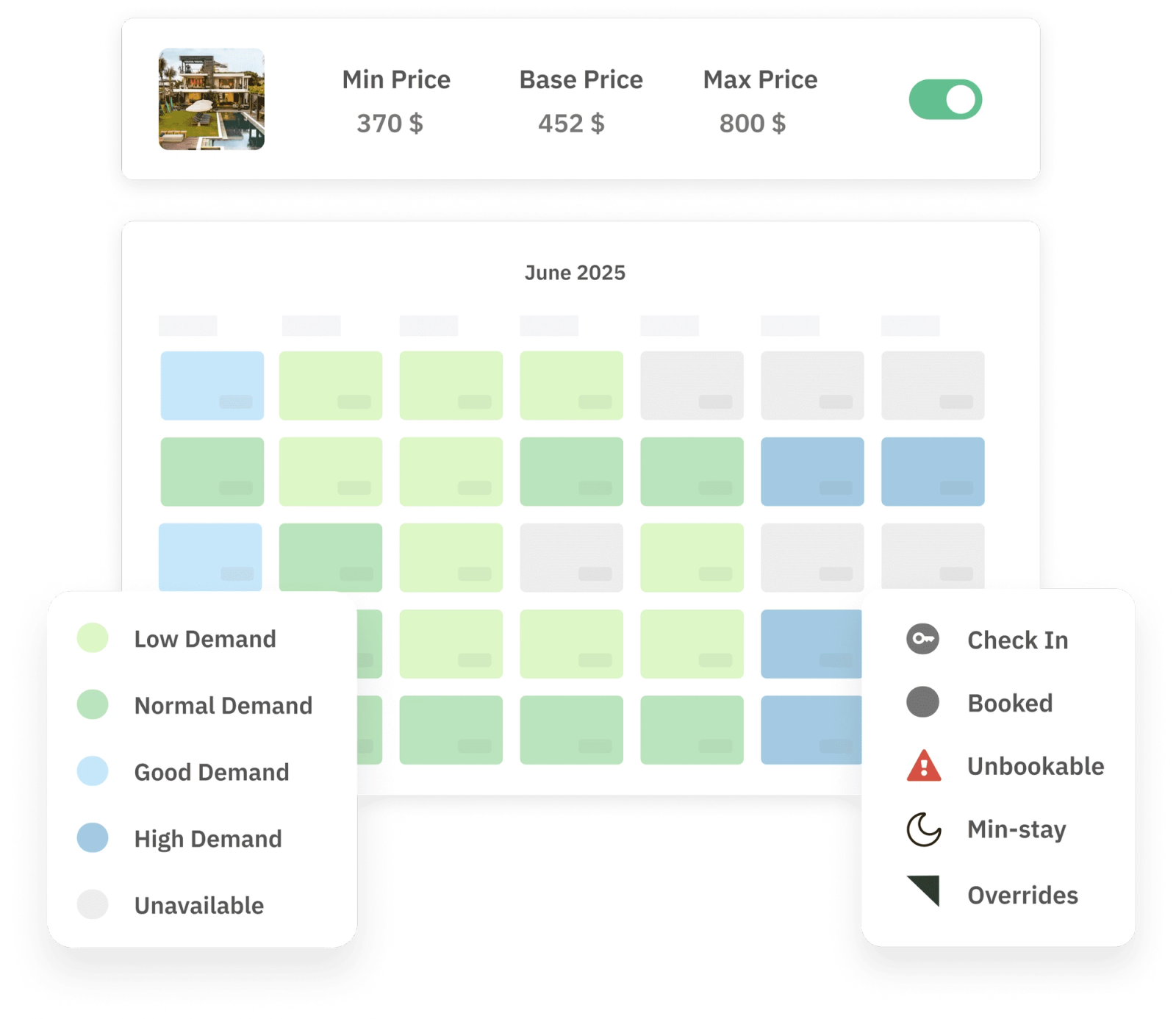
Pricing strategy is where many PMs under-deliver. Property owners expect that their PM is actively managing rates — not setting a price once per season and leaving it. STR property manager commission rate at the 25% to 30% level is only defensible when the pricing strategy is clearly data-driven and results are measurable. PMs using PriceLabs can demonstrate to owners exactly how the Hyper Local Pulse Algorithm sets rates based on real-time market signals, what rates competing properties are charging, and how booking pace is tracking. This level of pricing transparency is a material differentiator when owner conversations turn to fee justification. Dynamic pricing is not a feature — it is a full-service PM's core obligation to the owner.
Financial reporting at the full-service level means monthly owner statements that include gross revenue, management fee deduction, all operating expenses with receipts, net disbursement, occupancy rate, ADR, and a brief market comparison. Owners who receive clear, professionally formatted monthly statements renew contracts at materially higher rates than those who receive informal summaries or, worse, nothing at all. Professional property management is defined as much by its reporting quality as by its operational execution.
The most common fee-setting mistake is backward benchmarking: finding out what competitors charge and pricing at or below that level without first knowing your own cost structure. Setting fees based solely on competitor rates means you might be profitable, or you might be operating below cost — and you won't know which until the math catches up with you.
Start with cost-first analysis. Calculate your actual per-property per-month cost: PMS subscription allocated per property, PriceLabs subscription per property, insurance, marketing costs, your own time at a real hourly rate, and any staff or contractor costs specific to property operations. Your fee must cover this cost base and deliver a profit margin that makes the business worth running. Property management fees for vacation rentals that are priced below cost to win contracts are not a growth strategy; they are a slow drain on the business.
Value-based pricing is the next layer. If your properties consistently achieve above-market occupancy rates and ADR, your fee is worth more than the industry average regardless of what competitors charge. The PM who generates $85,000 in annual revenue from a property that comparable self-managed properties earn $65,000 from has created $20,000 of incremental value. Charging 25% of $85,000 is $21,250. The PM's fee is almost entirely covered by the incremental revenue the PM generated above what the owner would have achieved alone. PriceLabs Market Dashboards provide the competitive benchmarking data to quantify this outperformance — turning a qualitative claim into a measurable number that owners can evaluate objectively.
Tiered service packages remove the need for fee negotiation on individual line items. Offer three clearly defined service tiers (Essential, Standard, Premium) with explicit inclusions and exclusions at each price point. Owners self-select into the tier that fits their needs and budget. The Essential tier captures clients who want operational support but are cost-sensitive; the Premium tier captures clients who want the full white-glove experience and understand what it costs. This structure makes your fee conversation a presentation rather than a negotiation. Short-term rental property management guides for growing PMs consistently recommend the tiered package structure as a conversion and retention tool.
Revenue proof is the most compelling justification. Show the owner what their property earns under your management compared to what self-management or a lower-fee competitor would realistically achieve. Portfolio Analytics makes it straightforward to pull monthly, quarterly, and annual revenue data per property and present it in a format owners can quickly understand. When your fee is 25% and your management generates 30% more revenue than the alternative, the owner is net-positive before you finish the sentence.
Pricing transparency is the second most powerful justification. Walk owners through your pricing strategy at the first meeting and in every monthly report. Name the tool you use, explain how it works, and show what market data supports the rates you set. A PM who says "we use PriceLabs' Hyper Local Pulse Algorithm, which analyzes your specific competitive set's availability and pricing in real time to set your rates" is having a fundamentally different conversation than a PM who says "we set competitive rates." Dynamic pricing explained clearly to an owner is a fee justification that compounds over time.
Pacing data and forward-looking insights are the section of owner reporting that most PMs skip — and they are the most powerful trust-building element available. Showing an owner not just what their property earned last month but what the booking pace looks like for the next 60 days, and how your pricing strategy is responding to that pace, demonstrates a level of active management that immediately distinguishes professional property management from passive landlording. Revenue management is an active practice, and the owner conversations that demonstrate active practice close more renewals than any other single factor.
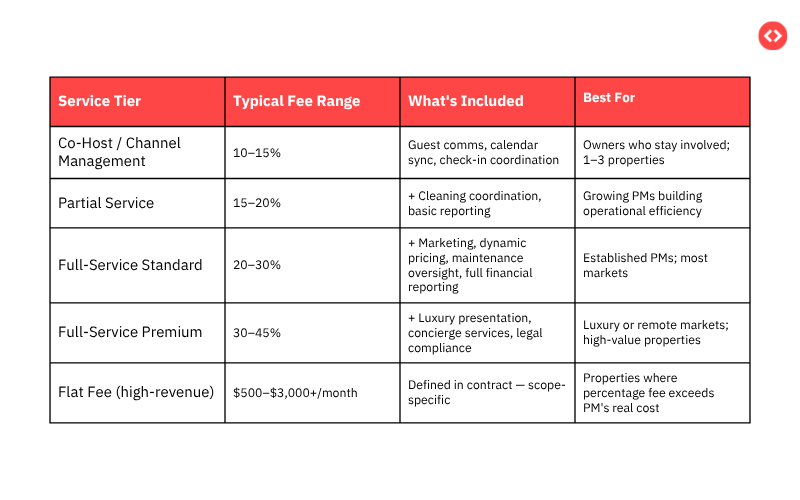
For full-service vacation rental management, the industry average in 2026 falls between 20% and 30% of gross booking revenue in standard US markets. Fees range from 10% at the co-hosting level to 45%+ for luxury or remote market full-service operations. The right number depends on services included, market characteristics, and the PM's demonstrable performance track record.
Most PMs charge on gross revenue (total booking value before OTA platform fees and taxes) because it is simpler to calculate and verify from booking confirmations. Net revenue basis can appear more competitive on paper, but the dollar difference is significant and needs to be explained clearly to owners who compare multiple management proposals. Always specify the basis in your management agreement before any percentage discussion.
At 25% full-service, the fee should cover professional listing (photography, multi-platform copy, distribution), data-driven dynamic pricing strategy, all guest communication, check-in and checkout management, cleaning coordination, maintenance oversight, and monthly owner financial statements. Anything beyond this scope — major repairs, special projects, additional marketing channels — should be either included in a higher tier or billed separately with clear advance disclosure.
Significantly. A PM using data-driven dynamic pricing like PriceLabs' HLP Algorithm can generate 15 to 30% more annual revenue than a PM using static pricing. The same management fee percentage on 25% higher revenue is a better deal for the owner in absolute terms. Dynamic pricing is the most quantifiable argument for why professional management at a higher fee is net-positive compared to self-management or lower-fee alternatives.
Yes, for most US property owners, professional management fees paid to a licensed or established property manager are deductible as a business expense against rental income on Schedule E or as a short-term rental business expense. Owners should consult their tax advisor for specifics based on their property's classification and use patterns.
For talking through pricing decisions with owners, see how to talk to owners about dynamic pricing and our guide to using Portfolio Analytics for owner conversations. For the reporting side, see our owner reporting guide and our piece on moving from reactive to proactive owner communication.
For building trust with data, see building trust with property owners with data, and for the relationship side more broadly, see maintaining a positive homeowner relationship and our tips for talking to owners during slow seasons. For real perspectives from the field, see how PriceLabs helps revenue managers, how a property manager uses PriceLabs, and how a property owner and industry analyst uses PriceLabs.
Want to learn what PriceLabs can do for you? See for yourself with a free trial. Get started now!