Get started with PriceLabs now!
Want to learn what PriceLabs can do for you? See for yourself with a free trial. Get started now!

Your calendar rarely behaves the same way two months running. One weekend a festival fills every listing within ten miles, and three weeks later the same nights sit open. Static rules cannot answer both situations, which is why minimum stay restrictions deserve as much attention as your nightly rate.
Dynamic minimum stay rules adjust that requirement automatically as demand, lead time, and calendar shape change. Most managers running 6 to 49 properties still set one number and forget it, which quietly costs revenue every month. This guide walks through three scenarios where flexible rules pay off, then shows how to automate them inside a wider automation stack.
A dynamic minimum stay rule changes your minimum night requirement based on signals rather than habit. Instead of one number across the year, the rule responds to season, event dates, lead time, and gaps left by existing bookings. PriceLabs describes this balance clearly in its guide to minimum length of stay restrictions.
The inputs are straightforward. Season and day of week set your baseline. Confirmed events raise it. Lead time lowers it as check-in approaches. Calendar shape overrides everything when a booking strands a night or two. Each of these already feeds the demand signals behind PriceLabs pricing, so the same data can drive stay rules.
Fixed minimums fail in both directions. A seven-night rule during a three-day festival removes you from search results for the guests who actually want those dates. A two-night rule through peak summer fragments a week you could have sold in one booking, and adds turnovers you have to staff. The Dynamic Min Stay feature exists because that trade-off is hard to manage by hand.
There is a second cost that rarely shows up in reporting. Average daily rate only averages nights that sold, so a fragmented month can look healthy while RevPAR slips. Reviewing both metrics together in Portfolio Analytics is the fastest way to spot the gap.
Take a three-day festival running Friday through Sunday. Demand peaks on those nights, but plenty of guests want Thursday arrival or Monday departure. A single rule cannot serve both groups, and this is where dynamic minimum stay rules earn their keep, which is why the cascading minimum stay approach steps the requirement down as the date approaches.
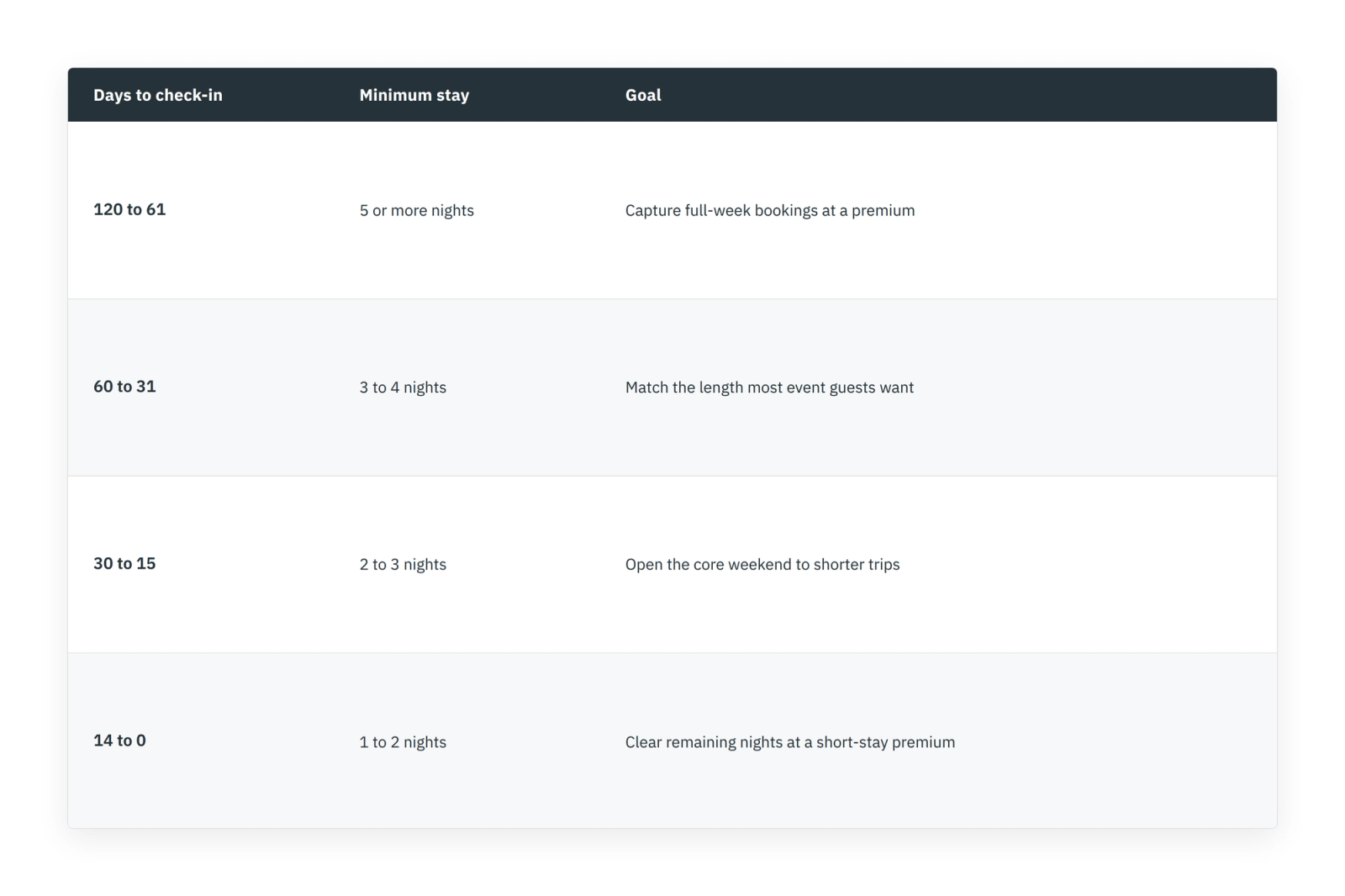
The pattern works in three stages. Far out, hold a longer minimum to capture guests booking the full trip. Around 60 to 30 days, relax to the length most guests actually want. Inside the final two weeks, drop further and let rate carry the value instead of length. Pairing each step with a rate adjustment keeps this profitable, which is the core idea in the event-based pricing playbook.
Cascading minimum stay pattern for a three-night event
PriceLabs surfaces confirmed events through the Events and Holidays table, and you can report a missing local event for review. Once a date is flagged, Date Specific Overrides let you force a rate, minimum stay, or availability change for exactly those nights. Both sit alongside the recommendations in the Minimum Stay Recommendation Engine.
Prices and minimum stays recalculate daily and sync automatically to Airbnb, Vrbo, and 160+ property management systems. For a growing portfolio that matters more than the rule itself, because manual overrides across dozens of listings stop being realistic. Applying changes at group level is covered in the pricing strategy setup guide.
Every market has peaks and valleys, and dynamic minimum stay rules should track them rather than sit above them. Ski towns and lake markets see week-long family trips in high season, then two-night couples trips in shoulder months. Building those bands once, through seasonal profiles, is faster than editing the calendar each quarter, as the adaptive seasonal pricing engine shows.
A workable framework runs in three bands. In peak season, raise the minimum so premium dates fill with longer bookings instead of fragmenting. In shoulder periods, step down gradually rather than dropping in one move. In off-peak, go low enough to catch midweek and one-night demand. Length-of-stay discounts can follow the same bands, which is the approach in the extended-stay pricing guide.
The mistake to avoid is treating a shorter minimum as a concession. It is a targeting decision. A two-night minimum in October reaches a different guest than a six-night minimum in July, and both can be the right call. Checking how your market actually books, using market and portfolio data together, keeps the bands honest.
It is Wednesday, the weekend is still open, and a three-night minimum is blocking the guests who want two. Dynamic minimum stay rules solve this by lowering the requirement automatically as check-in nears. PriceLabs supports up to three separate last-minute rules, so you can stage the drop rather than make one blunt change, as explained in the last-minute pricing guide.
A sensible ladder starts around 15 nights out with a three or four-night minimum, moves to two nights inside 14 days, and allows single nights inside the final week. Tune the thresholds to your own booking window rather than copying these numbers. Your booking pace and lead-time reports will show where your real cutoffs sit.
The guests you reach here are worth having. Traveling nurses, relocating professionals, and spontaneous weekend travelers all book late and often accept a short-stay premium. Rigid rules filter them out before they ever see your listing, which is one reason flexibility helps off-peak occupancy.
Orphan gaps appear when bookings leave fewer open nights than your minimum allows. The nights are not unwanted, they are unbookable, and dynamic minimum stay rules are what make them sellable again. PriceLabs defines and addresses this directly in its guide to orphan gaps.
Two settings work together here. A gap-specific minimum stay makes the orphan nights bookable at their actual length. A gap-specific rate then decides whether you discount or charge a premium for them. By default PriceLabs applies a 20% discount to gaps of one or two nights, and you can change that or turn it off through the Orphan Day Gap Filler.
Consider charging a premium rather than discounting when the gap is short and close in. A guest who needs one specific night at short notice is usually the least price-sensitive person in your funnel. Testing both directions across a season, then reading the result in your pricing performance data, will tell you which your market rewards.
Dynamic minimum stay rules and rate changes are two halves of the same decision. Raising the minimum without raising the rate leaves money on peak dates. Lowering it without adjusting the rate hands cheap short stays to guests who would have paid more. The pairing logic runs through PriceLabs Dynamic Pricing alongside stay rules.
Three pairings cover most situations. Long minimum plus premium rate for events and holidays. Short minimum plus a modest discount for soft last-minute dates. Short minimum plus a premium for orphan nights. Keeping these consistent across channels is easier when rates sync automatically, as covered in the multi-OTA rate automation guide.
Manual calendar edits across dozens of listings are slow and error-prone, especially when the same listing appears on several channels. Missing one event means either short stays blocking a lucrative long booking, or a long minimum blocking everything. Both outcomes show up as unbooked nights in portfolio-level reporting.
The admin cost compounds too. Time spent updating minimums is time not spent on owner relationships or acquisition, which is where a growing portfolio actually gains ground. That trade is the practical argument for the automation ecosystem rather than any single feature.
Roll dynamic minimum stay rules out to one group of listings before applying them portfolio-wide. Comparing the test group against the rest gives you a clean read, and minimum stay restrictions respond quickly enough that two weeks usually shows a signal.
Dynamic minimum stay rules are minimum night requirements that adjust automatically based on season, confirmed events, lead time, and gaps between bookings, rather than staying fixed across the year.
Not on their own. A shorter minimum paired with a higher rate often earns more than a long minimum on a night that never sells. The risk is lowering length and rate at the same time.
Most operators start stepping down around 60 days out and reach their shortest requirement inside the final two weeks. Your own historical booking window should set the exact thresholds.
Yes. Rules can be set at account, group, or listing level, so a manager running dozens of properties can apply a seasonal band once and override only the listings that need different treatment.
Pick one market where you already know the event calendar, build the seasonal bands, and add a cascading rule for the next major date. Turn on gap rules across the same group at the same time. Then check pacing after two weeks in your reporting view before extending the setup to the rest of the portfolio.
These minimum-stay rules are one lever within the fundamentals covered in our complete guide to dynamic pricing for short-term rentals.
Want to learn what PriceLabs can do for you? See for yourself with a free trial. Get started now!