
Table of Contents
Updated : Feb 27, 2026
In the world of short-term rentals, there has long been a Mexican Standoff between guests and property managers.
Guests want the freedom to change their minds—especially in a world where travel remains unpredictable. Property managers, on the other hand, want the security of a locked-in calendar. For a long time, the industry standard was Strict: you book it, you own it.
But the tide has shifted. Today, flexibility isn’t just a courtesy; it’s a high-performance growth strategy.
In this post, we’re diving deep into the mechanics of flexible cancellation policies, why they increase your bottom line, and how new innovations from Smily are finally removing the risk from the reward.
What Exactly is a Flexible Cancellation Policy
At its core, a flexible cancellation policy allows a guest to cancel their reservation within a specific window (often 24 hours to 14 days before check-in) and receive a full or significant refund.
In the STR ecosystem, these generally fall into three buckets:
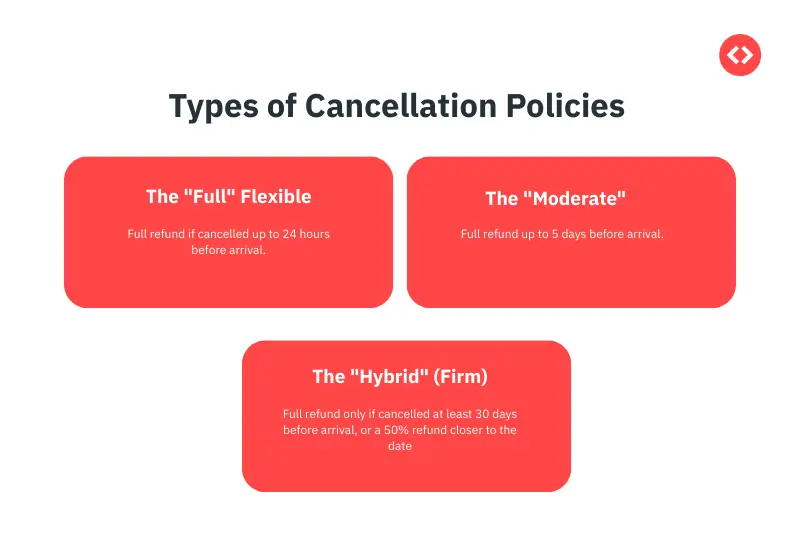
Why Flexible Cancellation Policies Work: The Psychology of De-Risking
Why would a property manager invite the possibility of a vacant home? Because uncertainty is the #1 killer of conversion.
- The Search Boost: Search engines on Airbnb, Vrbo, and Booking.com prioritize listings with flexible cancellation policies. When a traveler toggles the Free Cancellation filter—and most do—strict listings simply disappear.
- The Competitive Edge: If two properties are nearly identical in price and quality, the guest will almost always choose the one that offers an escape hatch.
- Reciprocity and Trust: Guests who feel safe booking with you are more likely to treat the home with respect and leave a 5-star review. They see you as a partner in their travel, not just a transaction.
Why Property Managers Should Consider Flexible Cancellation Policies
If you manage a smaller portfolio, every booking counts. You might think a strict cancellation policy protects you, but it might actually be costing you.
- Higher ADR (Average Daily Rate): Guests are statistically willing to pay 5–10% more for a flexible rate than a non-refundable one.
- Filling the Mid-Week Gap: Business travelers and digital nomads often have fluid schedules. They avoid strict listings like the plague. By opening up flexibility, you capture a demographic that fills your calendar outside of peak weekends.
- Adapting to Market Volatility: Markets shift. When demand is low, flexibility is the best lever you have to keep occupancy high without racing to the bottom on price.
How to Build a Cancellation Policy That Protects You
To build a truly resilient cancellation policy, you need to move beyond all-or-nothing thinking. A balanced policy acts as a filter: it rewards committed guests with better rates while charging a small premium for those who want the freedom to pivot.
Here is an elaboration on how to structure these three pillars to maximize your protection.
1. The Multi-Tiered Approach
Instead of forcing a single policy on everyone, let guests self-select based on their risk tolerance. This is a tactic used by major airlines and hotel chains because it works.
- Non-Refundable Rate: Offer a 5% to 10% discount on your base rate. This attracts certain bookers and gives you guaranteed cash flow immediately. This is your foundation revenue.
- Flexible Rate: This is your standard (or slightly marked-up) price. It appeals to the high-value traveler who is willing to pay more for the insurance of being able to cancel.
- The Benefit: You capture both bargain hunters and cautious travelers, ensuring your property is visible to both search types.
2. The Window Strategy
A “Flexible” policy doesn’t have to mean a “24-hour notice” policy. Your window should be dictated by your Average Lead Time (the number of days between booking and check-in), which you can find in your PriceLabs Portfolio Analytics.
- The Logic: If PriceLabs shows your market has a 60-day lead time, a Full Refund up to 30 days policy is very safe. Why? Because you still have a 30-day window to re-market those dates to the thousands of travelers still looking for a stay.
- The Adjustment: In high-demand periods (like a major festival or holiday), you can tighten your booking window because you know the dates will resell instantly. In low-season, a more relaxed window (e.g., 5-7 days) keeps you competitive when guests are scarce.
Ready to Supercharge Your Revenue Strategy?
Ready to Supercharge Your Revenue Strategy?
Don’t leave your occupancy to chance. By pairing Smily’s Cancellation Protection with PriceLabs’ Dynamic Pricing, you can offer the flexibility guests demand while ensuring every booking is optimized for maximum profit.
3. A Template for Your Direct Booking Site
When writing your policy, the tone matters as much as the terms. You want to sound professional and hospitable, not litigious. Clear communication reduces chargeback risks and he-said-she-said disputes.
A Sample Template:
Our Flexibility Guarantee
“We know that life happens and travel plans can shift. To support our guests while maintaining the sustainability of our local home, we offer the following fair-share cancellation policy:
- Peace of Mind Window: Receive a 100% refund (minus any processing fees) for cancellations made at least [X – e.g., 14] days before your check-in date.
- The 50/50 Split: For changes made between [Y – e.g., 7] and [X – e.g., 14] days before arrival, we provide a 50% refund. This helps cover our costs while returning a significant portion of your investment.
- Last-Minute Protection: Cancellations made within [Y – e.g., 7] days of arrival are non-refundable.
By booking with us, you help us keep our calendar reliable for our cleaning teams and local staff. We look forward to hosting you!”
How Smily’s New Cancellation Protection Is A Game Changer
The biggest hurdle has always been the financial sting of a late cancellation. If a guest cancels 2 days before arrival, even if you re-list the property, you might not fill it.
In November 2025, Smily launched Cancellation Protection, a feature that effectively ends this dilemma.
How it Works in Practice:
Smily has integrated a protection model directly into their Channel Manager. Instead of the property manager eating the cost of a cancellation, the system creates a dual-rate structure:
- Automation: Smily automatically applies a markup to your flexible rate. This markup covers the cost of the protection.
- The Payout: If a guest cancels within the protected window (30 days down to just 1 day before check-in), Smily reimburses the Property Manager 96% of the rental amount.
- Consistent Revenue: You get paid as if the booking happened. No guest disputes, no insurance paperwork, and no empty-pocket Sundays.
Why this is different:
This isn’t traditional travel insurance, where the guest has to prove they were sick. It’s revenue protection for the manager. You can offer Flexible terms to the guest (boosting your SEO and bookings), but your bank account stays Strict.
Final Thoughts: The 2026 Strategy
As we move into 2026, the property managers who thrive will be those who use technology to remove friction.
By pairing PriceLabs’ dynamic pricing (to ensure your rates are always optimized for the current market) with Smily’s Cancellation Protection, you are essentially crisis-proofing your business. You get the high conversion rates of a flexible host with the guaranteed income of a strict one.
Frequently Asked Questions (FAQs)
1. Why should I offer Flexible Cancellation Policies if they increase the risk of an empty calendar?
In short: visibility and conversion. Most major OTAs (Airbnb, Booking.com, Vrbo) prioritize flexible listings in their search algorithms. By offering flexibility, you can expect up to 3x more bookings. While the risk of an empty calendar is real, using a tool like Smily’s Cancellation Protection eliminates the financial sting by guaranteeing you get paid even if the guest backs out.
2. How do flexible policies affect my search ranking on Airbnb and Booking.com?
Significantly. Free Cancellation is one of the most used filters by travelers. If your policy is Strict, your property is hidden the moment a guest toggles that filter. Flexible listings also tend to have higher conversion rates, which signal to the platform that your listing is high-quality, further boosting your organic ranking.
3. What is Smily’s Cancellation Protection, and how does it differ from guest travel insurance?
Traditional travel insurance requires the guest to file a claim and prove a covered reason (like illness or flight delays). Smily’s Cancellation Protection is designed for the Property Manager. It’s a revenue safeguard that automatically reimburses you 96% of the booking value if a guest cancels within the protected window, regardless of their reason. No paperwork, no disputes.
4. How does the dual-rate structure work in practice?
Through Smily, you can offer two price points for the same stay: a lower Non-Refundable Rate and a slightly higher Flexible Rate. The markup on the flexible rate covers the cost of the protection. This allows the guest to buy peace of mind while ensuring you, the manager, remain revenue-neutral or even more profitable.
5. Is there a sweet spot for a cancellation window?
For most property managers with under 100 listings, a 14-day or 5-day window is the sweet spot. It provides enough flexibility to attract guests but gives you a realistic timeframe to re-market the property. However, with Smily’s new feature, you can safely offer a 1-day window because your income is protected by the 96% reimbursement guarantee.