
Table of Contents
Updated : Apr 14, 2026
The “good old days” of short-term rental (STR) management—where supply was scarce and guests had to book months in advance just to secure a spot—are officially behind us. Today, the market has shifted fundamentally. Between massive supply expansion and sweeping platform changes like all-in pricing and split-fee removals, property management companies (PMCs) are facing a “new normal” that requires a much more sophisticated playbook.
In a recent episode of RevLabs Pulse, Kyle was joined by Adrian Albus, CEO and Head of Analytics at SmartRev Management and former Airbnb venture builder. Adrian shared critical insights into why the revenue management game needs to “step up” and how professional PMCs (specifically those managing 50–150 units) can shift from a defensive stance to an offensive growth strategy.
4 Big Factors Changing the STR Industry in 2026
To understand why your old strategies might be failing, you first need to recognize the structural shifts in the market. Adrian identifies four pillars of change:
1. Supply Expansion
Five years ago, a lack of supply during peak times like Thanksgiving or Christmas forced guests to book early. Today, supply has exploded. Guests no longer fear “sold out” dates, which has drastically shortened booking windows and increased competition.
2. All-In Pricing
The shift to total price transparency has fundamentally changed guest decision-making. Guests are now making choices based on the final cost (including fees), putting much more pressure on hosts to optimize their listing health and cleaning fees to remain competitive in search results.
3. Removal of Split Fees
With many PMCs now paying 100% of their guest acquisition costs, Airbnb has moved toward a “pure-play OTA” model. This shift changes the math on your RevPAR and ADR, requiring a tighter handle on your actual payout revenue.
4. The Cancellation Crisis
This is the hidden challenge of 2026. Higher supply and flexible platform policies mean cancellations are more frequent. You need a proactive remarketing and repricing strategy for when a high-value booking (like the 4th of July) drops at the last minute.
The SMART Approach to Revenue Management
For professional property managers, revenue management isn’t just about moving a price slider; it’s a system. Adrian utilizes the SMART framework to define high-level property management:
- Sustainable: Your revenue management strategy must be sustainable in terms of both results and costs. Avoid models that eat into your growth as you scale.
- Multi-Model: Be open to different ownership models, including traditional VRM and arbitrage. Arbitrage operators often have the sharpest revenue strategies because “the buck stops with them”—if they don’t hit their numbers, they can’t pay the lease.
- Applied: This means being hands-on and embedded in the team. You need a partner who can talk directly to owners about “tough” topics like minimum rates and off-peak occupancy.
- Reliable Reporting: You cannot manage what you do not measure. You need a single view that brings together PMS data and market KPIs.
- Trust: The relationship between a property manager and their revenue expert must be built on trust to navigate market slumps and economic shifts.
“Revenue management should be like the best bookkeeper or the most reliable cleaner you’ve ever had—someone who has your back and understands your system.” — Adrian Albus
The “Bottom-Up” Strategy for Cancellations
When a guest cancels a peak-season booking, the natural reaction is panic or a “wishful” repricing. Adrian argues for a data-driven, offensive approach:
- Analyze the “Why”: Use data to understand why the cancellation happened without letting emotions cloud the strategy.
- Hand-Pick Your Comp Sets: Don’t rely on broad market averages. Your revenue manager should hand-zoom into the 5–10 properties a guest would actually look at if they were booking your home today.
- Check “Sold Out” Status: If your competitors’ listings are already sold, you have more “pricing power” to maintain a higher rate. If not, you must adjust immediately to the current market reality.
Use PriceLabs to Navigate the New Normal
To execute the strategies Adrian discussed, you need tools that offer more than just basic automation. Here is how you can use the PriceLabs suite to stay ahead:
Analyze Competitor Pricing with Neighborhood Data
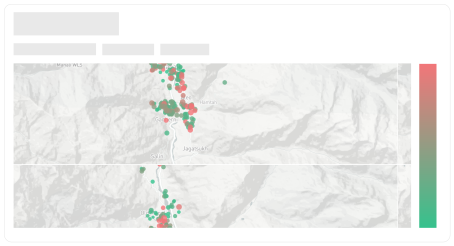
As Adrian highlighted, you need to know exactly who you are competing with. The Neighborhood Data tool allows you to see the exact price points and occupancy of comparable listings in your area.
Optimize Your Base Price
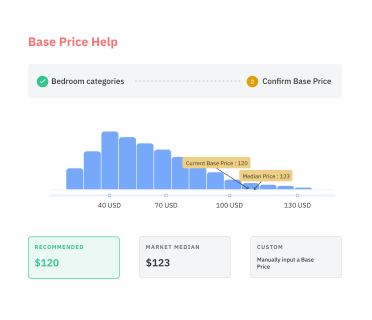
If you are entering a new market or your old playbook isn’t working, use the Base Price Help Tool. It factors in seasonality, lead time, and market demand to ensure your starting point is profitable yet competitive.
Master the “Aperture” with Market Dashboards
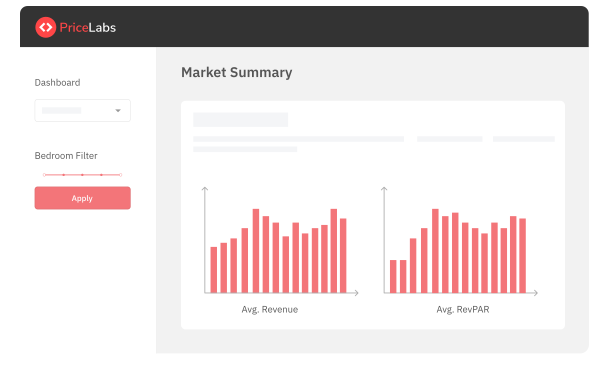
Market Dashboards provide the high-level vacation rental KPIs Adrian mentioned—Estimated Revenue, Average RevPAR, and Occupancy—but allow you to filter by the “aperture” guests use (e.g., only 3-bedroom, pet-friendly homes).
Bottom Line
In 2026, staying “neutral” is not an option. If you aren’t actively growing and evolving your revenue playbook, you are losing ground to competitors who are. By leveraging hand-picked comp sets, automated dynamic pricing, and transparent owner reporting, you can turn market shifts into opportunities for your portfolio.
Key Takeaways for Property Managers
- Cancellations are the new normal: Develop a specific weekly report to analyze and immediately re-market cancelled dates based on current (not historical) comp set data.
- Focus on the “SMART” system: Ensure your revenue management is sustainable, multimodel, and based on reliable reporting.
- Don’t outsource your strategy: Use technology like PriceLabs to handle the daily tactical price tweaks, so you can focus on high-level growth and owner relationships.
- Know your payout revenue: In a post-split-fee world, tracking “payout revenue” (guest revenue minus OTA fees) is critical for understanding your true profitability.
Frequently Asked Questions
1. Should I use a flexible or strict cancellation policy?
While flexible policies attract more bookings in low seasons, they increase your risk of last-minute drops. In 2026, the key is having a remarketing plan ready for when those cancellations inevitably happen.
2. How do I know if my base price is still correct?
If your occupancy is declining while the rest of the market remains stable, it’s time to reassess. Use tools like the PriceLabs Neighborhood Data to see if your base price has drifted too far from your current competitive set.
3. What is a “good” RevPAR in the current market?
A healthy RevPAR is one that shows growth without sacrificing too much occupancy. If you raise your ADR but your RevPAR falls because your occupancy plummeted, your pricing is too aggressive for the “perceived value” of your listing.