
Table of Contents
Updated : Apr 6, 2026
Attracting guests in an increasingly volatile market is a challenge every vacation rental manager faces. As we wrap up 2025, it is time for property managers to rethink their revenue management strategies in 2026 to stay profitable in the coming year.
The short-term rental (STR) landscape has shifted significantly. We are seeing shorter booking windows, fluctuating demand, and a hypersensitive consumer base that prioritizes value above all else.
So, what should you do to ensure your portfolio thrives in 2026? We sat down with revenue experts Meg Park (VRM Advocate), Rick Jernigan (Brett Robinson Vacation Rentals), and Aaron Addison (VRM Advocate) to break down the data-driven strategies you need to master.
1. Analyze Guest Behavior Shifts from 2025
Every season brings new reasons to travel, and monitoring your Key Performance Indicators (KPIs) is vital to filling your spaces. In 2025, several key trends emerged across the U.S. and international markets:
- Shrinking Lead Times: Across the U.S., the U.K., and France, booking windows are tightening. Guests are waiting longer to pull the trigger, often booking within a 15-to 30-day window. This trend is also visible in markets such as Poland, Portugal, Greece, and Spain.
- Price Hypersensitivity: The consumer’s perception of value is at an all-time high. Minor price differences now dictate whether a guest chooses your listing or a competitor’s.
- Inventory Growth: Ongoing inventory growth means guests have more choices than ever, diluting demand across a broader range of listings.
The Bottom Line: You cannot rest your hat on previous years’ successes. 2026 will be unique, and your strategy must be flexible enough to respond to these “nail-biter” booking cycles.
Start Scaling Your Portfolio with Data-Driven Pricing
Gain the competitive edge by leveraging real-time market intelligence and automated pricing. Protect your property’s wealth and optimize your ROI with the industry's most trusted revenue management platform.
Start Your Free 30-Day Trial2. Master Your Pacing and Demand Indicators
Pacing is your primary indicator of success. If your occupancy is behind where it was at the same time last year, you need to know why immediately.
- Micro vs. Macro Views: Don’t rely solely on national averages. A ski-in/ski-out unit in Montana behaves differently from a shuttle-access home. Analyze your data at the neighborhood and property type levels.
- Identify “Pops” in Demand: Look for even the smallest increases in pacing. These are your early demand signals.
- School and Event Calendars: Shifting holidays (like Easter) and local school breaks are major demand drivers. Research these early to set the right minimum stay restrictions.
Bonus Read: Vacation Rental Revenue Management: The Complete Guide for Hosts and Property Managers
3. Pivot Your Stay Restrictions for Q1
Flexibility is going to be “money” heading into Q1 2026. If you are still holding onto strict 7-night minimums for the low season, you are likely missing out on the last-minute weekend traveler.
- Reduce Minimum Stays: During off-peak periods, update 5-night policies to 2 nights to attract travelers seeking short breaks.
- Softening Restrictions: As you get closer to a date—especially within the 30-day window—start softening your stay requirements to fill remaining gaps.
- Same-Day Bookings: In drive-in destinations, allowing same-day bookings can be extremely beneficial for capturing spontaneous weather-driven trips.
4. Reoptimize Listings for Maximum Visibility
Visibility is critical. Before you even touch your prices, ensure your “online storefront” is optimized for conversion. Tools like PriceLabs Listing Optimizer can help with that.
- Data-Driven Titles: Use keywords that highlight your USPs, such as “Oceanfront” or “Private Beach Access.”
- Professional Imagery: High-quality, well-lit photos that reflect the current season (e.g., autumn foliage or snow-capped mountains) help guests visualize their experience.
- Highlight Amenities: If you target digital nomads, emphasize high-speed Wi-Fi and dedicated workspaces.
5. Proactive Owner Communication
Your homeowners are savvy business people who expect professional reporting. Trust is the cornerstone of your relationship, and transparency is the best way to build it. Use data reporting to build trust with your homeowners.
- “Plant the Seed”: If you see a market hiccup, tell your owners now. Don’t wait for them to call you when their revenue is down.
- Explain the “Why”: Use data to show them that while occupancy might be slow, it’s due to a market-wide shift in booking windows, not a failure of your management.
- Monthly Cadence: A monthly newsletter or video update is the right frequency to keep owners informed without overwhelming them.
Use PriceLabs To Set 2026 Up for Success
PriceLabs offers a suite of data-driven tools designed to help property managers and hosts optimize revenue and occupancy by analyzing market trends and internal performance.
Neighborhood Data & Market Dashboards
PriceLabs Market Dashboard and Neighborhood Data provide hyper-local market intelligence by comparing your property against similar listings in your immediate area.
- Market Data: Focuses on immediate surroundings, showing hyper-local competitor prices, minimum stay requirements, cleaning fees, and availability.
- Custom Comp Sets: Instead of comparing a high-end villa to a budget studio, you can use over 40 filters—including property type, bedroom count, amenities (like pools or hot tubs), and pricing strategy (luxury vs. budget)—to create a tailored “comp set“.
- Actionable Insights: Market Dashboards visualize occupancy trends, average daily rates (ADR), and booking pace, allowing you to see what drives bookings in your specific market segment.

Portfolio Analytics & Pacing Reports
Portfolio Analytics analyzes future booking trends and past performance to help you identify and correct revenue gaps.
- Pacing Reports: These compare your current “on-the-books” performance (occupancy, ADR, and RevPAR) against benchmarks such as last year’s data or market trends.
- Spotting Trends: If your occupancy is pacing behind the market for a specific window (e.g., 2 points lower for an upcoming 15-day window), it signals that your prices may be too high or your stay restrictions too rigid, prompting you to trigger last-minute promotions.
- Booking Curves: You can visualize how quickly your properties are being booked over time compared to historical averages, helping you forecast future demand accurately.

Owner Analytics (Beta)
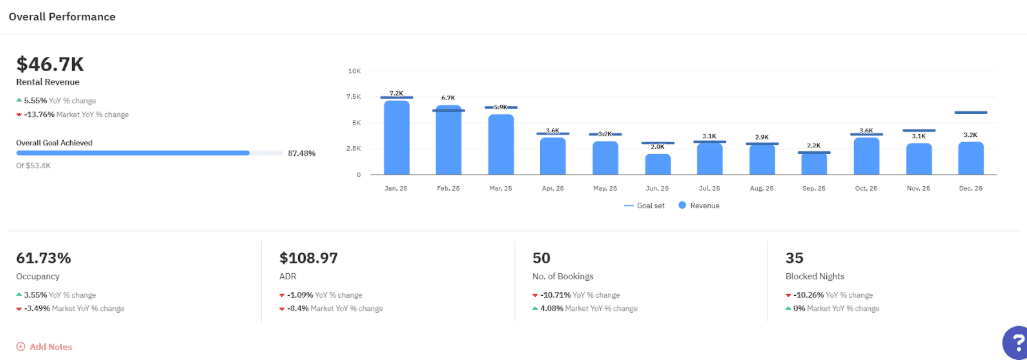
Owner Analytics is designed for property managers who handle portfolios for multiple owners; this tool streamlines high-level reporting.
- Customizable Views: Reports can be tailored to show the specific data points that align with different owner goals, such as maximizing total profit versus maintaining consistent volume.
- Automated KPI Reporting: It eliminates the need for manual data entry into Excel by generating branded reports that track essential metrics like Revenue, ADR, and Occupancy.
- Transparency and Trust: Clear visualizations help managers explain pricing decisions to homeowners, such as the revenue lost due to owner-blocked calendars or overly restrictive guest requirements.
Frequently Asked Questions
1. How do I handle owners who are nervous about 2026 revenue?
Be honest and proactive. Share market data showing that guests are booking later, and explain your “pivot plan” for capturing those last-minute stays.
2. What is the most important KPI to watch right now?
Pacing is critical. It tells you if you are winning or losing relative to the market and your own historical performance, giving you time to adjust your strategy.
3. Should I lower my rates if my occupancy is low?
Not necessarily. First, check your visibility and stay restrictions. If your minimum stay is too high for the current market trend, lowering the price won’t help. Adjust restrictions first, then consider incremental rate tweaks.
4. How can I capture more “value-driven” guests?
Highlight USPs and optimize vacation rentals for amenities. Small upgrades, such as high-end coffee or curated local guides, can make your listing stand out as a stronger value proposition than a standard hotel.