Updated : Mar 26, 2026
The short-term rental (STR) landscape has transitioned from a period of “passive renting”—where a clean bed was a sufficient value proposition—to an era of “strategic hospitality.” In today’s saturated markets, commanding a price premium requires a sophisticated “Architecture of Experience.” This framework balances high-concept, intentional design with an invisible but robust technical infrastructure. By engineering this equilibrium, operators move beyond providing mere accommodation; they offer a curated lifestyle that justifies elevated rates through both perceived aesthetic value and frictionless service.
The “Synthesis” of hospitality exists at the intersection of human-centric design (the “Experience”) and automated systems (the “Architecture”). While the aesthetic soul of a property captures guests’ imagination and drives top-of-funnel conversion, the technical architecture ensures operational excellence and remote scalability. This combination creates a “competitive moat,” protecting the asset from commoditization by delivering a seamless, high-yield stay that casual hosts cannot replicate. This evolution from operator to revenue architect begins with the intentional selection of a branding archetype.
Branding Archetypes: Engineering Aesthetic Differentiation
A cohesive brand identity functions as a psychological trigger for high-value guest segments, effectively reducing price sensitivity. By rejecting the “beige” market standard, hosts can increase booking velocity—guests are no longer purchasing a night in a room, but an identity they wish to inhabit.
Based on high-performance market data, four distinct archetypes have emerged as leaders in visual contrast:
The Western Nomad:
As exemplified by Jerry McKinish’s “Joshua Tree Saloon” approach, this archetype rejects Palm Springs minimalism in favour of desert authenticity. By utilising swinging saloon doors, macramé, and vintage wood, the property provides a rugged “frontier” experience that resonates with modern travellers seeking local roots.
Scandinavian Minimalism & Modern Cleanliness:
This archetype utilizes visual contrast to capture the “thumb-stop” on mobile searches. Thomas Recke employs a “pink retro fridge” against a clean Scandi backdrop, while Michelle Woods utilizes “Dark and Moody” media rooms—painting ceilings, walls, and trim in dark gray—to provide a sophisticated departure from standard interiors.
The Off-Grid Oasis:
This strategy bridges the gap between luxury and utilitarian isolation. Addie Wales transformed an off-grid hunting shack into a “Huga” (phonetic hygge) log cabin by integrating a well, septic, and solar system with boutique comforts. Similarly, Amanda Osborn’s “Bluestone Corey” black cabin utilises salvaged barn beams and flannel wallpaper to market a “private quiet experience” in the woods, yielding high performance through unique materials.
The Historic Miner’s Cabin:
Synthesised by Chuck Mobraten in Bisbee, this approach focuses on “fixing the bones” of a 1903 structure. By addressing historic quirks—such as a floor that was 11 inches lower in one corner—and integrating Risson pine and era-appropriate antiques, the host creates a narrative of “historic soul” supported by modern amenities.
The “Shop Window” Effect
As noted by Nicholas Casely-Parker, the first listing photo serves as a “shop window,” where hosts have exactly 3 seconds to win the click. Whether through Michelle Woods’ visual contrast or Mckinish’s local flavour, the brand must be immediately legible. These distinct identities serve as the primary engine for conversion, transitioning the guest from a browser to a confirmed booker.
The “Hero Asset” Strategy: Driving RevPAR through Joy and Wonder
“Hero Assets” are the central engine for organic brand loyalty and social media virality. By investing in features that evoke “wonder and awe,” hosts transform a commodity stay into a “memorable retreat,” as described by Puneet Dhillon. These assets are not merely decorative; they are proactive business decisions designed to maximize Revenue Per Available Room (RevPAR).
Secret Rooms & Play Nooks:
Patrick Combs utilized a “secret bookshelf door” and Eric Savory integrated a “hidden play nook” under a staircase. These features create a sense of discovery that anchors family-friendly branding and drives repeat bookings.
Private Cinema Experiences:
High-tech entertainment adds value without compromising aesthetics. Sharon Biggar utilises automated drop-down screens to preserve mountain views, while JoAnna Woods upgraded to a 17-foot screen for “big game” immersion. Carolyn Finlayson’s garage-to-theatre conversion demonstrates how underutilised square footage can be repurposed into a high-yield amenity.
Wellness & Outdoor Immersion:
Features like “Cowboy Pools” (JoAnna Woods) and wood-fired hot tubs (Robin Smith) are essential for increasing gross yield. Lucy Krakow’s addition of an infrared sauna and outdoor bathtub was a strategic intervention specifically designed to solve the “dead/low season” yield problem, proving that wellness assets can stabilise revenue year-round.
The Emotional ROI of Hero Assets
- Calm Clarity: Creating “effortless flow” and open sightlines to reduce guest anxiety (Puneet Dhillon).
- Sensory Engagement: Features like a balcony hanging chair that force a guest to “pause and breathe.”
- Social Currency: Providing “wow” angles that guests feel compelled to share, resulting in organic marketing.
Environmental Control and Utility Optimization
Smart climate control serves a dual role: it enhances the guest experience while protecting the host’s bottom line. By utilizing platforms like Nest or EcoBee, hosts can ensure the property is perfectly conditioned for arrival while preventing “utility creep” during vacancies or guest negligence.
Advanced Sensors and HVAC Optimization
Hosts are increasingly deploying a “defense layer” of peripheral sensors to manage environmental efficiency:
- Window and Presence Sensors: As implemented by Dumitru Cojocari, these sensors automatically disable the HVAC system if a guest leaves a window open, preventing the system from cooling the neighborhood.
- Wi-Fi Booster Fans: Emealia Hollis demonstrates a high-impact solution for garage-to-bedroom conversions where central air may be weak; she uses Wi-Fi-enabled booster fans controlled via smartphone to ensure even airflow.
- “Just-in-Time” Utility Use: Smart switches allow hosts to activate pool heaters or dehumidifiers only when a reservation is active, avoiding the cost of heating an empty pool.
The automation stack also serves as a property’s first line of defense. Dumitru Cojocari utilizes humidity and water leakage sensors on the floors that are programmed to trigger an automatic water shut-off of the main valve the moment a leak is detected. Combined with smart smoke and CO2 detectors (such as Nest), these systems provide “peace of mind” that transcends simple temperature control.
The Professional Tech Stack: Engineering Remote Scalability
Technical automation is the “Invisible Concierge” of premium hosting. It enables “hands-off” management (Charlene Miller) while maintaining the high standards required by elite guest segments. This infrastructure prevents “negative ROI” by mitigating risks before they escalate into complaints.
The Integrated Tech Stack Framework
| Category | Technical Solution | Operational Impact |
| Access & Security | Smart Locks (Schlage/Yale) & Hospitable Integration | Solves “traveler mindset” friction (Michael Vogel) by eliminating key exchanges and allowing remote entry for late arrivals. |
| Risk Mitigation | Noise Monitors (Ravenscroft) & Smart Smoke Detectors (Oprea) | Jessica Oprea’s smart detector allowed her to intervene from Honduras, saving the property from a potential fire; Alexis Ravenscroft uses a vertical stack to fix issues before they reach the host. |
| Environmental Safety | Humidity & Water Leakage Sensors | Dumitru Cojocari utilizes automated main-line shut-off sensors to prevent catastrophic damage from leaks. |
| Climate Control | Smart Thermostats (Nest/EcoBee) & Presence Detectors | David utilizes presence sensors to deactivate HVAC when units are unoccupied, optimizing operational margins without guest intervention. |
To ensure scalability in remote environments, Spencer Rex utilizes Starlink to provide high-speed fiber-like connectivity in the “Off-Grid Oasis” segment. Additionally, Lauren (an engineer by trade) utilizes a QR Code Troubleshooting system. By placing QR codes on appliances that link to video instructions, she empowers guests to solve issues independently, significantly reducing support volume.
The “Remote Rescue” Protocol
The most significant advantage of intelligent access is the ability to perform a “Remote Rescue.” Host Abhimanyu recounts a specific scenario where an elderly couple, exhausted after a long journey, struggled to operate a keypad. Using his phone, Abhimanyu remotely unlocked the door instantly. This immediate intervention transformed a moment of potential guest failure into one of deep gratitude and relaxation. This capability ensures the home environment is accessible the moment a guest arrives, allowing the automation to focus on interior management.
Property Management Systems (PMS) & Channel Managers
Hosts use PMS software to centralize their calendars, automate guest messaging, and sync hardware like smart locks.
- Hospitable: Several hosts rely on Hospitable to streamline operations. For example, it is used to seamlessly integrate with Schlage smart locks to dynamically generate and change access codes for each guest between stays, allowing for a completely hands-off check-in process.
- Guesty for Hosts: Used to automate daily management and reduce the need for manual oversight.
- Smoobu (referred to as “Smoou”): Used as a channel manager to automate guest messaging and handle check-ins and communications globally.
- SuperHote: One host mentions using a channel manager called “SuperHote” (transcribed as “super haute”) that synchronizes with their pricing tools and automates the delivery of digital welcome books via QR codes.
- OwnerRez: One host mentions utilizing a system called “Owner” to manage their actual property operations as part of their vertical tech stack
Data-Driven Revenue Synthesis: The Role of PriceLabs
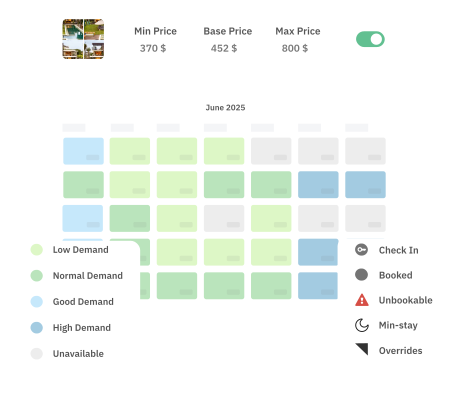
In a professionalized market, intuition-based pricing is a liability. Strategic hospitality requires the synthesis of dynamic pricing and market data to capture every dollar of potential RevPAR. PriceLabs has become the industry standard, with hosts like Rayan Touil noting its ability to calculate prices “outside the host’s comfort zone” to capture peak demand. For operators like Darrach Bourke, transitioning to a data-driven model resulted in tripling the revenue of previous traditional rental models.
Operational Challenge vs. Technical Solution
| Operational Challenge | Technical Solution |
| Capturing Peak Demand & Occupancy Gaps | PriceLabs (Dynamic Pricing Engine) |
| High-Volume Repetitive Guest Messaging | Hospitable / Smoobu (Messaging Automation) |
| Coordination of Remote Cleaning/Maintenance | Automated Scheduling (Integrated PMS) |
| Frictionless Guest Onboarding | Smart Locks + Automated Code Generation |
Conclusion: The Unified Theory of High-Performance Hosting
The “Architecture of Experience” is the ultimate synthesis of soul and system. The future of the hospitality industry belongs to those who can “keep it honest and authentic” (Dean Baker) while utilizing “AI and automation to get their time back” (Doris Toh).
High-performance hosting is the intentional transformation of raw real estate into an oasis. A distinct archetype with a professional tech stack, the host ceases to be a manual operator.