Get started with PriceLabs now!
Want to learn what PriceLabs can do for you? See for yourself with a free trial. Get started now!

Managing rates for a group of 50 or more properties on Booking.com isn’t a job for a calculator and a spreadsheet. To really win, you need smart, automated revenue management strategies that go way beyond just fiddling with prices manually.
For big operators, optimizing rates means using booking.com pricing software like Pricelabs with occupancy forecasting and rate optimization to ensure you’re always charging the right price. This software uses data to suggest the best rates, predict how booked your properties will be (occupancy forecasting), and respond instantly to market conditions.
With the right tools and approach, large property managers can see their income jump by 20-30% while making their day-to-day work much easier across their entire portfolio. This comprehensive guide explores the essential strategies, tools, and implementation tactics needed to optimize Booking.com rates at scale.
Think of rate optimization as employing a 24/7 revenue expert for every unit you manage, constantly fine-tuning prices to maximize both bookings and yield. This system uses continuous data analysis to adjust rates based on current market behavior, competitor moves, your set customizations, and your real-time booking pace.
For managers running 50+ listings, this sophisticated approach isn’t a nice-to-have—it’s a fundamental business requirement. Manually setting rates across that many doors is not only inefficient but also guarantees significant revenue leakage.
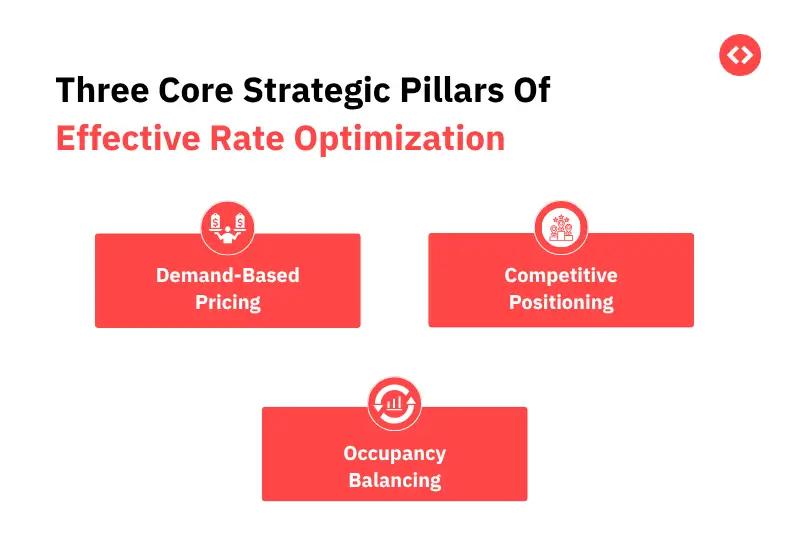
Effective rate optimization hinges on three core strategic pillars:
By deploying the right dynamic pricing tools across your large portfolio, you can realistically expect revenue increases of 20% or more, as seen in Mexico, where listings with high dynamic pricing saw a 148% in RevPAR as compared to listings with no dynamic pricing, while simultaneously eliminating the operational overhead of manual pricing.
Dynamic pricing is the automated adjustment of your nightly rates in real time. It reacts instantly to current booking velocity, competitor price changes, specific local events, and market demand signals. For high-volume portfolios, this level of property management automation is mandatory.
The starting point is selecting booking.com pricing software engineered for multi-property management. These advanced systems are proven to boost both occupancy and income. The optimal deployment strategy involves setting a primary, company-wide set of pricing rules, then enabling specific overrides and customizations for each unique property or micro-market. Tools like PriceLabs Dynamic Pricing Software help you set customizations and pricing rules for your portfolio, which are automatically pushed to your booking.com listings.
The Property Management System (PMS) integration is the foundational, critical step. This connection allows your pricing software to “speak” directly to your PMS, ensuring that every calculated optimal rate is automatically distributed to all sales channels (Booking.com, Airbnb, your direct booking site, etc.). This integration eliminates rate disparity and simplifies operational oversight.
The most effective rollout strategy is phased: test and refine the pricing algorithms on a small subset of properties before expanding across the entire portfolio.
Occupancy forecasting is your revenue manager’s crystal ball. It uses predictive analytics to anticipate future fill rates by analyzing historical patterns, current trends, seasonality, and major external drivers (e.g., university graduations, trade shows).
This predictive capability is crucial because it facilitates proactive rate adjustments. You can strategically increase rates well in advance when the forecast signals high demand, or intelligently apply a discount during an anticipated slow period. This is the core engine of occupancy-based pricing models.
Modern systems deploy AI and Machine Learning for precision:
The more comprehensive data generated by a large portfolio directly improves occupancy forecasting accuracy, allowing the software to learn faster and make more precise pricing decisions.
Market data integration requires automatically factoring in essential external signals—such as your competitors’ dynamic rates, local economic indicators, and demand events—into your pricing structure. Competitor benchmarking ensures your pricing is always responsive and optimally positioned.
To execute this effectively, you need automated and reliable data feeds:
Leading large-scale operators utilize comprehensive systems to monitor competitor activity in every market they touch. This allows your dynamic pricing tools to instantly and automatically adjust rates in response to a rival’s price change, ensuring you never sacrifice profitability.
The implementation steps include:
Rapid market responsiveness is paramount, especially during high-demand periods when the opportunity to capture revenue is greatest. This systematic data integration provides professional property managers with a measurable competitive edge over less technologically advanced competitors. Bookings or higher revenue?
Most large portfolio operators begin to see noticeable improvements in occupancy-based pricing models and revenue per available room (RevPAR) within 60 to 90 days of full implementation. It takes a little time for the system to gather enough data and for the market to react to the new, optimized prices.
The difference is best measured in yield and efficiency. Manual pricing is static, inherently delayed, and prone to costly human errors. Dynamic pricing tools provide instant, 24/7 rate adjustments based on real-time market data. This superior speed and accuracy translate directly into higher Revenue Per Available Room (RevPAR) than any manual approach. You’re replacing reactive guesswork with proactive data science.
The strategic goal is not the maximal price, but the optimal price. The software aims to capture the maximum possible revenue for every single night. This means it will strategically decrease rates during forecasted low-demand periods to boost occupancy and secure cash flow, while only increasing rates during true market surges. This ensures your listing remains competitively positioned at all times, avoiding lost bookings.
PMS integration is the operational backbone. It establishes a seamless, automatic data pipeline between your central booking/operations hub (PMS) and the pricing engine. This guarantees that every optimized rate is instantly reflected on Booking.com and across all channels, eliminating manual data entry, preventing price discrepancies, and, critically, ensuring real-time inventory sync to avoid overbookings.
Solely relying on internal booking data provides an incomplete picture—it’s like trying to navigate without a map. Market data integration is vital because your pricing success is always relative to your competition and external events. If a major local competitor runs a deep promotion or a city-wide event causes a demand spike, the software must know instantly to maintain strategic competitive positioning and revenue capture.
You must focus on tools built for scale. The non-negotiables are:
Occupancy forecasting transforms reactive pricing into a proactive revenue strategy. By predicting future occupancy based on historical data and current pace, the software anticipates demand peaks and valleys. If the forecast indicates an upcoming 95% occupancy rate, the system preemptively maximizes it. If it forecasts a drop to 40%, it triggers strategic early discounts to fill rooms—turning pricing into a data-driven science.
Absolutely. The top systems leverage Artificial Intelligence (AI) and Machine Learning (ML). The AI analyzes every booking outcome (successful conversion, failed conversion, and guest behavior). This process continuously refines the system’s predictive models, making its pricing logic more precise and effective over time, thereby accelerating revenue performance for your portfolio.
This is one piece of the broader challenge of keeping pricing in sync across every platform — see our full guide to OTA pricing sync.
Once your base rates are optimized, understanding how Booking.com's promotions interact with them is the next step — see our guide to Booking.com promotion and discount logic.
For the broader mechanics behind how any of this pricing actually gets decided, see our complete guide to dynamic pricing for short-term rentals.
Want to learn what PriceLabs can do for you? See for yourself with a free trial. Get started now!