Table of Contents
Updated : Jan 29, 2026
In the fast-paced world of short-term rentals, managing a single property on multiple sites is a challenge. Managing a whole portfolio? That’s a full-time logistical puzzle. To stay ahead, multi-property managers are moving beyond basic calendar syncing and embracing a more powerful tool: two-way sync.
But how important is two-way sync when choosing a channel manager for short-term rentals? Put simply, it’s the difference between a reactive business and a proactive, scalable engine. This blog explores why you need a two-way sync channel manager for short-term rentals.
What is Two-Way Sync?
Unlike a one-way sync (which only “pushes” data from your system to a listing site) or an iCal connection, a two-way sync creates a continuous, real-time loop. It ensures that your vacation rental channel manager, Property Management System (PMS), and pricing tools, such as PriceLabs, are constantly communicating with each other. When a guest books on Airbnb, your availability is instantly blocked on Vrbo, and your updated revenue data is reflected in your analytics.
For multi-property operators, this is the foundational technology that enables high-level automation.
7 Must-Know Benefits of Two-Way Sync
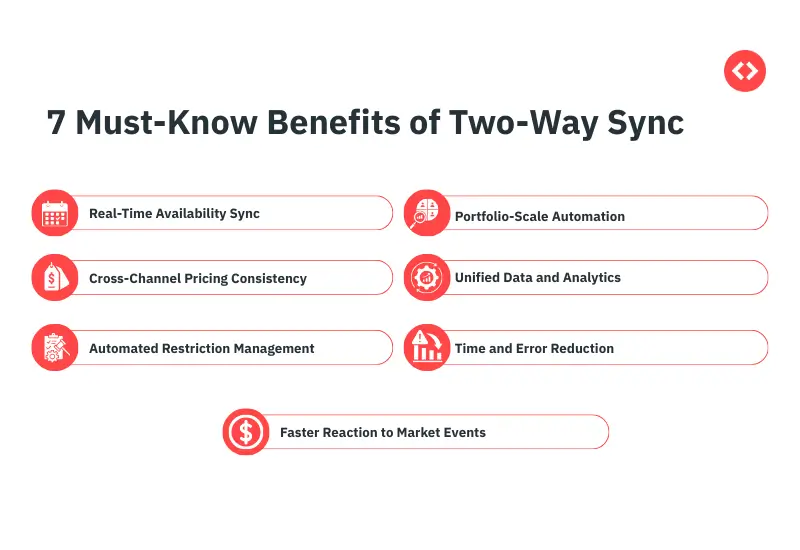
1. Real-Time Availability Sync: The Revenue Safety Net
In a one-way or iCal environment, there is a “latency gap.” If a guest books your beach house on Airbnb at 2:00 PM, an iCal link might not be sent to Booking.com until 3:00 PM. In that hour, a second guest can book the same dates.
The Deeper Value:
- Ranking Protection: OTAs (Airbnb/Vrbo) penalize hosts who cancel bookings. Frequent double-bookings lead to lower search rankings or even account suspension.
- The PriceLabs Edge: With two-way sync, PriceLabs receives booking notifications from your PMS in real time. This allows our algorithms to immediately recognize the inventory reduction, which can trigger “scarcity pricing” for your remaining unbooked dates.
2. Cross-Channel Pricing Consistency: Ending “Rate Leakage.”
Guests are savvy; they often “shop around” across multiple sites to find the lowest price for the same property. If your pricing isn’t synced in both directions, you might see different rates across sites due to manual update lag.
The Deeper Value:
- Brand Integrity: Consistent pricing builds trust. If a guest sees your property for $200 on one site and $150 on another, they feel cheated or suspicious.
- Dynamic Matching: A channel manager or property management software ensures that whether it’s a Tuesday in February or a Saturday in July, the exact optimized rate is pushed to every corner of the internet simultaneously.
3. Automated Restriction Management: Beyond the Nightly Rate
Pricing is only half the battle. You also need to manage how people book. This includes Minimum Length of Stay (MinLOS), “Closed to Arrival” (CTA), and “Closed to Departure” (CTD) settings.
The Deeper Value:
- Gap Filling: Two-way sync allows PriceLabs to see a 2-day gap between two 5-day bookings. Our system can automatically lower the “Minimum Stay” requirement for just those two days to ensure they get booked, then push that rule change to all channels instantly.
- Operational Control: You can prevent check-ins on major holidays (like Christmas Day) across all platforms with a single click, ensuring your cleaning staff gets a break.
Scale Faster with PriceLabs
Managing multiple properties shouldn't mean more manual work. Unlock the power of portfolio-wide automation and unified analytics with our robust two-way API connections. Whether you have 5 properties or 500, PriceLabs is built to scale with you.
Start Your free trial4. Portfolio-Scale Automation: Management via “Macro.”
When you manage 50+ properties, clicking into each individual listing to adjust for a local festival is impossible. Two-way sync allows for Bulk Actions.
The Deeper Value:
- Grouping Strategies: You can group all “3-Bedroom Condos” together. If you want to increase prices by 10% for the entire group due to a new stadium announcement, two-way sync carries that command to every listing across every OTA in one move.
- Scalability: This is the only way a small team can manage a large portfolio without a massive increase in headcount.
5. Unified Data and Analytics: Your Strategic Command Center
Without two-way sync, your data is siloed. You know your Airbnb revenue, but you might not see how it compares to your Vrbo revenue in real-time unless you manually export spreadsheets.
The Deeper Value:
- The PriceLabs Dashboard: Because data flows back into our system via a two-way sync, our Portfolio Analytics tool lets you see your listing performance in one place. You can also compare your performance against the market with PriceLabs Market Dashboards.
- Lead-Time Insights: You can see if guests are booking further in advance on one channel versus another and adjust your channel-specific markups accordingly.
6. Time and Error Reduction: Eliminating “Fat-Finger” Mistakes
Manual entry is the single greatest point of failure in property management. A typo in a pricing field can cost thousands of dollars in a matter of minutes. PriceLabs lets you automate your pricing while giving you complete control over your strategy through advanced customization.
The Deeper Value:
- Set It and Forget It: Once your sync is established, the “Human in the Loop” moves from data entry to strategy oversight.
- Financial Security: Two-way sync acts as a digital handshake that verifies that the data sent matches the data received, ensuring that a $500/night holiday rate doesn’t accidentally get listed as $50/night.
7. Faster Reaction to Market Events: Agility as a Weapon
The travel market is volatile. Weather events, political shifts, or sudden “viral” travel trends can change demand overnight.
The Deeper Value:
- First-to-Market Advantage: When demand spikes, the first manager to raise rates captures the highest margin. Two-way sync ensures your “high-demand” prices are live everywhere while your competitors are still drinking their morning coffee.
- Automated Response: PriceLabs’ Hyper-Local Pulse detects these shifts and uses the two-way sync to automatically update your channels, even while you sleep.
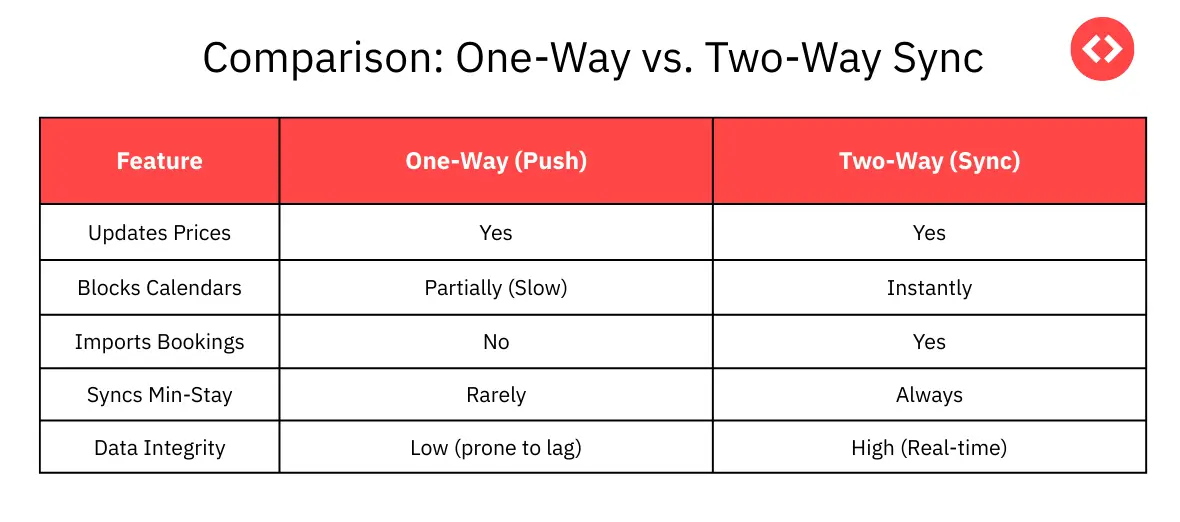
Comparison: One-Way vs. Two-Way Sync
Why Connection Type Matters
When selecting a channel manager, the “how” matters as much as the “who.”
- One-Way Sync: High risk of delays; no guest data returned.
- iCal Sync: Slow (updates can take hours); only handles dates, not prices.
- Two-Way API Sync: The gold standard. Real-time, automated, and comprehensive.
For any manager looking to scale, choosing a partner that supports full two-way integration with PriceLabs is essential for maintaining data integrity and optimizing revenue.
Implementation Checklist
To get the most out of your two-way sync, follow these steps:
- Verify API Coverage: Ensure your channel manager has full API (not just iCal) connections with your top OTAs.
- Map All Fields: Confirm that prices, taxes, and restrictions (like min-stay) are all correctly mapped.
- Governance: Establish clear rules for who can change prices to avoid “rule overlap.”
- Test Connectivity: Conduct a failover test to see how quickly a test booking blocks other channels.
Frequently Asked Questions
1. What is the main difference between one-way and two-way sync?
In a one-way sync, your channel manager “pushes” information (such as rates and availability) to your booking channels, but it doesn’t receive any data back. This means you still have to manually enter bookings from those channels into your system. Two-way sync is a bidirectional conversation: it pushes your rates out and automatically pulls reservation and guest data back in, keeping every system perfectly aligned without human intervention.
2. Is iCal sync a form of two-way sync?
Technically, yes, but it is a “weak” version. iCal can sync calendar dates in both directions, but it cannot sync pricing, guest names, or complex stay restrictions (like a 3-night minimum). More importantly, iCal has a “sync lag” that can range from 15 minutes to several hours, which significantly increases your risk of double bookings. Professional managers prefer API-based two-way sync for its near-instant speed.
3. How does two-way sync help me make more money?
It enables Dynamic Pricing. Because two-way sync allows tools like PriceLabs to see your real-time occupancy across all channels, it can automatically adjust your prices based on supply and demand. If you get a sudden surge of bookings on one channel, the system recognizes the lower inventory and can instantly raise prices on your remaining channels to optimize your RevPAR (Revenue Per Available Room).
4. Can I use PriceLabs if my channel manager only supports one-way sync?
While you can still send prices to your channels, you lose the “intelligence loop.” PriceLabs performs best when it can see your actual booking data flowing back from your channels. This data enables our AI to track your “pace” (how quickly you book compared to the market) and fine-tune your price recommendations.