
Table of Contents
Updated : Apr 6, 2026
The Czech Republic’s short-term rental (STR) landscape has officially shifted from a high-growth recovery phase into a period of professional stabilization. For property managers, 2026 isn’t just about filling calendars; it’s about sophisticated yield management in an increasingly competitive, hotel-dominated market. Whether you are managing a boutique pension in South Moravia or a portfolio of apartments in Prague, staying ahead of the Czech Republic vacation rental market trends 2026 is the difference between stagnation and a record-breaking fiscal year.
Czech Republic Vacation Rental Market Trends 2026 Summary
The 2025–2026 cycle reveals a market that has found its footing. While active listings reached 24,668 by early 2026, the real story lies in how that inventory is performing. We are seeing a “flight to quality” where professionally managed units are decoupling from the rest of the market in terms of revenue.
- RevPAR Growth: A healthy 13% YoY increase ($66 average).
- Supply Dynamics: A 12% increase in active listings, predominantly in the professional sector.
- The “Tech Gap”: Properties using high-automation dynamic pricing are outperforming static listings by 124% in RevPAR.
Read More: 2026 Short-Term Rental Trends: The Professional Manager’s Guide to Boosting RevPAR
Market Performance Overview: Rate-Driven Revenue
Current data suggests that Czech Republic vacation rental market trends 2026 are currently rate-favored. Managers are successfully pushing prices higher without a significant drop-off in volume—a classic sign of a maturing destination.
Key Performance Indicators (YoY Comparison)
| Metric | 2024-25 Average | 2025-26 Average | Change (%) |
| Occupancy | 56% | 58% | +1% (Absolute) |
| ADR (USD) | $103 | $114 | +10% |
| RevPAR (USD) | $58 | $66 | +13% |
What this means for property managers:
Currency Awareness: While USD ADR is up 10%, the CZK ADR growth appears flatter. Managers should monitor exchange rates and consider targeting international travelers from higher-purchasing-power regions (like the US or Western Europe) who are less sensitive to these local price increases.
Capture the “Compression Window”: Since occupancy is stable at 58%, your largest revenue gains will come during “compression events”—dates when market-wide demand exceeds supply. Use forward-looking market data to identify these dates (such as the Prague Marathon or Christmas markets) at least 3–6 months in advance to set aggressive “ceiling” rates.
Combatting Rising Competition: With hotels representing 64.4% of the market, STR managers are no longer just competing with other apartments; they are competing with professional hotel yield managers. To win, you must adopt similar technology. Properties using High dynamic pricing reached an average ADR of $131, compared to just $100 for those with fixed rates.
The Luxury Advantage: 5-star and luxury properties in Czechia currently experience extreme seasonal fluctuations, with rates peaking near 8,000 CZK in December. For high-end managers, the strategy should be “Occupancy-Based Logic”: maintain high rates even if it means slightly lower early occupancy, as luxury demand often materializes closer to the date at much higher price points.
Operational Efficiency: Because growth is rate-driven rather than volume-driven, managers can potentially earn more total revenue with fewer total bookings. This reduces wear and tear on properties and lowers cleaning/turnover costs, directly improving your bottom-line margins.
Don’t Leave a 124% Revenue Gap on the Table
As we’ve seen, static pricing is a liability in 2026. Transition from manual guessing to automated precision and start capturing the premium rates your property deserves.
Start Your Free Trial NowSupply & Demand Dynamics: The Professional Edge
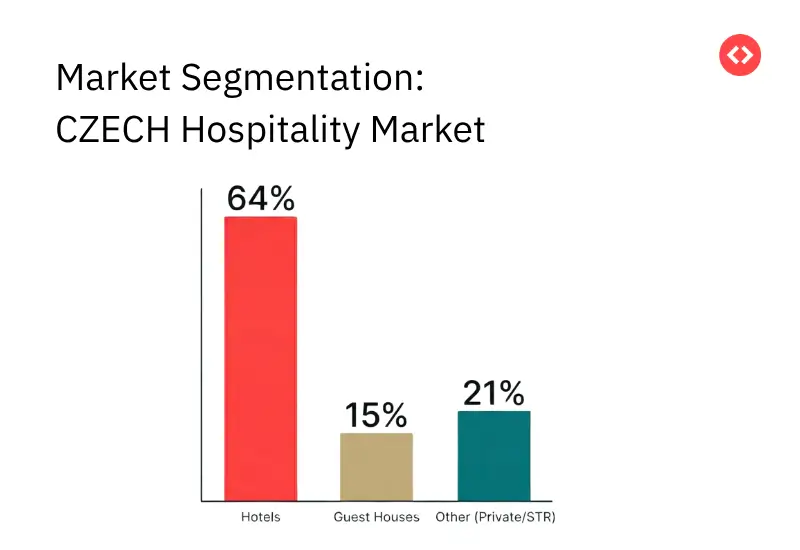
The Czech market is unique due to its high concentration of traditional hospitality, a key factor influencing Czech Republic vacation rental market trends 2026. Hotels (64.4%) and Guest Houses (15.2%) dominate the supply, creating a landscape where short-term rentals must compete with professional hospitality standards daily.
- Inventory vs. Absorption: While supply grew by 12% to 24,668 active listings, demand (booked nights) rose by 10%. This 2% delta indicates a slight “supply-heavy” trend, meaning managers can no longer rely on market growth alone to fill rooms. You must actively capture market share from the hotel sector.
- The Professional Pivot: 49% of the market is now controlled by professional managers (Small to Large size). This “Professional Edge” means your competitors are likely using property management automation. If you are an individual host, your “unique selling proposition” (USP) must be personality and local authenticity to counter the “branded” feel of the dominant hotel and guest house segments.
- Aparthotel Emergence: We are seeing a rise in “Smarter Aparthotels”—units that offer the space of an apartment with the tech-stack of a hotel (automated check-in via Previo, dynamic pricing via PriceLabs). This hybrid model is currently the fastest-growing threat to traditional STRs.
Seasonality & Booking Behavior
Vacation rental seasonality remains the “final boss” for Czech operators. The market experiences extreme peaks in August and December, with significant troughs in January where occupancy can dip as low as 45%.
- The “Summer Surge” Booking Window: While the median booking window is 25 days, the jump to 34 days for summer peaks and 35 days for December creates a “blind spot.” If your rates aren’t set 4 months in advance, you risk being booked out at baseline prices by early-bird travelers before the market-wide demand spike actually begins.
- Length of Stay (LOS) Micro-Trends: The 3.38-day average is consistent, but a deeper look shows that July and August push LOS to 4.0 nights, while mid-week stays in November drop to 2.5.
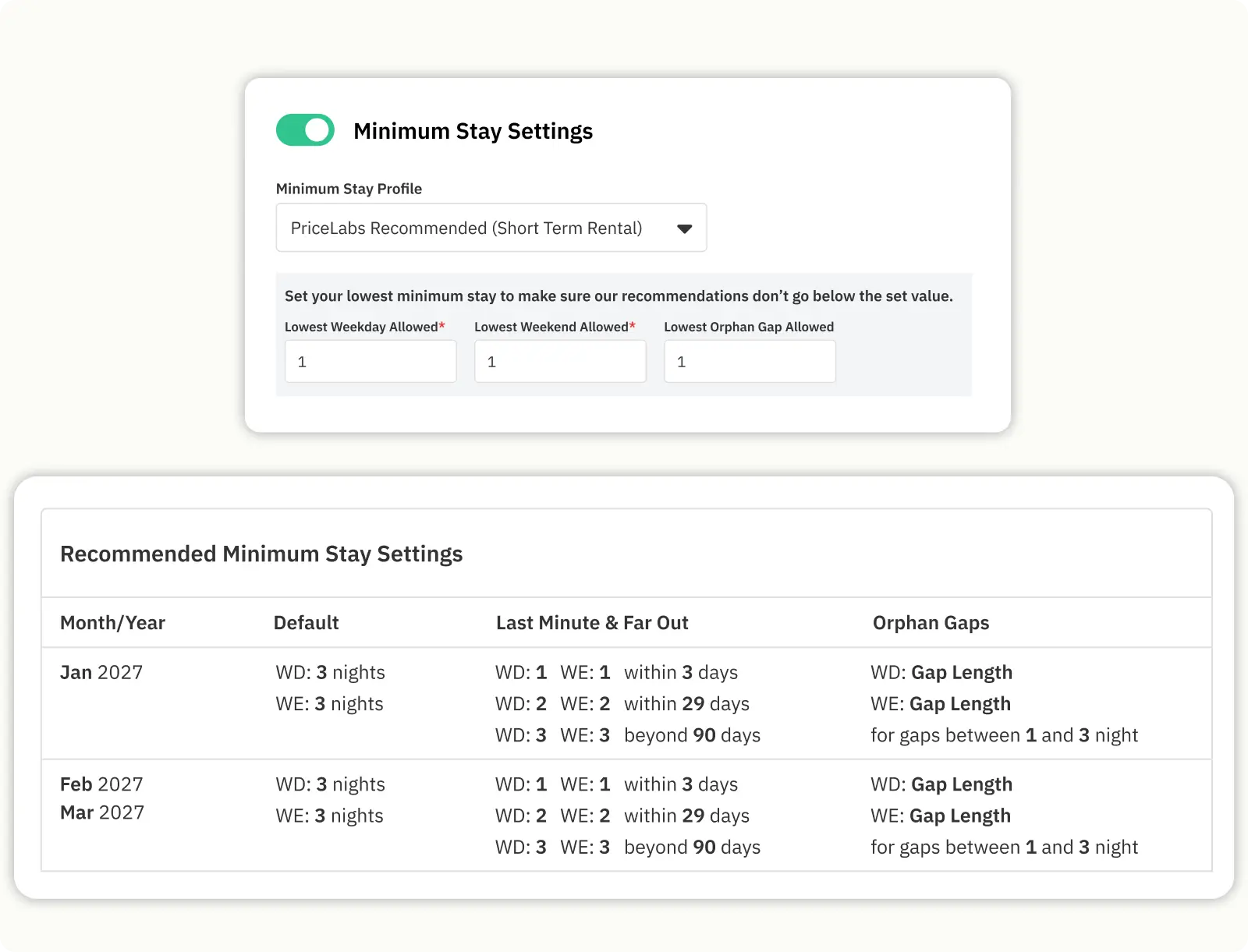
- Strategy: Implement a Minimum Stay Restriction using PriceLabs minimum stay restriction customization of 3 nights for weekends but drop to 1 or 2 nights for mid-week Tuesdays/Wednesdays to capture the business traveler and “city-break” crowd that keeps the market moving during shoulder months.
- Luxury Tier Volatility: Data from the 90th percentile shows that luxury properties (5-star equivalents) don’t just see higher rates—they see higher volatility. For example, while a standard 3-star room might see a 20% price increase for Christmas, a luxury apartment can see a 200% surge, hitting nearly 8,000 CZK.
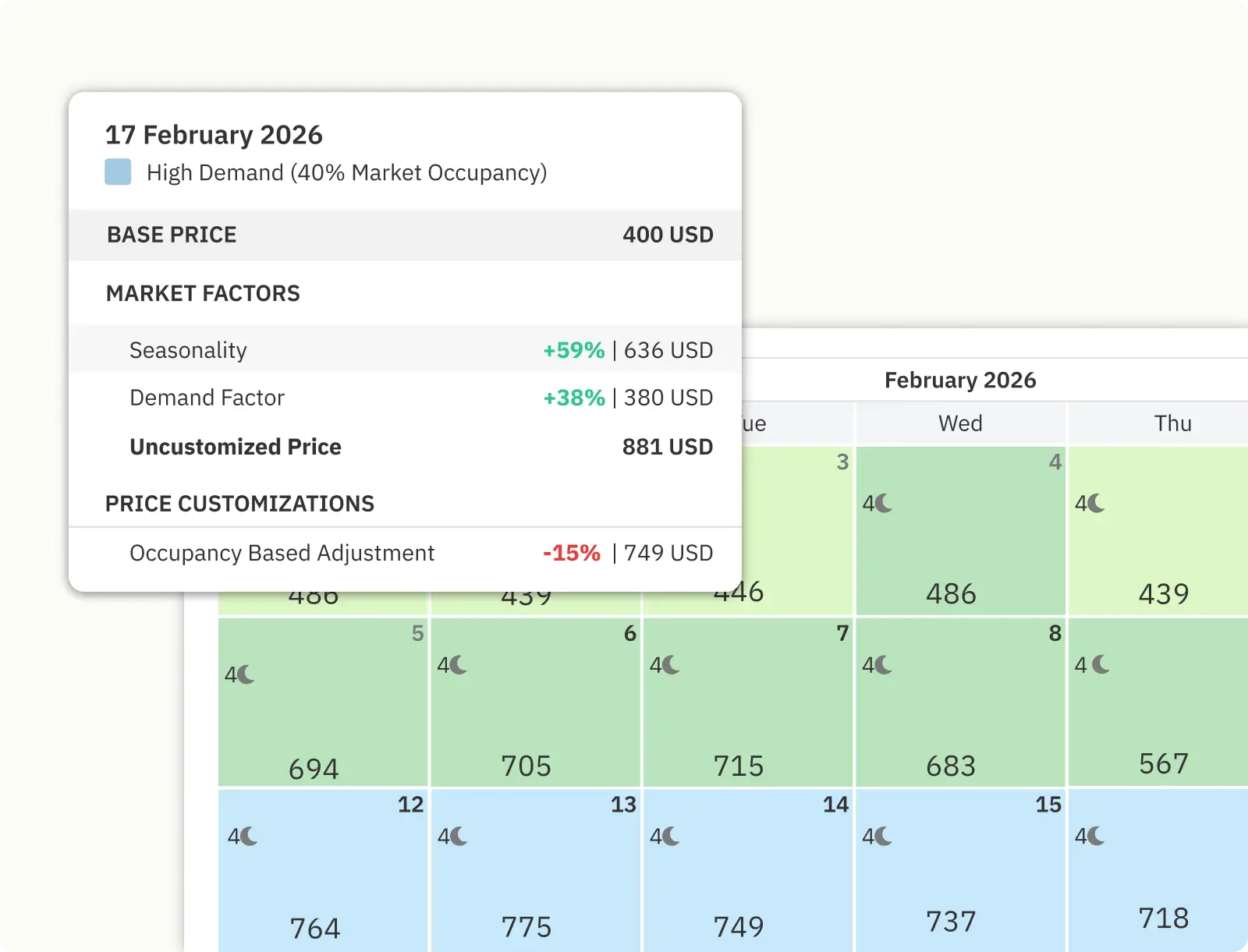
- Strategy: For luxury units, use “Aggressive” pricing profiles in PriceLabs. Don’t be afraid of a low “pacing” (occupancy) 60 days out; luxury guests in Prague often book high-value stays closer to the date.
Strategic Takeaways for Property Managers:
- Monitor the “Hotel Occupancy” Proxy: Since 64% of your competitors are hotels, monitor their “No Vacancy” signals. When hotels in Prague 1 hit 90% occupancy, your STR rates should increase by an additional 15-20% immediately to capture the overflow demand.
- The January “Survival” Discount: With January being the lowest demand month, your strategy should shift from Rate Maximization to Cost Coverage. Use Last Minute discounts of 20-30% for bookings within 7 days to ensure you aren’t sitting on empty inventory during the coldest months.
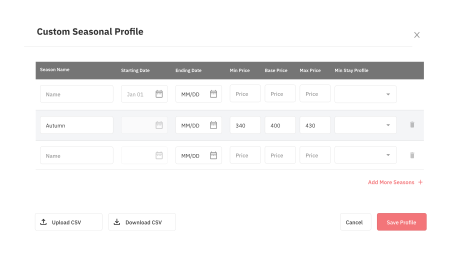
- Local Integration: Leveraging the Previo + PriceLabs integration allows you to automate these complex shifts. Set your Custom Seasonal Profiles once in the spring, and let the algorithm handle the 35-day booking window shifts for the December peak.
Don’t Leave a 124% Revenue Gap on the Table
As we’ve seen, static pricing is a liability in 2026. Transition from manual guessing to automated precision and start capturing the premium rates your property deserves.
Start Your Free Trial NowExternal Drivers: Regulations and Technology
The “Lex Voucher” Legacy & New Regulations
STR regulations in Prague continue to evolve. Credible reports from local tourism boards suggest a move toward stricter registration requirements (similar to the DAC7 directives across the EU). Professional managers who use integrated PMS systems like Previo are better positioned to handle these reporting requirements automatically.
The Previo + PriceLabs Advantage
With the Czech market being so hotel-heavy, the integration between PriceLabs and Previo has become a local industry standard. This allows managers to blend STR data with hotel-level insights, creating a more accurate competitive set.
The massive performance gap between automated and manual pricing isn’t just a trend; it’s the defining characteristic of the 2026 Czech market. When we look at the 124% RevPAR difference, we aren’t just seeing higher prices—we are seeing a fundamentally different way of capturing market share.
The 124% Difference: Dynamic Pricing vs. Static Strategy
The data is unequivocal: Static pricing has become a major liability for professional managers in the Czech Republic.
| Pricing Strategy | Occupancy | ADR (USD) | RevPAR (USD) | Performance Lift |
| High Dynamic Pricing | 75% | $131 | $100 | Baseline |
| Moderate Dynamic Pricing | 66% | $119 | $79 | -21% Gap |
| No Dynamic Pricing (Static) | 45% | $100 | $45 | -124% Gap |
Why the Gap is So Wide?
1. Capturing the “Hidden Peaks”
Static price users often set a “Weekend Rate” and a “Weekday Rate.” However, dynamic pricing identifies hyper-local demand spikes—such as a specific concert at the O2 Arena in Prague or a regional wine festival in Moravia—that static users miss entirely. By the time a manual host realizes a date is high-demand, the dynamic property has already been booked at a 40% premium.
2. Automated “Orphan Night” Filling
A key driver of the 30% occupancy lead held by dynamic users is the ability to automatically discount “orphan nights” (single or double-night gaps between longer bookings). In the Czech Republic, where the average stay is 3.38 days, these gaps occur frequently. Dynamic pricing lowers the barrier for these specific nights, ensuring the calendar remains tight without devaluing the rest of the month.
3. Real-Time Response to Hotel Inventory
Since 64.4% of the market is hotel-based, STR demand is often a byproduct of hotel sell-outs. Properties using “High” dynamic pricing are linked to algorithms that track hotel occupancy in real-time. When the local Marriott or Hilton hits 90% occupancy and spikes their rates, dynamic STRs immediately follow suit, capturing the “spillover” guest who is willing to pay a premium.
4. Psychology of the 25-Day Booking Window
Manually pricing hosts tend to panic and drop prices if they aren’t booked 30 days out. Dynamic pricing understands the 25-day median booking window in Czechia. It holds the rate steady (or even increases it) as the window approaches, knowing that demand is still coming. This prevents leave-on-the-table revenue caused by premature discounting.
5. Protecting the Bottom Line During Troughs
In the deep trough of January (45% occupancy), dynamic pricing doesn’t just lower rates—it finds the Floor Price that covers operational costs while remaining the most competitive option in the search results. Static hosts often stay priced too high for the low season making a common pricing mistake, resulting in zero-revenue months.
How PriceLabs Powers the Professional Edge
PriceLabs Dynamic Pricing Software transforms these raw Czech Republic vacation rental market trends 2026 into a proactive revenue shield. By integrating directly with your PMS (like Previo), PriceLabs analyzes hyper-local demand, competitor availability, and seasonal shifts in real-time, automatically pushing optimized rates to your listings. This removes the “guesswork” of manual updates, ensuring you are always priced high enough to capture premium revenue during the August surge, yet competitive enough to maintain occupancy during the quietest weeks of January. For professional managers, it’s not just a pricing tool—it’s an automated analyst that works 24/7 to ensure your portfolio never misses a market signal.
Don’t Leave a 124% Revenue Gap on the Table
As we’ve seen, static pricing is a liability in 2026. Transition from manual guessing to automated precision and start capturing the premium rates your property deserves.
Start Your Free Trial NowForward-Looking Outlook
The next 12 months will favor the “Technological Operator.” As supply growth (12%) continues to slightly outpace demand (10%), the winners will be those who can micro-adjust rates daily based on hyper-local events and competitor cancellations.
Frequently Asked Questions (FAQs)
1. What is the peak season for vacation rentals in the Czech Republic?
The primary peak is August (71% occupancy), followed by a secondary peak in December for the Christmas markets. Shoulder seasons in May and September also offer strong ADR opportunities.
2. How are STR regulations changing in Prague for 2026?
Regulations are shifting toward stricter local registration and tax compliance. Using a professional PMS like Previo helps ensure you meet the latest digital reporting standards required by Czech authorities.
3. Is dynamic pricing worth it for small portfolios in Czechia?
Absolutely. Data shows that even “Moderate” use of dynamic pricing leads to a significantly higher RevPAR ($79) compared to static pricing ($45), regardless of portfolio size.
4. What is the average length of stay in Czech STRs?
The average stay is approximately 3.4 days. Strategy tip: Implement a 2-night minimum to avoid high turnover costs while remaining available for the majority of market demand.