
Table of Contents
Updated : Apr 6, 2026
The short-term rental (STR) landscape in 2026 is no longer defined by the predictable cycles of the past. For professional property managers overseeing portfolios of 10+ listings, the transition from “gut-feel” pricing to a sophisticated data driven revenue management strategy has become a necessity for survival.
In a recent RevLabs Insider session, Kyndra Gardner, a performance expert at PriceLabs, shared critical insights into how mid-market managers are navigating shifting demand, tool fatigue, and the psychological hurdles of modern revenue management.
Why a Data-Driven Revenue Management Strategy Requires Market Context
Many experienced operators are currently facing “soft demand panic.” After years of record-breaking growth, 2026 seasonal shifts can feel like a crisis. However, the first step in a data driven revenue management strategy is moving beyond historical comparisons.
- The Trap: Comparing 2026 performance to “peak” pandemic years without context.
- The Reality: Booking windows have shrunk by 10–15% globally. Guests are booking closer to their stay dates, which can make a calendar look “empty” even if demand is stable.
- The Insight: Professional managers must lean into real-time pacing data to differentiate between a broken strategy and a naturally shifting market pace.
Optimize Your Portfolio with a Data Driven Revenue Management Strategy
Don't leave your 2026 revenue to chance. Stop guessing and start growing with the same sophisticated tools used by the world’s top property managers. Join thousands of professionals who use PriceLabs to automate their data driven revenue management strategy, eliminate manual errors, and maximize every booking.
Start Your Free Trial NowAvoid Manual Overrides to Protect Your Data Driven Revenue Management Strategy
With an influx of new technology, many property managers are experiencing “tool fatigue.” When overwhelmed by data points, the instinct is often to ignore the revenue management software and revert to manual pricing—a move that often complicates long-term recovery.
Bonus Read: Vacation Rental Revenue Management: The Complete Guide for Hosts and Property Managers
The Low Confidence Lever Trap
When revenue targets are missed, the instinct is to “yank the wheel”—pulling multiple levers at once by dropping rates, changing stay requirements, and updating marketing simultaneously.
“I’m not going to yank the wheel and push a bunch of buttons because I don’t know what change that made to actually get me to where I need to go.” — Kyndra Gardner
Manual overrides create “management debt.” Every manual price set today is a task your team must manually “undo” tomorrow, preventing your data driven revenue management strategy from scaling.
Apply the Single Lever Rule for an Effective Data Driven Revenue Management Strategy
To maintain a clear success metric, professional managers should adopt a strategy of small, incremental changes rather than global overhauls.
- Identify the Variable: Use portfolio analytics to analyze your listing performance and see if the issue is your Base Price or your Length-of-Stay (LOS) restriction.
- Make One Adjustment: Tweak only one setting at a time.
- Evaluate the Data: Allow the market 48–72 hours to respond before making the next move. This “scientific” approach ensures you know exactly which change drove the booking.
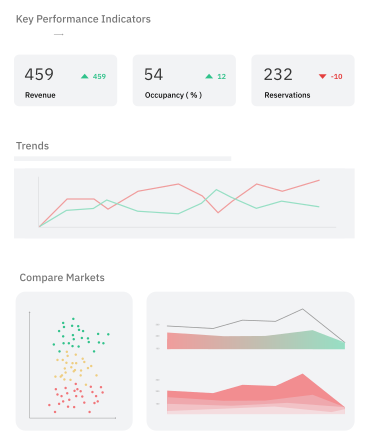
Hyper Local Mapping for Better Data Driven Revenue Management Strategy Results
While broad market data is useful for high-level reporting, professional managers often underutilize hyper-local competitor data to apply market-based pricing. In 2026, the guest decision often comes down to two or three nearly identical properties.
- The Competitive Set: Use a “Top 5” comp set of properties that share your exact bedroom count and amenity level.
- Performance Surprises: In 2026, smaller, well-optimized homes are often outperforming larger floor plans in terms of pure occupancy. If you manage large estates, your data driven revenue management strategy must account for the fact that group travel patterns are becoming more price-sensitive.
Common Errors That Damage a Data Driven Revenue Management Strategy
Through her work with diverse portfolios, Kyndra Gardner identified several recurring mistakes that erode owner trust and portfolio profitability. Avoiding these pricing pitfalls is essential for maintaining a clean, scalable data driven revenue management strategy.
1. Dropping Rates Without Long Term Impact Analysis
The most frequent mistake in a data driven revenue management strategy is the “fire sale” reaction to a quiet calendar. Lowering the base rate to capture immediate last-minute gaps often creates a domino effect across your entire booking curve.
- The Hidden Cost: When you drop your base price to fill a Tuesday-Wednesday gap next week, you risk lowering the price for high-demand future dates like the 2026 Super Bowl or local festivals if your seasonality offsets aren’t properly locked.
- The Solution: Instead of a global price drop, use Last-Minute Discounts that are specifically capped at a 7–14 day window. This allows you to stay competitive for immediate needs without devaluing your listing for peak dates six months away.
2. Ignoring Length of Stay Impact on Conversion
A property that isn’t booking is often a victim of rigid length of stay rules rather than high pricing. If your data driven revenue management strategy only looks at the nightly rate, you are missing half the picture.
- The Friction Point: In 2026, guest booking windows are tighter. If the market trend shows guests booking 2-night stays on a 7-day lead time, but your settings require a 4-night minimum, your property won’t even appear in search results.
- Data Driven Fix: Before touching your price, audit your Booking Pace vs. LOS. If your competitors are capturing shorter stays at a higher ADR, lowering your minimum stay requirement with PriceLabs minimum stay restricions is often more effective than lowering your price. This protects your revenue while increasing your search visibility. You can also use PriceLabs MinStay Recommendation Engine to see recommendations for LOS restricitions based on market data.
3. Neglecting New Revenue Streams and Ancillary Income
As ADR growth stabilizes across the industry, a sophisticated data driven revenue management strategy must look beyond the nightly rate to protect owner margins. Relying solely on the “rent” line item is a missed opportunity for portfolio-wide growth.
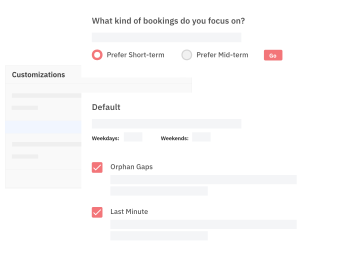
- Gap Filling Automation: Use “orphan night” logic to automatically discount those awkward 1- or 2-night gaps between longer stays. This turns unbookable “dead air” into high-margin revenue.
- Monetizing Flexibility: Data shows that in 2026, over 30% of guests are willing to pay for early check-in or late check-out. Automating these offers based on your cleaning schedule adds “pure profit” to the bottom line without increasing your marketing spend.
- Dynamic Professional Fees: Professional managers are increasingly using data to adjust management fees based on performance tiers, ensuring that as the strategy succeeds, both the owner and the manager benefit.
Actionable Takeaways for Property Managers
- Audit Your Comp Sets: Move beyond general neighborhood averages. Build a specific list of your primary competitors using the PriceLabs Neighborhood Data tool.
- Implement the 48 Hour Rule: When performance dips, adjust only one variable and wait 48 hours to measure the impact on booking pace.
- Contextualize 2026 Performance: Stop comparing 2026 “soft” months to 2021 peaks. Use pacing data to see if your occupancy is a reflection of the current market-wide booking pace.
Frequently Asked Questions
Should I lower my prices if I have a gap in my calendar next week?
Not necessarily. If demand for that period is market-wide low, dropping your price may not induce a booking—it will only lower your ADR.
What is more important: Price or Length of Stay?
In 2026, they are two sides of the same coin. Many properties are priced correctly but fail to book because their LOS restrictions are too rigid for the current shrinking booking window.