
Table of Contents
Updated : Feb 4, 2026
As an Airbnb host, you’ve likely heard both “dynamic pricing” and “revenue management” used interchangeably. While they both aim to put more money in your pocket, they function very differently. Understanding these differences is the first step toward choosing the right strategy for your unique business goals.
Master the Airbnb Guardrail Strategy: Download Your Weekly Revenue Review Checklist
Stop guessing and start growing. Get the exact 5-step checklist successful Airbnb hosts use every Monday to audit their pricing, protect their profit margins, and outpace the local competition.
Download It NowWhat Is Dynamic Pricing for Airbnb Hosts?
For most individual hosts, dynamic pricing is the first step toward professionalizing their rental. It is an automated process that adjusts your nightly rates in real time based on shifting market signals.
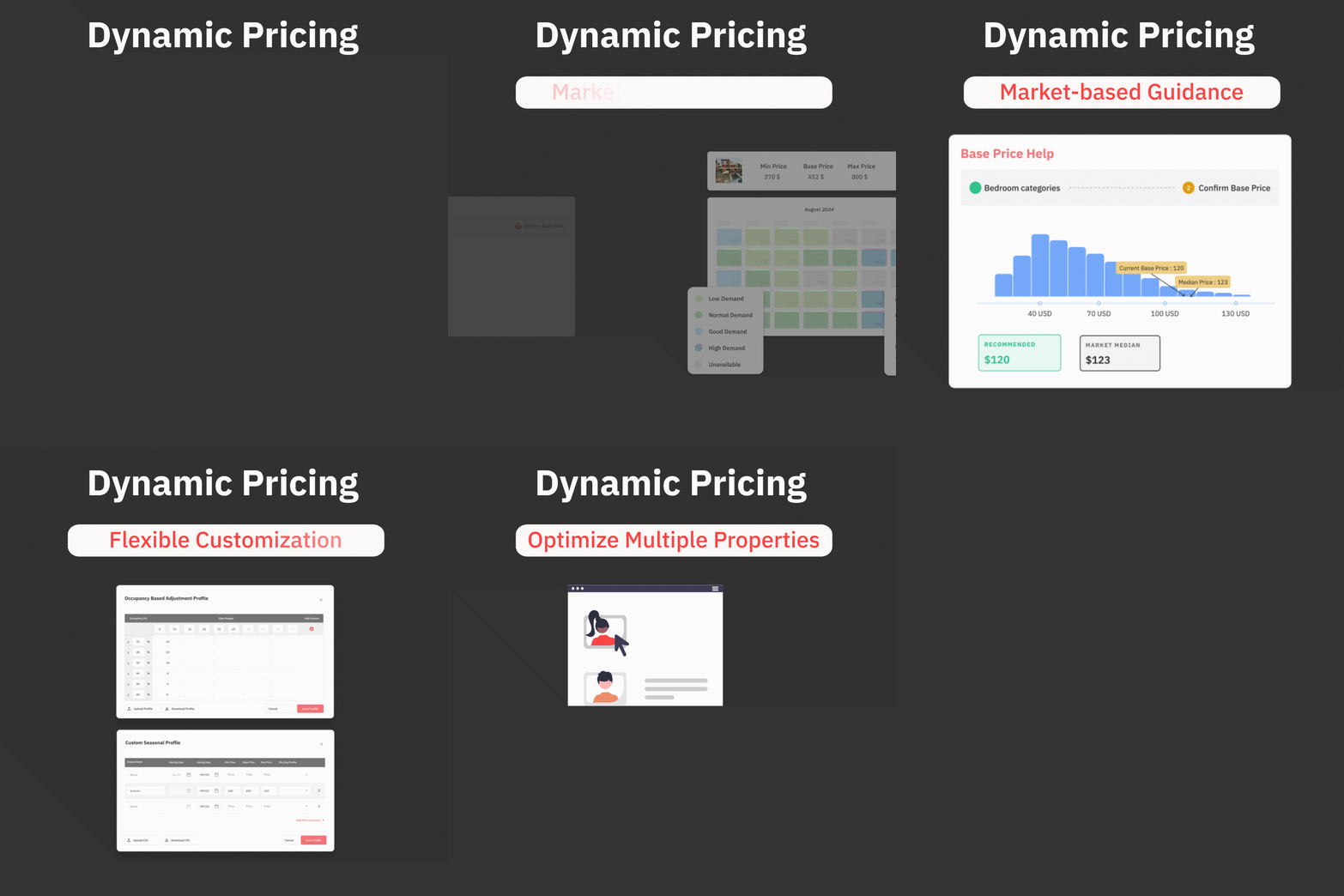
Think of it as a tactical tool that uses algorithms to react quickly to the market. Instead of you manually changing prices for a holiday weekend, the software does it for you by analyzing:
- Real-time demand and competitor prices.
- Booking lead time (how far in advance guests are booking).
- Local events and seasonal peaks.
The primary goal of “automated pricing” is to capture more bookings during high-demand periods or to clear out “inventory” (empty nights) at the last minute through rate optimization.
What Is Full Revenue Management for Airbnb Hosts?
While dynamic pricing is about the price, full revenue management is a broader, comprehensive strategy. It is a system that combines forecasting, guest segmentation, and distribution management to maximize your long-term profitability.
Revenue management looks beyond just the nightly rate to include:
- Strategic forecasting: Using historical market data from months or even years to plan weeks ahead rather than just reacting daily.
- Operational rules: Setting specific minimum stay requirements and inventory controls.
- Channel management: Deciding which platforms (Airbnb, Vrbo, or direct booking) provide the best guest mix and profit margins.
In short, if dynamic pricing is the “sprint” to get a booking today, revenue management is the “marathon” strategy to ensure your entire year is profitable.
Dynamically Price Your Property and Get FREE Custom Reports Tailored To Your Property!
Use PriceLabs Dynamic Pricing to competitively and dynamically price your property according to demand shifts and analyze past performance to set a strong pricing strategy for your property.
Create your Account NowKey Difference 1: Time Horizon of Pricing Decisions
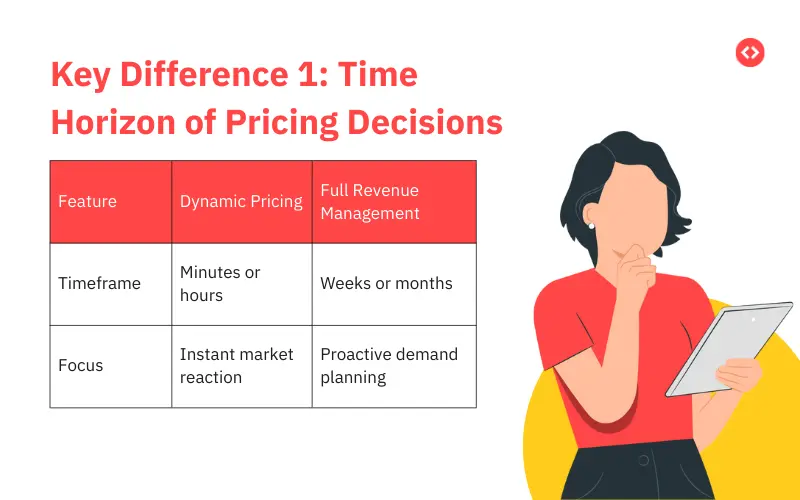
The most immediate difference between these two approaches is how far into the future they look.
- Dynamic Pricing: This operates on a very short time horizon, with algorithms often adjusting your rates within minutes or hours based on immediate market shifts.
- Full Revenue Management: This takes a long-term outlook, planning rate strategies across weeks or months by anticipating seasonal demand curves.
Key Difference 2: Primary Objectives
While both aim to increase earnings, their core goals differ in scope.
- Dynamic Pricing (Immediate Capture): The main goal is to maximize occupancy and your Average Daily Rate (ADR) based on current, real-time demand.
- Full Revenue Management (Long-term Health): This targets overall profitability by balancing short-term gains with metrics like Revenue Per Available Room (RevPAR) and maintaining a specific guest mix.
At a glance:
- Dynamic Pricing: Focuses on near-term revenue and filling empty calendar gaps.
- Revenue Management: Focuses on long-term profit, channel optimization, and business sustainability.
Dynamically Price Your Property and Get FREE Custom Reports Tailored To Your Property!
Use PriceLabs Dynamic Pricing to competitively and dynamically price your property according to demand shifts and analyze past performance to set a strong pricing strategy for your property.
Create your Account NowKey Difference 3: Types of Data Inputs Used
The “intelligence” behind each system comes from different data streams.
- Dynamic Pricing (Live Signals): Relies on real-time, actionable data such as current competitor rates, instant website traffic, and remaining unsold inventory.
- Full Revenue Management (Historical Context): Incorporates broader, aggregate data including historical occupancy trends, seasonal booking curves, and multi-year forecasts.
Data Comparison:
- Dynamic Pricing: Uses live signals that update multiple times daily.
- Revenue Management: Uses historical trends and aggregate market data to model future demand.
Key Difference 4: Complexity and Scope of Implementation
For an individual host, the “effort” required for each approach is a major deciding factor.
- Dynamic Pricing: These systems are typically “plug-and-play” and algorithm-driven. They focus specifically on automatically adjusting the rates for your individual listings with minimal manual intervention.
- Full Revenue Management: This involves much more complex, multi-faceted decision-making. It requires you to set policies for pricing, availability rules, and channel distribution, often requiring regular oversight to track KPIs.
Operational Effort:
- Dynamic Pricing: Uses a single setting and automation for ease of use.
- Revenue Management: Requires policy development, active KPI tracking, and regular strategic reviews.
Dynamically Price Your Property and Get FREE Custom Reports Tailored To Your Property!
Use PriceLabs Dynamic Pricing to competitively and dynamically price your property according to demand shifts and analyze past performance to set a strong pricing strategy for your property.
Create your Account NowKey Difference 5: Frequency and Flexibility of Price Changes
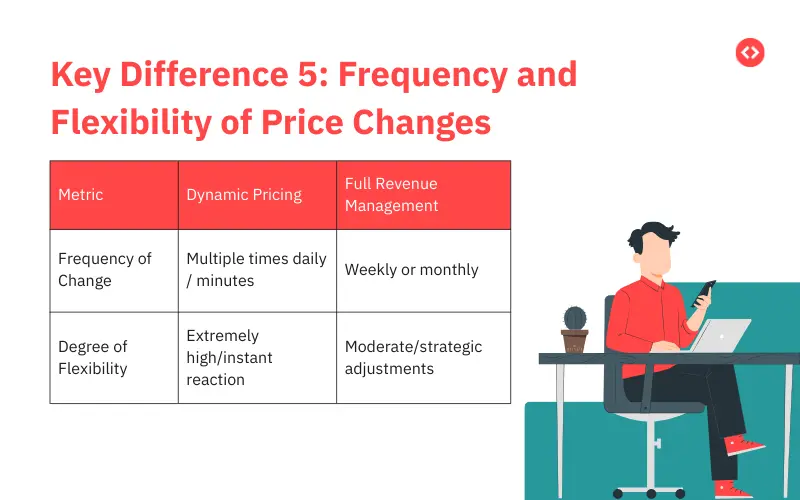
How often your prices change—and why—differs significantly between the two.
- Dynamic Pricing: Technology updates your rates multiple times per day or even within minutes. It is highly reactive, instantly responding to a sudden surge in demand or a competitor’s price drop.
- Full Revenue Management: Rates and stay restrictions are set with a much slower cadence. Reevaluations usually happen weekly or monthly as part of a broader business review, rather than a reaction to a single afternoon’s market shift.
Key Difference 6: Operational Fit for Different Host Profiles
Choosing the right path depends heavily on the size of your operation and how much time you have.
- Dynamic Pricing: This is ideal for individual Airbnb hosts or smaller operators who need “set-and-forget” automation. It is perfect for those with limited time or only a few listings to manage.
- Full Revenue Management: This is better suited for hosts with larger portfolios or those moving toward professional property management. It becomes vital when you need to coordinate across multiple properties and various booking platforms.
Typical User Profiles:
- Dynamic Pricing: Small-scale hosts, “side-hustle” operators, and those prioritizing speed.
- Revenue Management: Professional managers, large portfolios, and hosts focused on multi-channel distribution.
Dynamically Price Your Property and Get FREE Custom Reports Tailored To Your Property!
Use PriceLabs Dynamic Pricing to competitively and dynamically price your property according to demand shifts and analyze past performance to set a strong pricing strategy for your property.
Create your Account NowKey Difference 7: Risks, Guest Perception, and Transparency
Understanding how your pricing strategy affects your reputation is crucial for long-term success as an individual host.
- Dynamic Pricing Risks: While these tools can significantly boost occupancy and margins, they carry the risk of being perceived as “surge pricing”. If prices fluctuate too wildly without clear reason, you may face guest confusion or accusations of unfairness, which can lead to negative reviews.
- Revenue Management Benefits: By using a longer-term strategy and segmentation, revenue management aligns pricing with business goals and guest expectations. This helps maintain brand reputation and minimizes guest frustration because price changes follow a more predictable strategy.
Host Tip: Pricing Transparency
Maintain guest trust by clearly communicating the value of your property. While you don’t need to explain your algorithms, ensuring your “rate floor” (minimum price) reflects the quality of your home helps prevent guests from feeling overcharged during peak demand.
Pros and Cons: A Quick Comparison
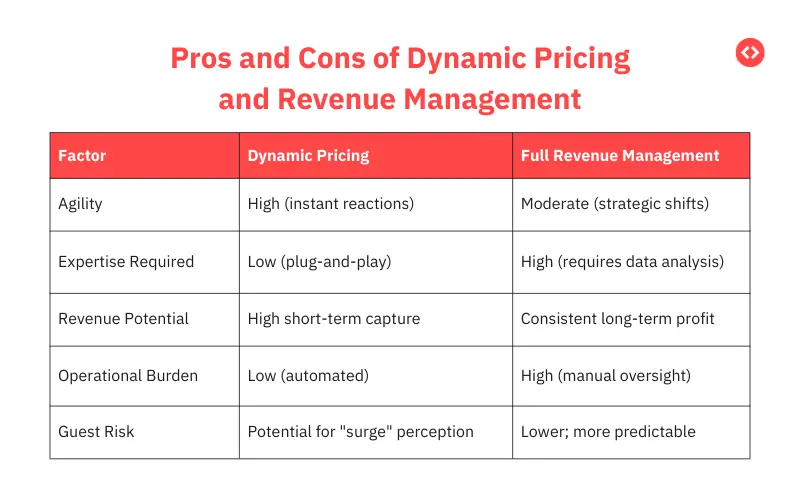
To help you decide which path to prioritize, here is a summary of the trade-offs:
Dynamic Pricing Pros:
- Fast implementation for immediate results.
- Maximizes occupancy during low-demand periods automatically.
- Requires very little daily maintenance.
Revenue Management Pros:
- Provides a stable, long-term business roadmap.
- Optimizes profit across different booking channels (Airbnb vs. Direct).
- Better for managing guest expectations and brand loyalty.
Dynamically Price Your Property and Get FREE Custom Reports Tailored To Your Property!
Use PriceLabs Dynamic Pricing to competitively and dynamically price your property according to demand shifts and analyze past performance to set a strong pricing strategy for your property.
Create your Account NowIntegrating Both: The Hybrid Approach
The most successful Airbnb hosts don’t actually choose one over the other; they layer them. You can use revenue management to set your “guardrails” (like your base rates and minimum stay rules) and then let dynamic pricing algorithms handle the daily fluctuations within those boundaries.
Suggested Host Workflow:
- Define Objectives: Are you aiming for 100% occupancy or the highest possible profit per stay?
- Set Guardrails: Establish your price floors and minimum stay requirements.
- Automate: Deploy a dynamic pricing tool to handle daily market shifts.
- Review: Check your performance weekly to see if your long-term goals are being met.
Frequently Asked Questions
1. How does dynamic pricing affect my occupancy?
It automatically adjusts rates to real-time demand, helping you fill nights that might otherwise stay empty and increasing total revenue.
2. Can I use a pricing tool and still have a long-term plan?
Yes. You can integrate dynamic pricing tools into a broader plan where the tool handles the daily “busy work” while you focus on the big-picture strategy.
3. What data do these tools actually use?
Dynamic tools look at competitor rates, local events, and current booking demand29. Revenue management adds historical trends and seasonal curves to that mix30.