The world of short-term rentals (STRs)—encompassing everything from a single spare room on Airbnb to vast portfolios of luxury vacation homes—operates in a constantly moving, highly sensitive market. In this ecosystem, relying on static, seasonal, or manually-set prices is the equivalent of leaving money on the table every single day. The difference between moderate success and true revenue mastery lies in one crucial strategy: Dynamic Pricing.
What is Dynamic Pricing?
Dynamic pricing, also known as surge pricing or revenue management, is a strategy in which prices for a product or service are adjusted in real time based on market demand and other influencing factors. Unlike a fixed yearly rate or a simple “high/low season” schedule, dynamic pricing uses data, algorithms, and market intelligence to determine the ideal price for every single night, for every single property, month, or even a year in advance.
In the context of short-term rentals, this means your property’s nightly rate might be $150 on a rainy Tuesday in February, but automatically surge to $450 for a Friday night during a major city-wide festival or a national holiday weekend. It is the science of selling the right unit to the right guest at the right price, at the right time.
Elevate Your Revenue Strategy.
Transitioning from manual to dynamic pricing is the biggest leap a property manager can take. If you’re managing a portfolio and want a personalized look at your market’s potential, our experts are here to help.
Why It Matters for STR Hosts and Property Managers
For the modern STR host or property manager, dynamic pricing is no longer an optional upgrade—it is a competitive necessity.
For Individual Hosts: Your goal is to maximize the profitability of your single asset. Dynamic pricing ensures you never undercharge when demand is high (capturing the maximum possible revenue) and that you stay competitive when demand is low (preventing prolonged vacancy).
For Property Managers: The stakes are exponentially higher. Dynamic pricing is the core of your value proposition to property owners. In a saturated market, your ability to demonstrate superior Revenue Per Available Rental (RevPAR) compared to a competitor using manual pricing is your greatest advantage. It ensures portfolio-wide optimization, optimizing returns for every client.
Industry Statistics and ROI Potential
The evidence is overwhelming: static pricing strategies are a severe handicap. Industry studies consistently demonstrate a significant return on investment (ROI) for properties that adopt a professional dynamic pricing system.
Revenue Growth: It is widely accepted that dynamic pricing, when implemented correctly, can lead to revenue increases of 10% to 40% over a static pricing model. This is achieved by simultaneously increasing both the Average Daily Rate (ADR) during peak times and the overall occupancy rate during shoulder and off-seasons.
Booking Volume: By automatically adjusting prices to align with real-time searches and booking intent, properties using dynamic models see higher booking conversion rates.
Time Efficiency: Moving from manual, weekly price updates to automated systems frees managers to focus on high-value tasks such as guest relations, maintenance, and owner acquisition.
In short, dynamic pricing is not just about making more money—it’s about professionalizing your operation and securing your financial future in the short-term rental industry. This guide provides the complete framework for not just implementing, but mastering this essential strategy.
How Dynamic Pricing Works?
Understanding that dynamic pricing works is only the first step; mastering it requires a deep dive into how the pricing engine makes its decisions. Dynamic pricing is a sophisticated model built on core economic principles, powered by massive data inputs, and fine-tuned by machine learning technology. It moves beyond simple human intuition, offering a precision that no manual pricing strategy can match.
Core Principles of Dynamic Pricing
The fundamental goal is to find the perfect equilibrium between Price Elasticityand Market Demand for any given night.
Supply and Demand: At its most basic, the system recognizes that as market supply decreases (fewer comparable units available) or demand increases (more people searching), the price should rise. Conversely, when supply is abundant and demand is flat, the price must decrease to stimulate bookings.
Price Elasticity: This principle measures how sensitive demand is to changes in price. For a high-demand date like New Year’s Eve, the demand is inelastic—people will pay a premium. For a random Tuesday in October, the demand is elastic—a small price drop can significantly increase the likelihood of a booking. The algorithm is constantly testing this elasticity.
Forecasting and Lead Time: The system doesn’t just look at today’s market; it forecasts future demand. Dates with a long lead time (far out on the calendar) are initially priced higher to capture early-bird premiums and maximize revenue potential. As a date approaches, the model adjusts the price based on booking pace—if the pace is too slow, the price drops; if it’s too fast, the price rises to capitalize on the urgency.
Events and Holidays: Highly granular data on local concerts, conventions, sporting events, and school breaks. These create sharp, short-term demand spikes.
Day of the Week: A Friday or Saturday night is almost always priced higher than a Monday or Tuesday. The system calculates these differentials automatically.
Comp Set Performance: Creating a competitive analysis on Airbnb is a critical component. The system continuously tracks the availability, occupancy, and pricing of your designated competitors (properties of similar size, quality, and location). If your competitors are booking up, your price will increase; if they are dropping rates, yours will adjust downward to stay competitive.
3. Property-Specific Attributes
These attributes allow the pricing to be hyper-personalized:
Reviews and Rating: Properties with 5-star ratings can sustain a higher price than those with lower ratings, reflecting perceived quality.
Amenities: Luxury features (hot tub, pool, dedicated workspace) allow for premium pricing, which the algorithm factors in.
Occupancy Goals: Hosts can set a strategic goal (e.g., a specific minimum occupancy rate), and the system will lean toward lower, more aggressive pricing to meet that goal.
Set Customizations: The unique minimum and maximum price boundaries a host sets for their property (which we discuss in depth later).
The sheer volume and velocity of this data necessitate advanced technology. Manual pricing, or even using simple spreadsheets, is fundamentally incapable of integrating these variables accurately.
Machine Learning (ML) Algorithms: This is the brain of the system. ML models are trained on years of historical booking data, local event calendars, and flight/weather patterns. They don’t just react to current demand; they predict future demand with a high degree of accuracy.
Real-Time Data Ingestion: Modern tools connect directly to major booking platforms (like Airbnb and Vrbo) and Property Management Systems (PMS), allowing them to update prices immediately—often multiple times per day—as conditions change.
Customization Layer: While the algorithm provides the core recommendation, the technology allows the host to inject their own strategy via configurable rules. For instance, a host can set a hard minimum price they will never go below or a special premium for bookings exactly 60 days out.
This technological framework transforms pricing from a guessing game into a scientific, data-driven strategy, ensuring your property is priced optimally for every single opportunity.
Benefits of Dynamic Pricing
The decision to adopt dynamic pricing is a commitment to a continuous revenue-optimization strategy. While the mechanism of how it works is complex, the benefits are clear, measurable, and directly impact your bottom line and operational efficiency. Dynamic pricing separates the casual host from the professional revenue manager.
Increased Revenue
The most compelling benefit is the significant boost to profitability. Dynamic pricing optimizes Revenue Per Available Rental (RevPAR) through a two-pronged approach:
Capturing Peak Premium: The system ensures that on the highest-demand dates (e.g., major concerts, city-wide conventions, peak holiday weeks), your price surges to the maximum the guest is willing to pay. A common static pricing mistake is setting a “high season” price of $300 when demand would have supported $500. Dynamic pricing eliminates this error.
Optimizing Shoulder/Off-Season: In periods of low or moderate demand, the system is aggressive in dropping prices to fill calendar gaps, preventing properties from sitting empty. $100 on a slow night is always better than $0. This strategy ensures the property is working for you year-round.
Higher Occupancy Rates
By constantly adjusting rates to match real-time market intent, dynamic pricing tools ensure your property remains visible and competitive across all booking windows:
Filling Last-Minute Gaps: As dates approach, the algorithm can intelligently lower the price to fill a remaining two-night gap, preventing lost revenue.
Booking Far Out: By setting competitive-but-high premiums on dates far in the future, the system captures early planners who are willing to book at a higher rate, securing occupancy ahead of the competition.
The balance of high rates for high-demand dates and strategically low rates for low-demand dates results in a consistently optimized occupancy rate that typically outperforms static-priced competitors.
Competitive Advantage
In a saturated marketplace, your pricing is your primary competitive weapon.
Agility: A dynamic system can react to a sudden market change (e.g., a major hotel closing, or a new festival being announced) within hours, while a manual manager might take days or weeks. This agility means you are always the first to capitalize on a shift in demand.
Data-Driven Decisions: You move from making decisions based on feel to making them based on data. You can confidently justify your rates to property owners because they are grounded in objective, real-time market analytics.
Time Savings and Automation
For both the individual host and the large portfolio manager, the time spent manually updating calendars and monitoring competitor prices is a huge opportunity cost.
Eliminate Manual Overheads: Dynamic pricing software automates the process of generating daily prices, saving hours of tedious, error-prone manual work every week.
Focus on the Guest: By offloading the complexity of pricing to a sophisticated system, hosts and managers can dedicate their valuable time to what truly drives positive reviews and retention: guest experience, maintenance quality, and owner relations.
Dynamic pricing is the engine that drives maximum profitability and provides the necessary operational leverage to scale a short-term rental business effectively.
Stop Leaving Money on the Table.
Ready to see what your property is truly worth? Don't let another high-demand weekend pass with static pricing. With PriceLabs, see exactly how much more revenue our data-driven algorithms can unlock for your portfolio.
Getting Started with Dynamic Pricing
The journey to dynamic pricing mastery is a structured, six-step process. Success is not achieved merely by connecting an account; it requires a strategic setup that merges the power of the algorithm with your unique property knowledge.
Step 1: Understand Your Market
Before you touch any software settings, define your competitive landscape.
Define Your Comp Set: Identify 5-10 properties that are genuinely comparable to yours in terms of size (bedrooms), amenities (pool, hot tub, parking), location (walkability, neighborhood), and quality (review score, aesthetic). These are the listings whose performance your algorithm will be tracking most closely.
Research Local Events: Manually identify your “Tentpole Events.” These are the massive, recurring or one-time events (e.g., annual festivals, major sports championships, university graduation) that demand manual review. Map these out for the next 12-18 months.
Determine Hyper-Local Seasonality: Go beyond the standard “summer is high season.” Is there a micro-seasonality, like “ski season weekends” vs. “ski season weekdays,” or “convention season” vs. “tourism season”? This granular understanding will inform your settings.
Step 2: Set Your Base Price
The Base Price is the single most important variable you will set. It is the foundation from which the dynamic algorithm builds all other rates. It is not your average rate, and it is not the highest price you’ll ever get.
Definition: Your Base Price is the theoretical, standard nightly rate for a typical, low-demand night (e.g., a mid-week night in the off-season) where the price is not heavily influenced by extreme market factors. All other prices—high-demand, low-demand, last-minute—will be calculated as a percentage adjustment from this anchor point.
Determination Methods:
Cost-Plus: Calculate your fixed nightly costs (mortgage/rent, utilities, cleaning fee allocation) and add a reasonable profit margin. This ensures you never book at a loss.
Competitor Average: Average the price of your comp set on a standard, low-demand Tuesday in the off-season. This gives you a competitive starting point.
The “Goldilocks” Principle: Start with a Base Price that you believe is “just right” for a typical night, then monitor your booking pace. If you are booking up too fast, your Base Price is too low. If you are booking too slowly, it’s too high.
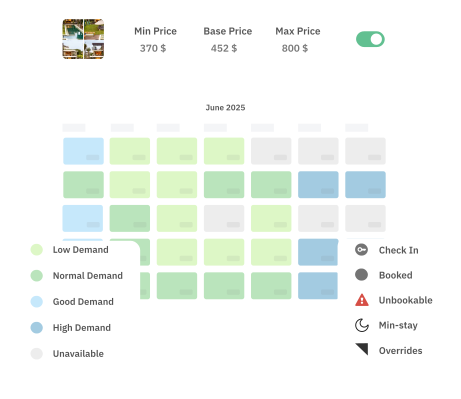
The Crucial Role of Min & Max Prices: The Base Price must be protected by a Minimum Price (the lowest you will ever go to avoid empty nights) and a Maximum Price (the absolute ceiling for your property). These act as guardrails for the algorithm.
Set the Right Base, Minimum and Maximum Price
Step 3: Choose the Right Tools
Selecting your dynamic pricing platform is an investment decision. The right tool should offer:
Robust Algorithm: It must be predictive, not just reactive, using machine learning.
Deep Customization: The ability to set your own Base, Min, and Max prices, as well as create custom, rule-based adjustments.
Seamless Integration: It must connect flawlessly with your Property Management System (PMS) and all your Online Travel Agencies (OTAs) like Airbnb, Vrbo, and Booking.com.
Ready to see what your property is truly worth? Don't let another high-demand weekend pass with static pricing. With PriceLabs, see exactly how much more revenue our data-driven algorithms can unlock for your portfolio.
Step 4: Configure Your Settings
Once the tool is chosen, the real customization begins.
Establish Booking Windows: Implement tiered discounts/premiums based on how far out the booking is. For instance, a +10% premium for bookings 180+ days out, and a -15% discount for bookings 0-3 days out.
Customize Minimum Stays: Set dynamic minimum stay rules. Increase the minimum stay to 3 or 4 nights for high-demand weekends or holiday periods to maximize revenue, while dropping it to 1 night for mid-week gaps or last-minute openings.
Event Overrides: For those Tentpole Events identified in Step 1, manually override the system’s Max Price and Minimum Stay to capitalize fully on the guaranteed demand spike.
PriceLabs Minimum Stay Setting
Step 5: Monitor and Adjust
Dynamic pricing is not “set it and forget it.” It requires continuous, but efficient, monitoring.
Weekly Performance Check: Dedicate 30 minutes each week to review your Booking Pace (how many nights you booked this week), Lead Time (how far out those bookings were), andADR (Average Daily Rate).
Identify Anomalies: Look for dates where bookings are too slow (suggesting your price is too high) or too fast (suggesting your price is too low). Use this data to make an informed adjustment to your Base Price or your Minimum Price.
Stay Informed: Keep abreast of local news, new competition, and unexpected event announcements that the algorithm might have missed initially.
Step 6: Measure Success
Success is measured by vacation rental KPIs, not feelings. Focus on RevPAR (Revenue Per Available Rental) as your ultimate performance indicator.
Track RevPAR: Compare your current RevPAR against your historical performance and against your comp set (if possible). A rising RevPAR indicates a successful dynamic pricing strategy.
Analyze Occupancy vs. ADR: Ensure your strategy is balancing the two. High ADR with low occupancy can signal overpricing. High occupancy with low ADR signals underpricing. The goal is to maximize the product of the two: RevPAR.
Strategy Scenario
Occupancy Rate
ADR (Avg Daily Rate)
RevPAR (Revenue/Available Rental)
Analysis
Overpricing
Low
High
Low
Few bookings at a high price = missed total revenue.
Underpricing
High
Low
Low
Many bookings at a low price = leaving money on the table.
Optimized (Dynamic)
Balanced
Balanced
MAXIMIZED
The ideal mix of rate and occupancy to yield the most profit.
Once the foundation is set, true revenue professionals employ specialized tactics to maximize every segment of the booking calendar. These advanced strategies turn a good pricing system into an exceptional one.
Last-Minute Pricing Tactics
The final 0-7 days before check-in are the final frontier for revenue. The goal is to capture the last-minute distressed traveler while maintaining the highest possible rate.
Tiered Discounting: Do not use a single, flat last-minute discount. Implement a tiered system that is most aggressive, closest to the date. Example: -10% for 5-7 days out, -15% for 3-4 days out, and -25% for 0-2 days out.
Avoid Panic Pricing: Ensure your minimum price is high enough to protect your profit margin. The biggest mistake is panic, dropping the price to a negligible amount. The last-minute traveler is often highly price-inelastic (they need a place), so a massive discount is rarely necessary.
Minimum Stay Flexibility: Pair last-minute pricing with an extremely low Minimum Stay (e.g., a 1-night minimum) to capture any short, isolated booking.
Far-Out Pricing Strategies
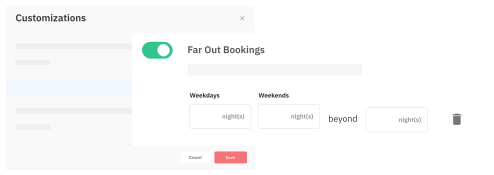
Besides last minute pricing strategy, setting far-out prices for your rental is key to your vacation rental pricing strategy. The booking window beyond 9 months is where you capture the early planners and test the market’s absolute maximum price ceiling.
The Premium Test: Set prices for 9-18 months out at a significant premium (e.g., 20-30% above your standard max price). Early bookers are often corporate, luxury, or large family groups who prioritize planning and are less price-sensitive. If you get a booking at this premium rate, it provides invaluable data that the market can support a higher price point.
Gradual Decay: The algorithm should automatically reduce this premium over time. As the date gets closer (e.g., within 6-9 months), the price should drop to a more market-aligned rate to match the general population of planners.
Strategic Minimum Stays: For dates far in the future, you can leverage your position to demand longer minimum stays (e.g., 4-7 nights). This maximizes revenue and reduces turnover costs. You can reduce this minimum later if bookings are slow.
Far Out Bookings Customization
Event-Based Pricing
While the algorithm is excellent at tracking recurring local demand, major one-off or large-scale events require host intervention for maximum profit.
Pre-emptive Manual Overrides: As soon as a major event (e.g., a national music festival or an international trade show) is announced, manually increase the Maximum Price for those specific dates. Do not rely solely on the algorithm, which might take time to catch up to the sudden, announced demand.
Minimum Stay Stacking: For a 3-day event, enforce a 3- or 4-night minimum stay that covers the entire period. This prevents you from being left with a one-night gap after the event.
Shoulder Night Strategy: Demand often starts the night before the event and lasts the night after. Price these “shoulder nights” higher than standard to capture the early arrivals and late departures.
Seasonal Adjustments
Beyond the big seasonal swings, the most successful managers fine-tune for smaller, predictable changes.
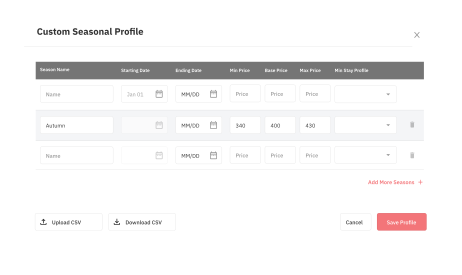
Micro-Seasonality: Implement custom seasonal profiles for specific periods: “Spring Break Week,” “Holiday Decorating Season,” or “Local School Holidays.” These are predictable demand surges that deserve a premium.
Soft Adjustments: Use the pricing tool’s interface to set a “soft” premium or discount for an entire season (e.g., “All rates +5% in December”), which layers on top of the dynamic algorithm.
An “orphan gap” is an unbookable, isolated night or two sitting between two confirmed bookings. This is wasted inventory that dynamic pricing can salvage.
Aggressive Automation: Set the system to automatically drop the minimum stay to 1 night and apply an aggressive discount (e.g., -30% to -40%) on any date that becomes an orphan gap within 7-14 days of its check-in. The goal is to quickly liquidate this dead space.
Focus on Cost Coverage: The orphan gap rate should be low enough to entice a booking but high enough to cover your turnover and fixed costs. Any profit is purely incremental revenue.
Orphan Day Pricing Customization
Minimum Stay Optimization
Minimum stay rules are a critical revenue management lever, used to screen for quality, reduce turnover, and increase average booking value.
Dynamic Min Stays: Avoid a static 2-night rule. Use the tool to impose longer minimum stays (3-5 nights) on weekends, holidays, and peak season.
Strategic Drop: Reduce the minimum stay to 1 night only for last-minute gaps (0-7 days out) or for orphan gaps, when the priority shifts from high revenue to pure occupancy.
Future Block Strategy: For the farthest out dates, set high minimum stays (e.g., 5-7 nights) to ensure that the early bookings you receive are high-value, long-term stays.
Dynamic Pricing by Property Type
A blanket pricing strategy fails to account for the unique demand characteristics of different property types and market niches. A high-rise urban apartment cannot be priced like a secluded mountain villa.
Single Properties vs Multi-Unit
The objective of your pricing system differs based on your portfolio size.
Single Properties: The focus is on Maximum RevPAR on a single asset. Your minimum price can be more flexible, as you are only managing the costs and profitability of one unit.
Multi-Unit Portfolios: The focus is on Portfolio Occupancy and Efficiency. The strategy shifts to using pricing to distribute bookings evenly across the portfolio. If one unit is booking too quickly, its price should rise to push guests toward slower-booking units, optimizing the collective performance and ensuring maximum utilization of all available inventory.
Luxury Properties
Luxury rentals operate on a different demand curve. Their guests are often less price-sensitive and more value-sensitive.
Prioritize ADR over Occupancy: The goal is to maximize the Average Daily Rate while maintaining a sufficient occupancy rate. A 5% increase in ADR is worth more than a 15% increase in occupancy if the latter means more turnover cost.
High and Consistent Pricing: The minimum price for a luxury property must be significantly higher to protect the brand’s perceived value. Aggressive last-minute discounting can be detrimental to the luxury brand.
Longer Minimum Stays: Luxury properties should strategically enforce longer minimum stays to attract high-value, longer bookings and reduce turnover frequency.
Urban vs Vacation Markets
Location dictates the demand drivers, which must be reflected in the pricing model.
Urban/City Markets:
Demand Driver: Business travel, corporate stays, conventions, short-term events, and concerts.
Pricing Focus: High seasonality based on the day of the week (high Monday-Thursday for business, high Friday-Saturday for leisure). The system must be aggressive in tracking convention calendars.
Minimum Stay: Should be highly flexible, often 1-2 nights, to capture corporate travelers and short weekend breaks.
Vacation/Destination Markets:
Demand Driver: Weather, school holidays, regional/national seasonality (ski, beach).
Pricing Focus: Long, predictable seasonal swings (e.g., three months of “peak beach season”). Pricing must be aggressive for week-long bookings (Saturday-Saturday check-ins).
Minimum Stay: Should be longer (5-7 nights) during peak season to reduce turnover and maximize booking value.
Mid-Term Rentals
Mid-term rentals (stays from 30 days to a few months) are a growing niche that requires a hybrid pricing approach.
Hybrid Pricing Model: Your pricing tool must be able to publish a dynamic daily rate and a discounted monthly rate. The algorithm must calculate the revenue difference to determine which booking is more profitable.
Monthly Discount Logic: The monthly discount should be high enough to be attractive to renters (often 25-40% off the daily rate) but always higher than the equivalent revenue generated by short-term bookings over the same period.
Utility Inclusion: The pricing should factor in the cost of utilities, which are often included in mid-term rentals but not in short-term stays, ensuring the price remains profitable.
Common Mistakes and How to Avoid Them
Even with the best tools, common pricing mistakes can derail your dynamic pricing efforts. The biggest advantage comes from avoiding the most frequent mistakes made by both new and experienced hosts.
Over-Relying on Automation Without Monitoring
The Mistake: The assumption that once the dynamic pricing software is connected, your pricing is “solved” forever. This leads to complacency.
How to Avoid: Dedicate a scheduled time (e.g., 30 minutes every Monday morning) to review your performance dashboards. Look for anomalies: dates far out with zero bookings or dates approaching that are still wide open. If a price is clearly wrong, override it manually or adjust your Base/Min/Max prices, which guide the algorithm. The tool is a powerful engine, but you are the driver.
Ignoring Market Trends
The Mistake: Failing to recognize a major shift in your local market or a national economic trend. This can include a new competitor opening a large building, or a sudden, localized spike in crime that dampens demand.
How to Avoid: Set up Google Alerts for local news and monitor local booking pages or event calendars. If a major economic downturn is predicted, you may need to proactively lower your Base Price to stimulate demand, rather than waiting for the algorithm to slowly react to a low booking pace. Conversely, a major new attraction may require a preemptive premium.
Not Adjusting for Special Events
The Mistake: Relying on the general algorithm to capture the full revenue potential of unique events. While most tools track holidays, they may miss a unique, non-recurring local event that drives massive, inelastic demand.
How to Avoid: Maintain a dedicated Events Calendar for your city. For any event that draws a large, external crowd, manually override the system to set an aggressive minimum stay (e.g., 3-5 nights) and a high maximum price for those dates. The manual override is your superpower for tentpole events.
Poor Base Price Setting
The Mistake: Setting a Base Price that is either too low or too high relative to your market. A low Base Price limits your top-end earning potential on high-demand dates, and a high Base Price will result in a consistently low occupancy rate.
How to Avoid: Regularly recalibrate your Base Price. If your property is consistently booking at the system’s maximum or near its minimum, it’s a sign that your Base Price is incorrect. The Base Price should ideally be the price your property books at most often on a typical low-demand night.
Inconsistent Pricing Across Channels
The Mistake: Allowing the price for the same night to differ across Airbnb, Vrbo, and your Direct Booking Site. This is often caused by integration issues or failure to sync.
How to Avoid: Ensure your dynamic pricing tool is the single source of truth for your rates and that it integrates seamlessly with your Property Management System (PMS) and all Online Travel Agencies (OTAs). Inconsistent pricing can lead to guest frustration and, critically, can cause booking platforms to penalize your listing’s visibility.
For property managers, dynamic pricing is not just a technology choice—it’s a communication challenge. Property owners who are accustomed to static, high-season rates can be resistant to the volatility inherent in dynamic pricing. Successfully selling this strategy is essential for client retention and acquisition. Therefore, you need to know how to talk to owners to adopt dynamic pricing strategy.
How to Convince Property Owners
The key to getting owner buy-in is to shift the conversation from “rate” to “Revenue Per Available Rental (RevPAR).”
Lead with Data and Science: Frame dynamic pricing as Revenue Science. Explain that the system is not guessing; it is using years of market data, competitor performance, and real-time demand signals to make data-driven decisions.
Address the Fear of Low Rates: Owners often panic when they see a low off-season rate. It’s essential to talk to owners during slow season to assure them. Explain that this is the system being strategic: it’s filling a low-value night to prevent a high-value weekend from being orphaned, or it’s capturing revenue that would otherwise be zero. Emphasize that the average rate (ADR) will be higher over the long run.
Highlight the Loss of Opportunity: Show them an anonymized case study of a similar property that used static pricing and lost out on a major event because their rates were not aggressive enough.
Key Performance Indicators (KPIs): Only present the three most critical metrics: ADR, Occupancy, and RevPAR. Focus the discussion on RevPAR, which is the ultimate measure of success, as it accounts for both rate and utilization.
Historical Comparison: Use the pricing tool’s analytics to show what the property earned before dynamic pricing versus what it is earning now. The contrast in RevPAR over a full 12-month cycle should speak for itself.
Comp Set Comparison: If possible, show how their property’s RevPAR compares to a basket of similar, non-dynamically priced homes in the area, positioning your service as the top performer.
Embrace Volatility: Explain that prices will look “crazy”—they will be very low on Tuesdays in November and very high on event weekends. This volatility is a sign that the system is working effectively to capture revenue at all points of the demand curve.
The Guardrails: Reassure them that you have set a Minimum Price to protect the asset’s value and a Maximum Price to ensure the listing remains competitive.
Tools and Software
The sophistication of your dynamic pricing strategy is directly tied to the power of the software you choose. This is an overview of the landscape and the criteria for making the right choice.
Overview of Dynamic Pricing Tools
The market for STR pricing software has evolved beyond simple spreadsheet automation into complex, AI-driven platforms. Tools generally fall into three categories:
Rule-Based Systems: These rely heavily on manual rules (e.g., “if occupancy is <50%, drop the price by 10%”). They are simple but often lack market intelligence.
Algorithm-Based Systems: These use statistical models and historical data to generate recommendations.
Machine Learning (ML) Platforms: The gold standard. These systems use predictive modeling and real-time competitor data to generate precise daily rates, automatically learning and adjusting over time.
Elevate Your Revenue Strategy.
Transitioning from manual to dynamic pricing is the biggest leap a property manager can take. If you’re managing a portfolio and want a personalized look at your market’s potential, our experts are here to help.
Key Features to Look For
When evaluating tools, ensure they possess the fundamental features necessary for a truly dynamic strategy:
Real-Time Comp Set Data: The ability to pull live availability and pricing from your direct competitors.
Customization Overrides: The flexibility to set a Base Price, Min Price, Max Price, and apply custom rules or manual overrides for specific dates or events.
Minimum Stay Automation: Dynamic minimum stay logic that automatically adjusts based on demand, lead time, and orphan gaps.
Integrated Reporting: Built-in dashboards to track ADR, Occupancy, and RevPAR, allowing for easy performance analysis.
PriceLabs Capabilities
PriceLabs has positioned itself as a market leader by focusing on deep customization and robust predictive analytics, making it the tool of choice for professional property managers and sophisticated hosts.
Customization Flexibility: PriceLabs offers industry-leading control over the Base Price, Min/Max Price, and a suite of “Customization” settings that allow managers to tailor the algorithm’s output to their specific property’s needs (e.g., specific discounts for mid-week stays, or premiums for high-end properties).
Orphan Gap Management: Built-in, aggressive logic to automatically fill those small, isolated gaps in the calendar, maximizing unit utilization.
PriceLabs Portfolio Analytics Tool
Integration with PMS Systems
A dynamic pricing tool is only as effective as its integration with your broader tech stack.
Seamless Sync: The tool must have a robust, bi-directional connection to your Property Management System (PMS) (like Guesty, Hostfully, or OwnerRez). This ensures that price changes made in the pricing tool are instantly reflected across all booking channels and vice versa.
Rate Parity: Strong integration is the only way to guarantee rate parity—that the price is the same on all platforms—which is crucial for maintaining listing health and visibility.
Measuring Success
Dynamic pricing is a quantitative strategy, and its success must be measured by clear, objective pricing metrics. Focusing on vanity metrics can lead to poor decision-making; the true measures of revenue performance must be prioritized.
Key Metrics to Track
There are three essential metrics that every host and manager must monitor:
ADR (Average Daily Rate): The average revenue generated per occupied night. Formula: Total Revenue / Total Occupied Nights. This measures the quality of the bookings you secured.
How to Calculate ADR?
Occupancy Rate: The percentage of available nights that were booked. Formula: Total Occupied Nights / Total Available Nights. This measures the utilization of your asset.
How to Calculate Occupancy Rate?
RevPAR (Revenue Per Available Rental): The single most crucial metric. It is the product of ADR and Occupancy Rate. Formula: Total Revenue / Total Available Nights. RevPAR measures the overall effectiveness of your strategy by factoring in both the rate you secured and the utilization you achieved.
How to Calculate RevPAR?
How to Analyze Performance
Analyzing performance is about comparison—against your past, and against your competition.
Year-over-Year (YoY) Comparison: The most reliable method. Compare the property’s RevPAR for the current quarter against the same quarter last year. This normalizes for vacation rental seasonality and shows the true growth (or decline) driven by your pricing strategy.
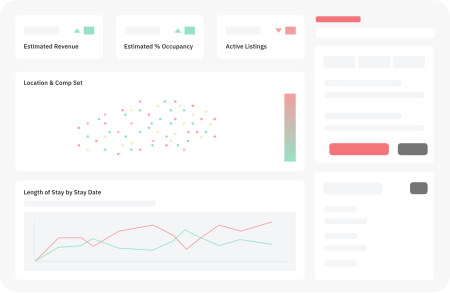
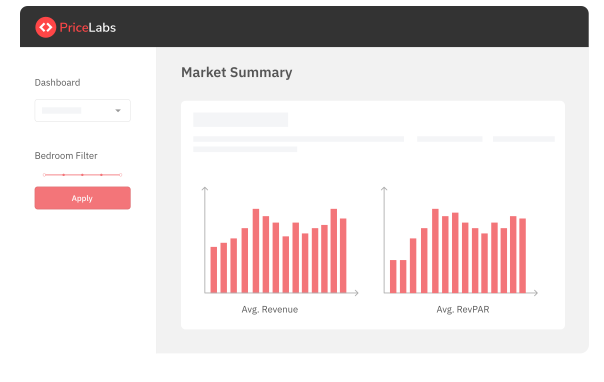
Comp Set Analysis: Compare your property’s RevPAR to that of your defined competitive set. If your property is outperforming the market, your strategy is succeeding. Use PriceLabs Market Dashboard to analyze your market’s performance.
Lead Time Analysis: Monitor when people are booking. If all your bookings are within 0-7 days, your far-out prices are too high. If you are booking up 6+ months out, your prices are likely too low. This analysis drives your strategy for Section 5.
PriceLabs Market Dashboard Market Summary
Continuous Optimization
Performance analysis must lead to action.
The Feedback Loop: Analyze the metrics, adjust your key settings (Base Price, Min/Max Price, seasonal premiums), and then measure the impact of those changes.
Quarterly Review: Commit to a deep, quarterly review where you assess if the Base Price still makes sense, if the Comp Set is still relevant, and if the Min/Max rates are still providing the right guardrails.
Future of Dynamic Pricing
Dynamic pricing is a field of constant technological evolution. The current generation of tools is powerful, but the next wave will bring even greater accuracy and automation, leveraging artificial intelligence (AI) and massive data sets.
AI and Machine Learning Trends.
The shift is moving away from purely reactive models—which adjust prices after demand changes—to predictive AI models that anticipate demand before it happens. This involves:
Unstructured Data Analysis: Incorporating data like local sentiment from social media, tracking flight and road traffic patterns, and even analyzing weather forecasts to predict micro-fluctuations in demand.
Self-Correction: Algorithms are becoming more sophisticated, automatically identifying and correcting sub-optimal pricing rules without explicit host intervention, leading to continuous, autonomous optimization.
The next step in revenue management is truly anticipating the market.
Event Prediction: AI is learning to identify and predict the price impact of minor, non-cataloged local events (e.g., a local school’s large championship game) that human managers might miss.
Cancellation Modeling: Pricing models will factor in the probability of a cancellation for a specific date or guest profile, adjusting the rate or accepting a lower rate to mitigate the risk of a lost booking.
Market Evolution
As technology advances, dynamic pricing will cease to be a competitive advantage and will simply become the industry standard. The true advantage will shift to the hosts and managers who can master the customization layer of the software—those who can best blend the power of the AI with their own hyper-local market expertise. This pillar guide provides the definitive playbook for that mastery.
Conclusion
Mastering dynamic pricing is the single most impactful action you can take to elevate your short-term rental business. It transforms pricing from a tedious, reactive task into a sophisticated, data-driven revenue engine.
Essential: Driven by objective market data, not guesswork.
Profitable: Proven to increase RevPAR by optimizing both rate and occupancy.
Actionable: Built on a six-step process, starting with the crucial Base Price.
Advanced: Offers specialized tactics for last-minute gaps, far-out demand, and event spikes.
For any host or property manager, the choice is clear: either participate in the revenue revolution or be left behind by competitors who are leveraging AI to maximize every booking opportunity.
The time to move past static, set-it-and-forget-it pricing is over. Take control of your revenue, optimize your portfolio, and deliver the best possible returns to your owners.
Get started with PriceLabs now!
Want to learn what PriceLabs can do for you? See for yourself with a free trial. Get started now!