Get started with PriceLabs now!
Want to learn what PriceLabs can do for you? See for yourself with a free trial. Get started now!

Vacation rental revenue usually comes from stacking several disciplined decisions: picking the right location, building a listing guests want to book, pricing that reacts to real demand, marketing that actually gets seen, and a cost structure that doesn't quietly erode what you earn.
The opportunity here is real and growing. The global short-term vacation rental market is on track to reach $165.7 billion in 2026, growing at an 11.8% CAGR through 2033, according to Grand View Research. A bigger market also means more competition for the same guests, so owners and property managers who treat revenue growth as a system win more bookings than those chasing single tactics.
Here's how to build that system, from location and listing quality through pricing, marketing, upselling, and the benchmarks that tell you whether it's actually working.
The first step in ensuring the profitability of your vacation rental business is picking the correct location. Profitability depends heavily on a location's popularity, proximity to local amenities and prime areas, and ease of transportation. Assess these factors by listing your ideal locations, talking to local realtors, and researching using the PriceLabs Market Dashboard.
Choose desirable locations with activities that run all year round. The complete guide to vacation rental investment walks through how to use the Market Dashboard to make a sound investment decision.
An ideal vacation spot gives you a better chance at maximizing revenue and puts you in a competitive market. The line between in-demand and oversaturated is thin, since hosts tend to invest in popular destinations, which can sometimes lead to an oversupply of vacation rentals in an area.
The second most crucial aspect of your vacation rental property is its aesthetics. Guests prefer properties that give them a stay experience they don't typically get in their day-to-day lives. Investing time in beautiful yet functional décor drives more bookings, and better aesthetics make it easier to stand out across listing sites. A good host earns repeat visitors and grows revenue without extra marketing effort. Our handpicked Airbnb hosting tips will help your guests love their stay.
Hire a professional designer. One common mistake is decorating a property to suit your own taste. A professional designer gives you an objective opinion and knows how to create rentals that book well.
Choose neutral color schemes and durable furniture. Stick to the basics so guests with different tastes still enjoy the property. Opt for neutral colors, classic lines, tried-and-tested fabrics, and durable furniture. If you buy second-hand pieces, make sure they show no visible wear.
Bring the accents of the city indoors. Guests chose a specific city or town for a reason. Alongside a cohesive interior theme, subtle local accents personalize the experience and make the listing feel like an extension of the destination, such as a rustic theme for a mountain cabin.
The relevance of your amenities depends directly on guest comfort. The best setups cover the essentials plus a few extras. Use the PriceLabs Market Dashboard to see which amenities are most in demand in your market.
Cover the basics. A complete range of supplies creates a five-star experience. Missing basics show up fast in guest reviews. Keep a checklist for extra blankets, towels, and toiletries, build inventory lists for the kitchen, bedrooms, and bathrooms, and share them with your cleaning crew. A full vacation rental inventory checklist and the Airbnb cleaning checklist are both good starting points.
Add extras that impress. A hot tub, welcome basket, or free Wi-Fi upgrades the stay and earns better reviews.
Leverage the high traffic of top vacation rental platforms by listing your property widely, and read the fine print on each one so you know which platform fits your property best.
Take great pictures. Photos are the first thing potential guests see. Hire a professional photographer, or add a 3D tour, to show the property in its best light.
Write an eye-catching title. With no shortage of listings on Vrbo, Airbnb, or Booking.com, a generic title gets lost. Avoid overpromising, and make the title specific to what actually makes the property stand out.
Write a comprehensive description. A detailed description highlights features that are hard to photograph and sets accurate guest expectations. Use the keywords guests actually search for to rank higher.
List on more than one OTA. Every platform has trade-offs, so listing on several increases your total reach.
Keep the rental clean and well-maintained, and hire a reliable cleaning company. Airbnb lets you set an Airbnb cleaning fee at booking to cover the cost.
A property in good condition when guests arrive drives repeat bookings. Professional cleaning between every stay prevents buildup and saves on labor over time.
Keep the rental in marketable shape: handle repairs, updates, and anything that looks dated or worn. As you plan finishes, build in resilience. Scratch- and waterproof flooring like luxury vinyl tile, door stoppers behind each door, and semi-gloss paint in one consistent color make touch-ups fast and cheap.
Forget the old set-it-and-forget-it model of fixed nightly rates for weeknights, weekends, or a whole season. Dynamic pricing automates nightly rates based on data-backed suggestions instead.

A more sophisticated pricing strategy also accounts for seasonality, minimum-night restrictions, gap nights, and occupancy. Layering these factors together is how you meaningfully grow short-term rental earnings, rather than adjusting rates on instinct alone.
PriceLabs adjusts to each listing's market conditions and prices it optimally for both last-minute and far-out bookings. This keeps pricing competitive and accurate without constant manual monitoring.
Vacation rental owners and property managers commonly use minimum length of stay restrictions to manage bookings across seasons and booking windows. This advanced feature helps optimize occupancy, for example by requiring a full week's stay during a local festival when guests are already likely to book the whole week.
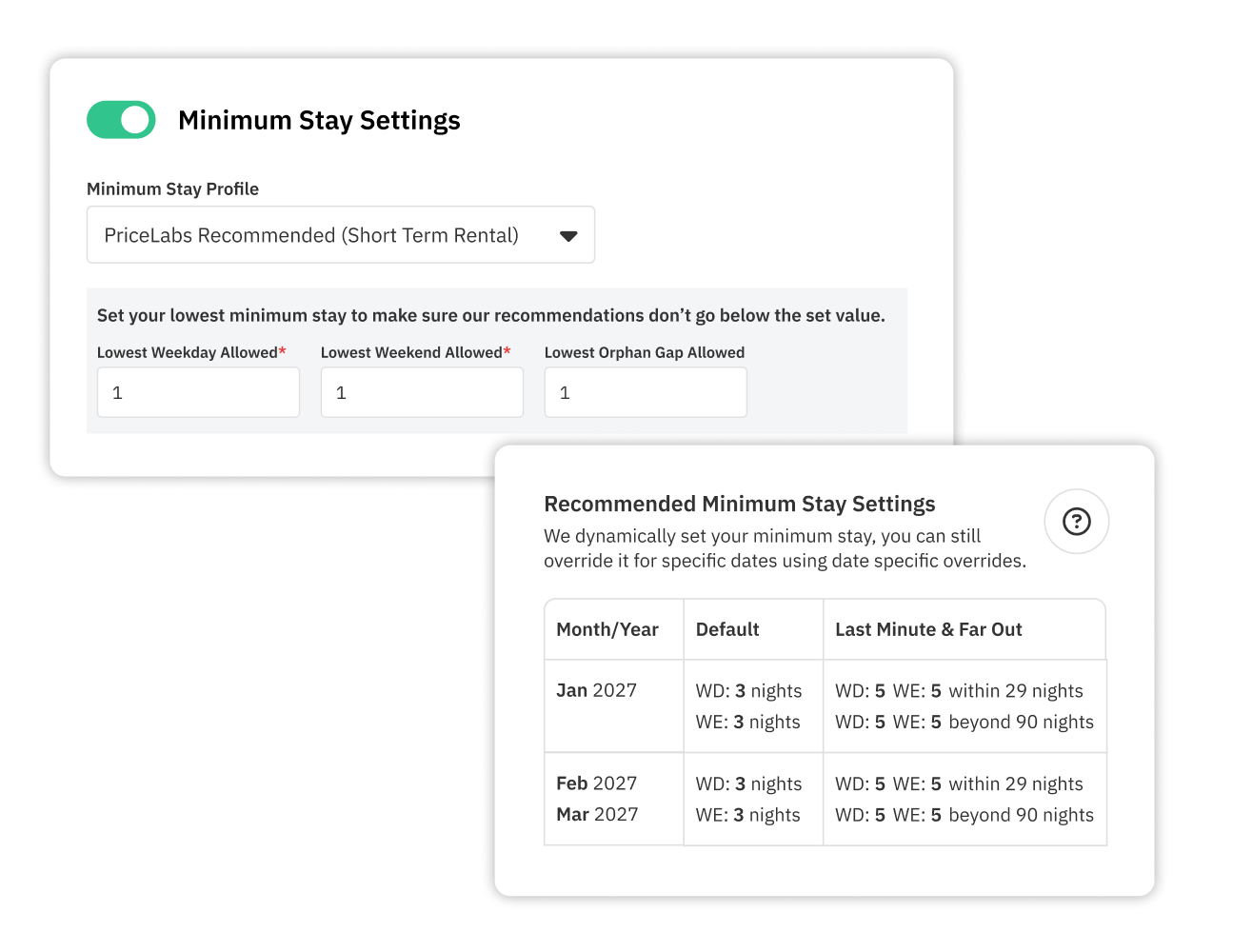
Since this is an advanced feature, get to know your market first. Setting too long a minimum stay when the market trend favors shorter stays costs you bookings, so anticipate guest needs before applying it.
PriceLabs identifies local events and adjusts pricing accordingly. When a conference, music festival, or sporting event lands nearby, the tool factors it into your rates to capture extra revenue.
The Events and Holidays Calendar feature surfaces upcoming events, holidays, and high-demand dates so you can adjust pricing or minimum-stay settings manually, or let PriceLabs do it automatically.
Larger groups split trip costs, and accommodation is usually the biggest line item. Making a rental suitable for bigger groups, with more sleeping arrangements, attracts more guests, and you can charge extra for additional guests beyond a set count.
If your rental depends on seasonal tourism, business travel and the rise of remote-work digital nomads can fill the gaps. Position the rental for this group with discounts for extended stays, reliable Wi-Fi, and a usable work-from-home setup.
PriceLabs shifts automatically between high- and low-season rates as the calendar turns, so you're not manually repricing every season change. With seasonality customization, choose from conservative, recommended, aggressive, or no seasonality adjustment based on your preference.
Vacation rental marketing starts with choosing the right platforms and being deliberate about how you show up on each one. Airbnb, Vrbo, Booking.com, and property management company sites each have their own audience and fine print, so read the terms before committing. If you're renting an entire property to larger groups, Vrbo tends to fit better; if you're listing a private room, Airbnb is usually the stronger first choice.
Beyond the major OTAs, many owners build direct-booking demand through their own website and social channels, including influencer marketing for vacation rentals. A few channels worth combining rather than picking just one:
Hiring a marketing expert can help if running all of this in parallel isn't realistic for your team. For a deeper breakdown of what works, read the strategies that short-term rental and Airbnb experts like Annette Grant, Sarah Karakaian, and Jonathan Farber recommend.
Marketing doesn't stop at the first booking. In a competitive, buyer's-market industry, excellent customer service is one of the simplest ways to stay ahead: a property that's always in great condition, paired with attentive service, is what turns first-time guests into repeat bookings and referrals. Getting the pricing side of that visible to guests matters too, which is where promoting your rates for direct bookings comes in.
Airbnb add-on services are a proven way to grow vacation rental income, yet many property managers still leave them unused. Selling premium services or upgrades generates extra revenue per stay, supports the local economy, and builds guest relationships beyond a single booking. Brainstorm promotions and services relevant to your area and start small.
Renting a property for more than 14 days makes it a business for tax purposes, meaning the income is taxable, but it also opens up deductions. Nearly any "ordinary and necessary" cost of doing business qualifies, including hosting fees charged by Airbnb and other platforms.
Expenses worth reviewing with a professional include:
This isn't an exhaustive list, so talk to a financial advisor or accountant to maximize your deductions.
Property insurance is essential for any vacation rental investment. It protects you from losses the property might incur while hosting, such as a guest injury during a stay. Standard homeowners' coverage often falls short here, so review carefully what is and isn't covered before you need it.
Pricing, marketing, and cost control only pay off if you can measure whether they're moving the needle. Three numbers matter most:
Tracking these against comparable listings in your market, rather than in isolation, is what turns a number into a decision. The PriceLabs Market Dashboard benchmarks your listing's occupancy, ADR, and RevPAR against similar properties nearby, so you can see whether a slow month is a market-wide dip or a signal to adjust your own strategy. It's also worth checking your fair rental days alongside occupancy, since a raw occupancy percentage can understate what a listing is actually capable of earning. For a closer look at lifting occupancy specifically, our guide to boosting your Airbnb occupancy rate breaks down where to start.
A dynamic pricing strategy is helping many property managers and vacation rental owners increase their rental ROI. Other factors that affect an STR business's earning potential include location, property aesthetics, minimum-night-stay settings, and marketing strategy.
List your short-term rental on multiple vacation rental platforms, such as Airbnb and Vrbo, where guests actively search for places to stay. Keep the listing updated with a clean, visually appealing property and clear, complete amenity information.
Both short-term and mid-to-long-term rentals can be profitable. Short-term rentals command higher nightly rates but require more effort to keep occupancy high. Mid-to-long-term rentals charge lower nightly rates but tend to stay booked longer, with fewer gap nights to manage.
Maximizing revenue matters most once the fundamentals are in place. If you're still working through the basics of becoming an Airbnb host, our complete guide covers the full setup process first.
Maximizing revenue this way builds on the fundamentals in our complete guide to vacation rental revenue management.
Want to learn what PriceLabs can do for you? See for yourself with a free trial. Get started now!