
Table of Contents
Updated : Feb 21, 2026
Low occupancy can feel frustrating, especially when you’re doing everything you can to attract guests—updating your listing, replying quickly, and keeping your place spotless. But here’s the reality: even great listings experience dips. Demand changes constantly, competitors adjust their strategies, and guest preferences shift throughout the year, which is where a Listing Optimizer can help.
The good news? You can regain control by taking a simple, data-driven approach. With the correct information and tools, you can understand why occupancy drops occur, adjust your pricing with confidence, and refresh your listing so more guests choose you.
This guide walks you through three friendly, practical steps to help you stabilize and grow your occupancy rate using a combination of historical data, AI-powered pricing, and ongoing listing optimization. These steps are beginner-friendly, actionable, and designed for hosts who want to improve their results without getting overwhelmed.
Step 1: Continuously Monitor Market Conditions and Adjust Listings
Pricing alone won’t solve occupancy issues—your listing must convert. Even a perfectly priced home can sit empty if the description is outdated or the photos don’t resonate with current guest preferences.
Why Market Monitoring Matters
Competitors change their strategies all the time. New listings appear, older ones add amenities, and hosts experiment with discounts.
Monitoring competitors’ rate increases or sold-out inventory helps adjust your own pricing to maximize revenue.
Tracking these changes helps you avoid falling behind.
What Is Listing Optimization?
Listing optimization is the process of improving your property’s online presence—including the headline, description, photos, and amenities to increase conversions and appeal to your target guests.
Good optimization helps you:
- Improve your click-through rate
- Convert more of your views into bookings
- Stand out in competitive markets
- Give guests the information they need to choose confidently
With PriceLabs Listing Optimizer You Can Analyze The Quality Of Your Competitor's Listings.
With PriceLabs Listing Optimizer, you will be able to compare your listing with other listings guests would consider your competition and optimize your listing accordingly.
Create your Account NowStep 2: Gather and Analyze Historical Pricing and Market Data
If you’ve ever found yourself wondering, “Why am I not getting bookings this month?”, the answer is almost always in your past performance data. Pricing without looking at history is a lot like guessing.
That’s why “successful price optimization starts with collecting and analyzing historical pricing and booking data.” It’s the foundation of every strong occupancy strategy—no matter how experienced you are as a host.

What Historical Data Really Tells You
Historical data gives you a high-level picture of your property’s booking behavior:
- Which months book fast
- When cancellations spike
- Which days of the week generally underperform
- Whether last-minute deals work for your listing
- How early guests usually book (your “lead time”)
For example:
- A beachfront listing might see strong demand every winter weekend but struggle midweek.
- A city apartment may book steadily year-round but drop sharply during holiday weeks when business travel slows.
- A suburban home may see unpredictable demand unless tied to local events like sports tournaments or college graduations.
This isn’t just interesting—it’s essential for setting prices that match actual demand.
Dynamically Price Your Property and Get FREE Custom Reports Tailored To Your Property!
Use PriceLabs Dynamic Pricing to competitively and dynamically price your property according to demand shifts and analyze past performance to set a strong pricing strategy for your property.
Create your Account NowWhat Is Historical Data Analysis?
Historical data analysis involves reviewing past occupancy, rates, and bookings to identify patterns and correlations that guide future pricing strategies.
It’s like replaying old game footage to understand what you did right and where you can improve.
Don’t Forget to Look Outside Your Listing
Your competitors are shaping guest expectations too. Their pricing decisions affect yours—even if you don’t realize it.
Airlines use real-time competitor pricing to adjust fares dynamically, influencing price patterns across the industry. Hotels and short-term rentals should also operate the same way.
When you integrate competitor data, you’ll notice things like:
- Similar listings dropping prices before slow seasons
- Homes with hot tubs or pools are getting booked faster
- Competitors raising prices around local concerts or sports events
- Property managers bundling fees or offering weekly discounts
This information helps you stay competitive and avoid mispricing your listing.
The Most Common Mistakes Hosts Make With Their Own Data
Many hosts unintentionally misread their data. A few examples:
- Comparing only one year of performance (instead of looking at multiple years or broader trends)
- Reacting emotionally to a slow month instead of identifying seasonal patterns
- Matching competitor prices without checking their amenities
- Ignoring lead-time trends, which causes early underpricing or last-minute overpricing
- Not tracking listing views vs. bookings, which makes it hard to diagnose visibility vs. conversion issues
Understanding the “why” behind the numbers makes your pricing decisions far more effective.
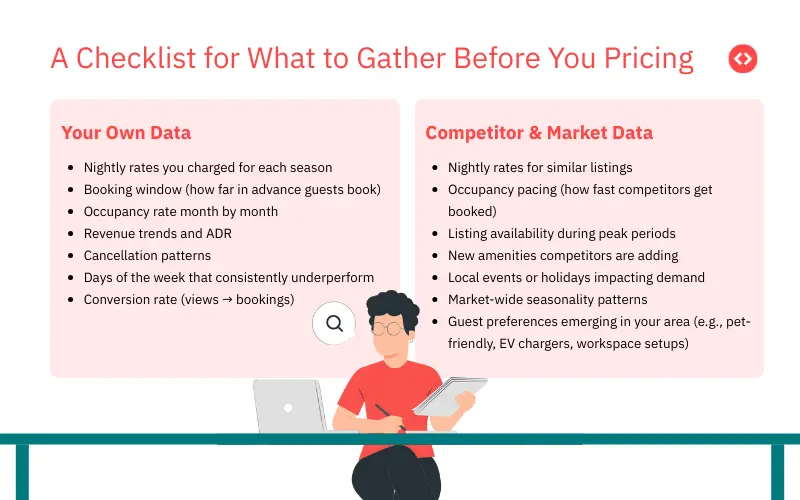
Collecting these insights gives you clarity—and prepares you for Step 2, where AI can take over the heavy lifting.
Step 3: Implement AI-Driven Dynamic Pricing Models
Once you have a solid understanding of your listing’s historical performance and the broader market, the next step is to upgrade how you set your prices. Manual pricing is exhausting, and even diligent hosts can only track so much.
This is where dynamic pricing comes in.
What Is Dynamic Pricing?
Dynamic pricing is the practice of adjusting rental rates in real time or near real time based on current market demand, competitor activity, and booking patterns.
Think of it as having a digital assistant that constantly checks:
- Who is booking
- How many listings are left
- What competitors are charging
- Whether demand is rising or falling
- What events are happening nearby
Then it automatically updates your prices so you earn more when demand is high and stay competitive when demand dips.
Dynamically Price Your Property and Get FREE Custom Reports Tailored To Your Property!
Use PriceLabs Dynamic Pricing to competitively and dynamically price your property according to demand shifts and analyze past performance to set a strong pricing strategy for your property.
Create your Account NowWhy AI Makes This Process So Much Easier
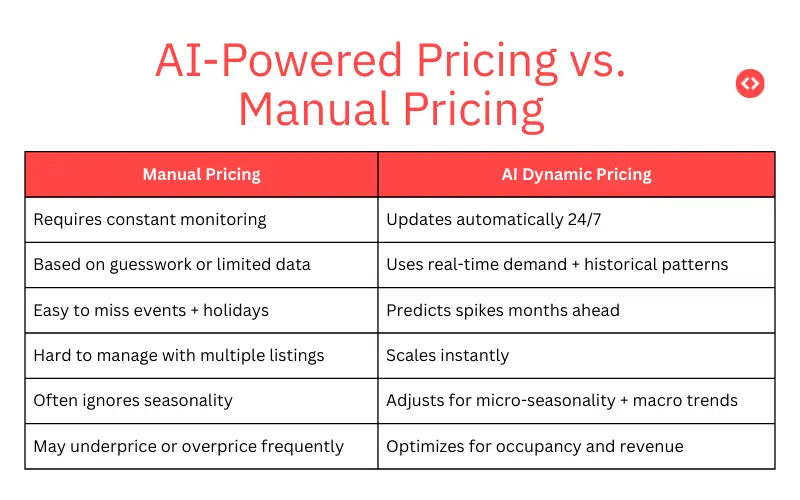
AI-driven dynamic pricing implements real-time rate adjustments using predictive analytics and machine learning.
This means AI tools can:
- Spot demand surges before you do
- Detect when competitor calendars fill up
- Adjust your rates during low occupancy periods
- Protect your revenue during high-demand weeks
- React instantly to changes—something manual pricing cannot do
If your occupancy drops below 30%, AI can automatically lower prices or add strategic discounts. If demand hits 70%+, AI increases rates to capture additional revenue.
Why Manual Pricing Often Fails
Most hosts start with manual pricing. But manual adjustments have limits:
- It’s hard to track daily demand changes
- You may accidentally overprice during slow seasons
- You may miss high-demand spikes (concerts, festivals, long weekends)
- You may react too late when competitors sell out
- You spend more time adjusting prices than managing your listing
This leads to inconsistent occupancy and unpredictable revenue.
A Simple Example of AI Pricing in Action
Imagine you host a 2-bedroom home:
- Monday bookings are slow: AI drops price by 10% to attract remote workers
- A big event is announced in your city: AI increases weekend rates instantly
- Competitors run out of availability: AI raises your price automatically
- Your occupancy is low for next month: AI identifies price gaps and adjusts downwards
- A last-minute cancellation happens: AI adds a same-week discount
This constant responsiveness keeps your listing competitive and visible.
Why Seasonality Matters More Than Most Hosts Realize
Seasonality doesn’t just affect high-level demand—it affects:
- Booking windows
- Guest profiles
- Price sensitivity
- Minimum stays
- Preferred amenities
Ignoring seasonality can result in lost revenue during peaks or low occupancy in off-seasons.
AI tools automatically handle these shifts so you don’t have to.
How to Keep Your Listing Fresh (Without Overthinking It)
1. Review Analytics Weekly
Look at:
- Views — Are people finding your listing?
- Bookings — Are views turning into reservations?
- Conversion rate — Low conversions often indicate weak photos or unclear descriptions.
- Pricing competitiveness — Are you too high or too low vs. the market?
Small dips usually signal when it’s time to make adjustments.
2. Refresh Your Listing Content
Based on what you see:
- Rework your headline to highlight your best features
- Add or replace photos (especially the cover photo)
- Update amenities if you’ve added anything new
- Rewrite descriptions to match current traveler preferences (e.g., “Reliable Wi-Fi + Desk Setup for Remote Work Trips”)
- Reorder photos to prioritize your strongest selling points
Even a simple tweak, like changing the first line of your description, can boost conversions.
3. Use Discounts Thoughtfully
Avoid over-discounting because it can erode perceived value.
Instead of constant price cuts:
- Use targeted promotions
- Offer weekly or monthly stay discounts
- Add non-financial perks (late checkout, welcome basket, parking)
- Pair discounts with strong marketing (updated photos + seasonal positioning)
Common STR Challenges and Listing Fixes
| Problem | Listing Solution |
| Low midweek occupancy | Highlight remote-work features or add midweek promos |
| Slow seasons | Emphasize long-stay amenities, add flexible cancellation |
| High views but low bookings | Improve photos, strengthen description hooks |
| Rising competition | Update amenities or highlight unique add-ons |
| Price-sensitive guests | Add value instead of heavy discounts |
Your listing should evolve as guest expectations evolve.
Key Considerations for Sustainable Occupancy Growth
Short-term fixes help temporarily, but long-term occupancy success requires solid systems. Here’s how to build a sustainable foundation.
1. Build Strong, Scalable Data Infrastructure
As the brief notes, using a cloud-based pricing data warehouse allows you to integrate booking, transactional, and competitor information into one reliable source.
This helps you:
- Compare performance across years
- Identify market-wide changes
- Forecast demand more accurately
- Make pricing decisions confidently
Think of it as a long-term investment in your hosting business.
2. Use Real-Time Analytics to Stay Ahead
Real-time dashboards give you ongoing visibility into:
- Which listings attract the most attention
- How your pricing changes impact occupancy
- Market shifts you might miss otherwise
- Competitor availability and pacing
The brief highlights that real-time visibility ensures pricing and marketing “always align with current demand.”
When you can see problems early, you can fix them early.
3. Understand What an RMS (Revenue Management System) Can Do
A Revenue Management System combines strategy, automation, and analytics to improve both occupancy and revenue.
It helps hosts:
- Automate pricing
- Forecast demand
- Benchmark competitors
- Analyze performance trends
- Identify opportunities for higher ADR
Think of it as your long-term strategic partner.
4. Balance Discounts With Brand Integrity
Promotions are powerful, but over-discounting attracts guests who book based on price alone. This can hurt your brand reputation and your margins.
Instead:
- Offer targeted discounts
- Add value (early check-in, free parking, EV charger access)
- Create themed packages (remote-work stays, family weeks, pet-friendly deals)
These create perceived value without hurting your long-term pricing strategy.
5. Your Sustainability Checklist
- Invest in a scalable pricing system
- Maintain brand value by offering smart, limited discounts
- Use automation wherever possible
- Continue refining your listing based on performance data
- Revisit your strategy before each new season
- Track competitors regularly
- Review your analytics at least once a week
These small habits compound into long-term occupancy growth.
Frequently Asked Questions About Improving Occupancy and Pricing Optimization
1. What is dynamic pricing for Airbnb, and how does it work?
Dynamic pricing is a strategy where nightly rates automatically adjust based on demand, seasonality, events, and competitor behavior. AI-powered dynamic pricing tools analyze real-time and historical data to recommend the best price for each night, helping you stay competitive and maximize revenue.
2. Can pricing optimization tools really increase my occupancy rate?
Yes! Optimization tools respond instantly to market changes and help prevent over- or underpricing. They help you fill gaps in your calendar, attract more guests during slow periods, and capture higher-value bookings during peak demand.
3. What data should I analyze to improve my Airbnb occupancy rate?
Review your past bookings, nightly rates, occupancy trends, guest lead times, competitor pricing, seasonality, and demand patterns. This data helps you understand what your guests respond to and ensures your pricing aligns with real market behavior.
4. How often should I review and update my pricing and listings?
Weekly reviews work well for most hosts. Update your listing whenever you notice drops in views, booking pace, or conversion rate. Pricing adjustments may be needed more frequently during busy seasons, event-heavy months, or last-minute gaps.
5. Are there risks in offering too many discounts to increase occupancy?
Yes—constant discounts can cheapen your brand and train guests to wait for reductions. Instead of aggressive price cuts, use targeted promotions or add value through amenities, flexible check-in, or stay packages.